Mihaja Raberahona, Alexandra Zimmer, Rivonirina Andry Rakotoarivelo, Patrick Andriniaina Randrianarisoa, Garcia Rambeloson, Etienne Rakotomijoro, Christophe Elody Andry, Haingonirina Anique Razafindrakoto, Dera Andriantahiana, Mamy Jean de Dieu Randria, Niaina Rakotosamimanana, Simon Grandjean Lapierre
{"title":"Continuous digital cough monitoring during 6-month pulmonary tuberculosis treatment.","authors":"Mihaja Raberahona, Alexandra Zimmer, Rivonirina Andry Rakotoarivelo, Patrick Andriniaina Randrianarisoa, Garcia Rambeloson, Etienne Rakotomijoro, Christophe Elody Andry, Haingonirina Anique Razafindrakoto, Dera Andriantahiana, Mamy Jean de Dieu Randria, Niaina Rakotosamimanana, Simon Grandjean Lapierre","doi":"10.1183/23120541.00655-2024","DOIUrl":null,"url":null,"abstract":"<p><strong>Background: </strong>Recent advances in digital and wearable technologies with artificial intelligence (AI) enable the use of continuous cough monitoring (CCM) to objectively monitor symptoms as surrogate markers of treatment efficacy in pulmonary tuberculosis (PTB). The objectives of this study were to describe the evolution of cough during PTB treatment in adults and to assess the feasibility of community-based CCM.</p><p><strong>Methods: </strong>We prospectively enrolled PTB adult participants upon treatment initiation. Participants' coughs were continuously monitored during 6 months with a smartphone loaded with an app able to detect cough by using an AI algorithm.</p><p><strong>Results: </strong>22 participants were included. The median (interquartile range (IQR)) age was 28.5 (22-42) years and 62% were male. The median (IQR) coughs per hour (medCPH) was 11.0 (7.0-27.0) at week 1. By the end of the intensive phase of PTB treatment at week 8, the medCPH was 3.5 (1.5-7.0), which was significantly lower than the medCPH at week 1 (p=0.002). At week 26 (end of treatment), the medCPH was 1.0 (1.0-2.5). The adherence to CCM was high during the first 13 weeks of PTB treatment and then waned over time. The adherence was similar during daytime and night-time.</p><p><strong>Conclusion: </strong>Cough counts rapidly drop during the intensive phase of PTB treatment and then slowly decrease to a low baseline level by the end of the treatment. Community-based CCM using digital technology is feasible in low-resource settings but requires evaluation of alternative approaches to overcome adherence issues and technical limitations (mobile internet and electricity availability).</p>","PeriodicalId":11739,"journal":{"name":"ERJ Open Research","volume":"11 2","pages":""},"PeriodicalIF":4.0000,"publicationDate":"2025-03-24","publicationTypes":"Journal Article","fieldsOfStudy":null,"isOpenAccess":false,"openAccessPdf":"https://www.ncbi.nlm.nih.gov/pmc/articles/PMC11931562/pdf/","citationCount":"0","resultStr":null,"platform":"Semanticscholar","paperid":null,"PeriodicalName":"ERJ Open Research","FirstCategoryId":"3","ListUrlMain":"https://doi.org/10.1183/23120541.00655-2024","RegionNum":3,"RegionCategory":"医学","ArticlePicture":[],"TitleCN":null,"AbstractTextCN":null,"PMCID":null,"EPubDate":"2025/3/1 0:00:00","PubModel":"eCollection","JCR":"Q1","JCRName":"RESPIRATORY SYSTEM","Score":null,"Total":0}
引用次数: 0
Abstract
Background: Recent advances in digital and wearable technologies with artificial intelligence (AI) enable the use of continuous cough monitoring (CCM) to objectively monitor symptoms as surrogate markers of treatment efficacy in pulmonary tuberculosis (PTB). The objectives of this study were to describe the evolution of cough during PTB treatment in adults and to assess the feasibility of community-based CCM.
Methods: We prospectively enrolled PTB adult participants upon treatment initiation. Participants' coughs were continuously monitored during 6 months with a smartphone loaded with an app able to detect cough by using an AI algorithm.
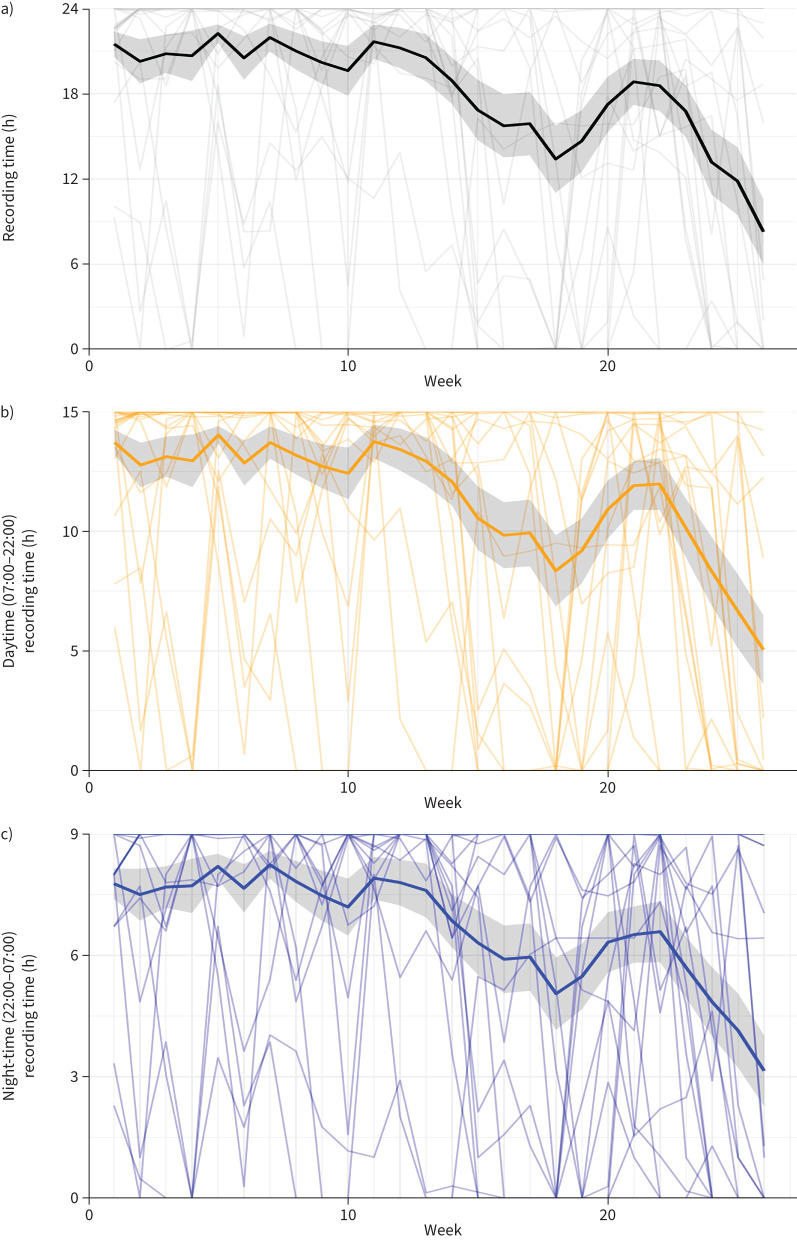
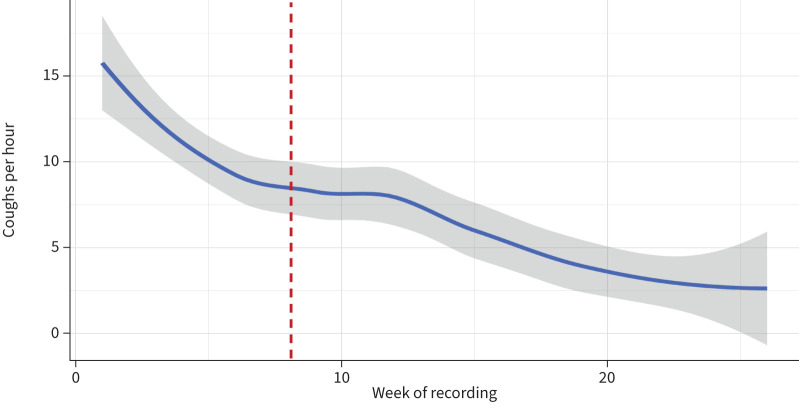
Results: 22 participants were included. The median (interquartile range (IQR)) age was 28.5 (22-42) years and 62% were male. The median (IQR) coughs per hour (medCPH) was 11.0 (7.0-27.0) at week 1. By the end of the intensive phase of PTB treatment at week 8, the medCPH was 3.5 (1.5-7.0), which was significantly lower than the medCPH at week 1 (p=0.002). At week 26 (end of treatment), the medCPH was 1.0 (1.0-2.5). The adherence to CCM was high during the first 13 weeks of PTB treatment and then waned over time. The adherence was similar during daytime and night-time.
Conclusion: Cough counts rapidly drop during the intensive phase of PTB treatment and then slowly decrease to a low baseline level by the end of the treatment. Community-based CCM using digital technology is feasible in low-resource settings but requires evaluation of alternative approaches to overcome adherence issues and technical limitations (mobile internet and electricity availability).
期刊介绍:
ERJ Open Research is a fully open access original research journal, published online by the European Respiratory Society. The journal aims to publish high-quality work in all fields of respiratory science and medicine, covering basic science, clinical translational science and clinical medicine. The journal was created to help fulfil the ERS objective to disseminate scientific and educational material to its members and to the medical community, but also to provide researchers with an affordable open access specialty journal in which to publish their work.




 京公网安备 11010802042870号
京ICP备2023020795号-1
京公网安备 11010802042870号
京ICP备2023020795号-1

 分享
分享
 求助内容:
求助内容: 应助结果提醒方式:
 扫码关注我们
