Sofie M Bagger, Hannes Schihada, Anna L S Walser, Anna K Drzazga, Lukas Grätz, Tiago Palmisano, Christina K Kuhn, Maša Mavri, Ann-Sophie Mølleskov-Jensen, Gregory G Tall, Torsten Schöneberg, Signe J Mathiasen, Jonathan A Javitch, Gunnar Schulte, Katja Spiess, Mette M Rosenkilde
{"title":"Complex G-protein signaling of the adhesion GPCR, ADGRA3.","authors":"Sofie M Bagger, Hannes Schihada, Anna L S Walser, Anna K Drzazga, Lukas Grätz, Tiago Palmisano, Christina K Kuhn, Maša Mavri, Ann-Sophie Mølleskov-Jensen, Gregory G Tall, Torsten Schöneberg, Signe J Mathiasen, Jonathan A Javitch, Gunnar Schulte, Katja Spiess, Mette M Rosenkilde","doi":"10.1016/j.jbc.2025.108441","DOIUrl":null,"url":null,"abstract":"<p><p>ADGRA3 (GPR125) is an orphan adhesion G protein-coupled receptor (aGPCR) involved in planar cell polarity, primarily through recruitment of the signaling components disheveled (DVL) during vertebrate gastrulation and discs large homolog 1, implicated in cancer. Limited knowledge exists of the canonical G protein-coupled receptor pathways downstream of ADGRA3. Here, we employed a series of human cell line-based signaling assays to gain insight into the G protein-mediated signaling of ADGRA3. We designed ADGRA3 constructs based on transcript variant analysis in publicly available human liver and brain RNA-seq datasets. Cleavage in the GPCR autoproteolysis site (GPS) is an aGPCR hallmark; thus, we generated a truncated ADGRA3 (C-terminal fragment, CTF) corresponding to a potential cleavage at the GPS. We found low-level activation of Gi and Gs by ADGRA3 and slightly more by its CTF. As the N terminus of the CTF constitutes a class-defined tethered agonist (so-called stachel peptide), we removed the initial three amino acids of the CTF. This resulted in abrogated G protein-mediated signaling, as observed for other aGPCRs. Due to the central role of ADGRA3 in planar cell polarity signaling through DVL recruitment, we investigated the G-protein signaling in the absence of DVL1-3 and found it sustained. No transcriptional activation was observed in an assay of downstream β-catenin activity. Collectively, this establishes classical G protein-mediated signaling for ADGRA3.</p>","PeriodicalId":15140,"journal":{"name":"Journal of Biological Chemistry","volume":" ","pages":"108441"},"PeriodicalIF":4.0000,"publicationDate":"2025-05-01","publicationTypes":"Journal Article","fieldsOfStudy":null,"isOpenAccess":false,"openAccessPdf":"https://www.ncbi.nlm.nih.gov/pmc/articles/PMC12059339/pdf/","citationCount":"0","resultStr":null,"platform":"Semanticscholar","paperid":null,"PeriodicalName":"Journal of Biological Chemistry","FirstCategoryId":"99","ListUrlMain":"https://doi.org/10.1016/j.jbc.2025.108441","RegionNum":2,"RegionCategory":"生物学","ArticlePicture":[],"TitleCN":null,"AbstractTextCN":null,"PMCID":null,"EPubDate":"2025/3/22 0:00:00","PubModel":"Epub","JCR":"Q2","JCRName":"BIOCHEMISTRY & MOLECULAR BIOLOGY","Score":null,"Total":0}
引用次数: 0
Abstract
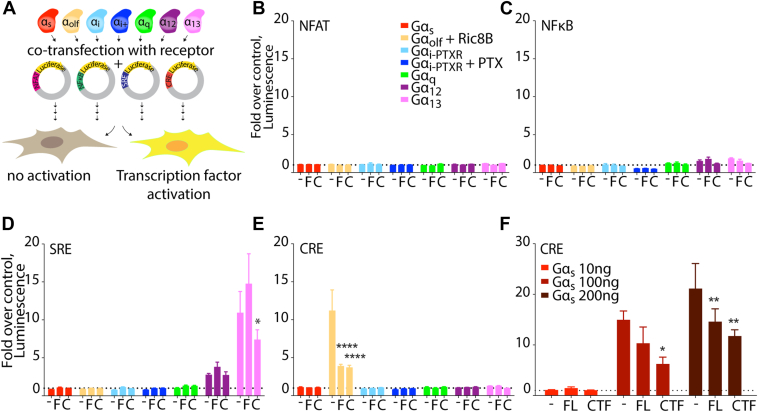
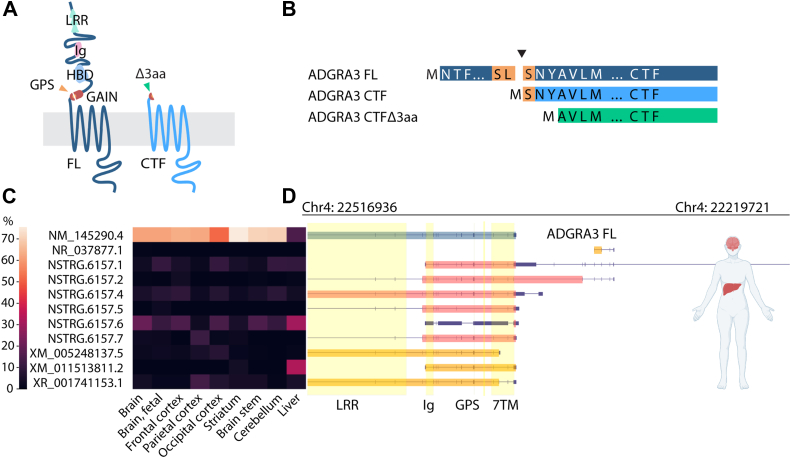
ADGRA3 (GPR125) is an orphan adhesion G protein-coupled receptor (aGPCR) involved in planar cell polarity, primarily through recruitment of the signaling components disheveled (DVL) during vertebrate gastrulation and discs large homolog 1, implicated in cancer. Limited knowledge exists of the canonical G protein-coupled receptor pathways downstream of ADGRA3. Here, we employed a series of human cell line-based signaling assays to gain insight into the G protein-mediated signaling of ADGRA3. We designed ADGRA3 constructs based on transcript variant analysis in publicly available human liver and brain RNA-seq datasets. Cleavage in the GPCR autoproteolysis site (GPS) is an aGPCR hallmark; thus, we generated a truncated ADGRA3 (C-terminal fragment, CTF) corresponding to a potential cleavage at the GPS. We found low-level activation of Gi and Gs by ADGRA3 and slightly more by its CTF. As the N terminus of the CTF constitutes a class-defined tethered agonist (so-called stachel peptide), we removed the initial three amino acids of the CTF. This resulted in abrogated G protein-mediated signaling, as observed for other aGPCRs. Due to the central role of ADGRA3 in planar cell polarity signaling through DVL recruitment, we investigated the G-protein signaling in the absence of DVL1-3 and found it sustained. No transcriptional activation was observed in an assay of downstream β-catenin activity. Collectively, this establishes classical G protein-mediated signaling for ADGRA3.
期刊介绍:
The Journal of Biological Chemistry welcomes high-quality science that seeks to elucidate the molecular and cellular basis of biological processes. Papers published in JBC can therefore fall under the umbrellas of not only biological chemistry, chemical biology, or biochemistry, but also allied disciplines such as biophysics, systems biology, RNA biology, immunology, microbiology, neurobiology, epigenetics, computational biology, ’omics, and many more. The outcome of our focus on papers that contribute novel and important mechanistic insights, rather than on a particular topic area, is that JBC is truly a melting pot for scientists across disciplines. In addition, JBC welcomes papers that describe methods that will help scientists push their biochemical inquiries forward and resources that will be of use to the research community.




 京公网安备 11010802042870号
京ICP备2023020795号-1
京公网安备 11010802042870号
京ICP备2023020795号-1

 分享
分享
 求助内容:
求助内容: 应助结果提醒方式:
 扫码关注我们
