Beyond the coronal plane in robotic total knee arthroplasty—Part 1: Variations in tibial slope and distal femoral flexion do not affect outcomes

IF 5 2区 医学 Q1 ORTHOPEDICS Knee Surgery, Sports Traumatology, Arthroscopy Pub Date : 2025-03-25 DOI:10.1002/ksa.12658
Luca Andriollo, Christos Koutserimpas, Pietro Gregori, Elvire Servien, Cécile Batailler, Sébastien Lustig
{"title":"Beyond the coronal plane in robotic total knee arthroplasty—Part 1: Variations in tibial slope and distal femoral flexion do not affect outcomes","authors":"Luca Andriollo,&nbsp;Christos Koutserimpas,&nbsp;Pietro Gregori,&nbsp;Elvire Servien,&nbsp;Cécile Batailler,&nbsp;Sébastien Lustig","doi":"10.1002/ksa.12658","DOIUrl":null,"url":null,"abstract":"<div>\n \n \n <section>\n \n <h3> Purpose</h3>\n \n <p>Robotic-assisted total knee arthroplasty (TKA) and new alignment principles are transforming traditional implant positioning, not only in the coronal plane but also in the sagittal and axial planes. The impact of differences between a patient's native tibial slope (TS) and distal femoral flexion (DFF) compared to the final implant positioning remains unclear. This study aims to evaluate whether variations in TS (ΔTS) and DFF (ΔDFF) play a role in clinical outcomes and implant survival.</p>\n </section>\n \n <section>\n \n <h3> Methods</h3>\n \n <p>This retrospective study analysed patients who underwent robotic-assisted TKA following functional alignment (FA) principles between March 2021 and January 2023. A total of 310 patients were included. Preoperative and postoperative data, including radiographic and robotic measurements, were collected. Clinical outcomes (KSS, FJS-12 and AKPS), range of motion (ROM), complication rates, and implant survival were compared between groups at a minimum of 2 years follow-up.</p>\n </section>\n \n <section>\n \n <h3> Results</h3>\n \n <p>At the final follow-up (mean 2.93 ± 0.62 years), no significant differences were found in clinical scores or ROM between groups with different ΔTS or ΔDFF values. Complication rates and implant survival (99%) were also similar. However, patients with ΔTS &gt; 5° had a slightly increased femoral valgus alignment, while those with ΔDFF ≤ 5° had lower preoperative ROM, with the femoral implant positioned in varus.</p>\n </section>\n \n <section>\n \n <h3> Conclusions</h3>\n \n <p>Variations between native and implant TS and DFF in robotic-assisted TKA do not negatively impact functional outcomes or implant survival. A personalised sagittal alignment approach within the concept of FA represents a progression to a functional knee positioning based on three dimensions. Further research is needed to explore the long-term effects of sagittal alignment on TKA performance.</p>\n </section>\n \n <section>\n \n <h3> Level of Evidence</h3>\n \n <p>Level III.</p>\n </section>\n </div>","PeriodicalId":17880,"journal":{"name":"Knee Surgery, Sports Traumatology, Arthroscopy","volume":"33 8","pages":"2928-2938"},"PeriodicalIF":5.0000,"publicationDate":"2025-03-25","publicationTypes":"Journal Article","fieldsOfStudy":null,"isOpenAccess":false,"openAccessPdf":"https://onlinelibrary.wiley.com/doi/epdf/10.1002/ksa.12658","citationCount":"0","resultStr":null,"platform":"Semanticscholar","paperid":null,"PeriodicalName":"Knee Surgery, Sports Traumatology, Arthroscopy","FirstCategoryId":"3","ListUrlMain":"https://esskajournals.onlinelibrary.wiley.com/doi/10.1002/ksa.12658","RegionNum":2,"RegionCategory":"医学","ArticlePicture":[],"TitleCN":null,"AbstractTextCN":null,"PMCID":null,"EPubDate":"","PubModel":"","JCR":"Q1","JCRName":"ORTHOPEDICS","Score":null,"Total":0}
引用次数: 0

Abstract

Purpose

Robotic-assisted total knee arthroplasty (TKA) and new alignment principles are transforming traditional implant positioning, not only in the coronal plane but also in the sagittal and axial planes. The impact of differences between a patient's native tibial slope (TS) and distal femoral flexion (DFF) compared to the final implant positioning remains unclear. This study aims to evaluate whether variations in TS (ΔTS) and DFF (ΔDFF) play a role in clinical outcomes and implant survival.

Methods

This retrospective study analysed patients who underwent robotic-assisted TKA following functional alignment (FA) principles between March 2021 and January 2023. A total of 310 patients were included. Preoperative and postoperative data, including radiographic and robotic measurements, were collected. Clinical outcomes (KSS, FJS-12 and AKPS), range of motion (ROM), complication rates, and implant survival were compared between groups at a minimum of 2 years follow-up.

Results

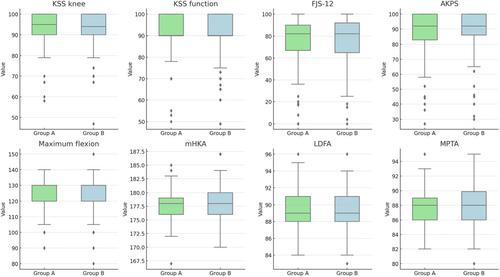
At the final follow-up (mean 2.93 ± 0.62 years), no significant differences were found in clinical scores or ROM between groups with different ΔTS or ΔDFF values. Complication rates and implant survival (99%) were also similar. However, patients with ΔTS > 5° had a slightly increased femoral valgus alignment, while those with ΔDFF ≤ 5° had lower preoperative ROM, with the femoral implant positioned in varus.

Conclusions

Variations between native and implant TS and DFF in robotic-assisted TKA do not negatively impact functional outcomes or implant survival. A personalised sagittal alignment approach within the concept of FA represents a progression to a functional knee positioning based on three dimensions. Further research is needed to explore the long-term effects of sagittal alignment on TKA performance.

Level of Evidence

Level III.

Abstract Image

Abstract Image

Abstract Image

Abstract Image

查看原文
分享 分享
微信好友 朋友圈 QQ好友 复制链接
本刊更多论文
机器人全膝关节置换术的冠状面以外部位-第1部分:胫骨斜度和股骨远端屈曲的变化不影响结果。
目的:机器人辅助全膝关节置换术(TKA)和新的对齐原则正在改变传统的假体定位,不仅在冠状面,而且在矢状面和轴向面。与最终的植入物定位相比,患者的原始胫骨斜度(TS)和股骨远端屈曲(DFF)之间的差异的影响尚不清楚。本研究旨在评估TS (ΔTS)和DFF (ΔDFF)的变化是否在临床结果和种植体存活中发挥作用。方法:本回顾性研究分析了2021年3月至2023年1月期间遵循功能对齐(FA)原则接受机器人辅助TKA的患者。共纳入310例患者。收集术前和术后数据,包括x线摄影和机器人测量。临床结果(KSS, FJS-12和AKPS),活动范围(ROM),并发症发生率和种植体存活率在至少2年的随访中进行比较。结果:在最终随访(平均2.93±0.62年)时,不同ΔTS或ΔDFF值组的临床评分或ROM无显著差异。并发症发生率和种植体存活率(99%)也相似。然而,ΔTS bbb50°的患者股骨外翻对准略有增加,而ΔDFF≤5°的患者术前ROM较低,股骨内翻定位。结论:在机器人辅助TKA中,原生TS和种植体TS以及DFF之间的差异不会对功能结果或种植体存活产生负面影响。FA概念中的个性化矢状面对齐方法代表了基于三维的功能性膝关节定位的进展。矢状排列对TKA表现的长期影响有待进一步研究。证据等级:三级。
本文章由计算机程序翻译,如有差异,请以英文原文为准。
求助全文
约1分钟内获得全文 去求助
来源期刊
CiteScore
8.10
自引率
18.40%
发文量
418
审稿时长
2 months
期刊介绍: Few other areas of orthopedic surgery and traumatology have undergone such a dramatic evolution in the last 10 years as knee surgery, arthroscopy and sports traumatology. Ranked among the top 33% of journals in both Orthopedics and Sports Sciences, the goal of this European journal is to publish papers about innovative knee surgery, sports trauma surgery and arthroscopy. Each issue features a series of peer-reviewed articles that deal with diagnosis and management and with basic research. Each issue also contains at least one review article about an important clinical problem. Case presentations or short notes about technical innovations are also accepted for publication. The articles cover all aspects of knee surgery and all types of sports trauma; in addition, epidemiology, diagnosis, treatment and prevention, and all types of arthroscopy (not only the knee but also the shoulder, elbow, wrist, hip, ankle, etc.) are addressed. Articles on new diagnostic techniques such as MRI and ultrasound and high-quality articles about the biomechanics of joints, muscles and tendons are included. Although this is largely a clinical journal, it is also open to basic research with clinical relevance. Because the journal is supported by a distinguished European Editorial Board, assisted by an international Advisory Board, you can be assured that the journal maintains the highest standards. Official Clinical Journal of the European Society of Sports Traumatology, Knee Surgery and Arthroscopy (ESSKA).
期刊最新文献
Issue Information From milestone to momentum: Thank you for powering KSSTA's present and future Mid- to long-term outcomes of capsular management in hip arthroscopy for FAIS: A multilevel meta-analysis Issue Information ChatGPT models provide higher-quality but lower-readability responses than Google Gemini regarding anterior shoulder instability, with no added benefit of the orthopaedic expert plugin
×
引用
GB/T 7714-2015
复制
MLA
复制
APA
复制
导出至
BibTeX EndNote RefMan NoteFirst NoteExpress
×
×
提示
您的信息不完整,为了账户安全,请先补充。
现在去补充
×
提示
您因"违规操作"
具体请查看互助需知
我知道了
×
提示
现在去查看 取消
×
提示
确定
0
微信
客服QQ
Book学术公众号 扫码关注我们
反馈
×
意见反馈
请填写您的意见或建议
请填写您的手机或邮箱
已复制链接
已复制链接
快去分享给好友吧!
我知道了
×
扫码分享
扫码分享
Book学术官方微信
Book学术文献互助
Book学术文献互助群
群 号:604180095
Book学术
文献互助 智能选刊 最新文献 互助须知 联系我们:info@booksci.cn
Book学术提供免费学术资源搜索服务,方便国内外学者检索中英文文献。致力于提供最便捷和优质的服务体验。
Copyright © 2023 Book学术 All rights reserved.
ghs 京公网安备 11010802042870号 京ICP备2023020795号-1