Adam B Grimmitt, Maeve E Whelan, Douglas N Martini, Wouter Hoogkamer
{"title":"Walking with increased step length variability increases the metabolic cost of walking in young adults.","authors":"Adam B Grimmitt, Maeve E Whelan, Douglas N Martini, Wouter Hoogkamer","doi":"10.1242/jeb.250126","DOIUrl":null,"url":null,"abstract":"<p><p>Several studies have observed a relationship between step length variability and the metabolic cost of walking. In those studies, changes in step length variability were secondary to changes in walking speed or step width variability. The purpose of this study was to determine how directly increasing step length variability affects the metabolic cost of walking. Eighteen healthy young adults completed 5 min trials of treadmill walking at 1.20 m s-1 while we manipulated their step length variability. Illuminated rectangles were projected onto the surface of a treadmill to cue step length variabilities of 0%, 5% and 10% coefficient of variation. Step length and its variability were tracked with reflective markers on the feet. Metabolic power across habitual (no projections) and the three variability conditions was measured using indirect calorimetry and analyzed using linear mixed effects modeling. Metabolic power was largest in the 10% condition (mean±s.d. 4.30±0.23 W kg-1) compared with 0% (4.16±0.18 W kg-1) and habitual (3.98±0.25 W kg-1). Actual step length variability was significantly different from prescribed conditions: 0%, 3.17±0.64%; 5%, 4.38±0.98% and 10%, 6.94±1.07%. For every 1% increase in step length variability, there was a 1.1% (0.05 W kg-1; P<0.001) increase in metabolic power. Our results demonstrate an association between the metabolic cost of walking and step length variability. This suggests that increased gait variability contributes to a small portion of the increased cost of walking seen in older adults and people with neurological impairments.</p>","PeriodicalId":15786,"journal":{"name":"Journal of Experimental Biology","volume":" ","pages":""},"PeriodicalIF":2.6000,"publicationDate":"2025-04-15","publicationTypes":"Journal Article","fieldsOfStudy":null,"isOpenAccess":false,"openAccessPdf":"https://www.ncbi.nlm.nih.gov/pmc/articles/PMC12045634/pdf/","citationCount":"0","resultStr":null,"platform":"Semanticscholar","paperid":null,"PeriodicalName":"Journal of Experimental Biology","FirstCategoryId":"99","ListUrlMain":"https://doi.org/10.1242/jeb.250126","RegionNum":2,"RegionCategory":"生物学","ArticlePicture":[],"TitleCN":null,"AbstractTextCN":null,"PMCID":null,"EPubDate":"2025/4/24 0:00:00","PubModel":"Epub","JCR":"Q2","JCRName":"BIOLOGY","Score":null,"Total":0}
引用次数: 0
Abstract
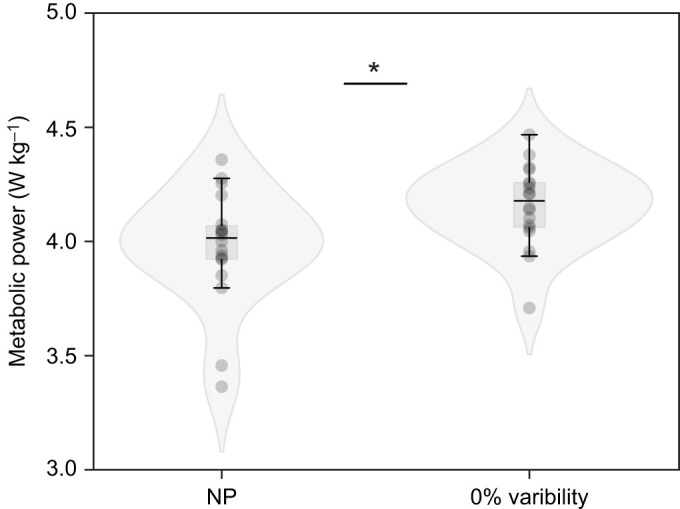
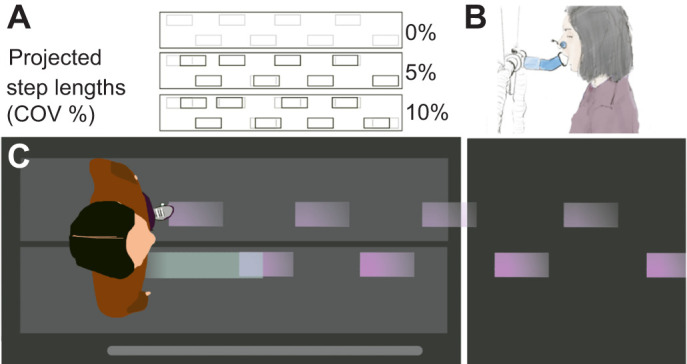
Several studies have observed a relationship between step length variability and the metabolic cost of walking. In those studies, changes in step length variability were secondary to changes in walking speed or step width variability. The purpose of this study was to determine how directly increasing step length variability affects the metabolic cost of walking. Eighteen healthy young adults completed 5 min trials of treadmill walking at 1.20 m s-1 while we manipulated their step length variability. Illuminated rectangles were projected onto the surface of a treadmill to cue step length variabilities of 0%, 5% and 10% coefficient of variation. Step length and its variability were tracked with reflective markers on the feet. Metabolic power across habitual (no projections) and the three variability conditions was measured using indirect calorimetry and analyzed using linear mixed effects modeling. Metabolic power was largest in the 10% condition (mean±s.d. 4.30±0.23 W kg-1) compared with 0% (4.16±0.18 W kg-1) and habitual (3.98±0.25 W kg-1). Actual step length variability was significantly different from prescribed conditions: 0%, 3.17±0.64%; 5%, 4.38±0.98% and 10%, 6.94±1.07%. For every 1% increase in step length variability, there was a 1.1% (0.05 W kg-1; P<0.001) increase in metabolic power. Our results demonstrate an association between the metabolic cost of walking and step length variability. This suggests that increased gait variability contributes to a small portion of the increased cost of walking seen in older adults and people with neurological impairments.
期刊介绍:
Journal of Experimental Biology is the leading primary research journal in comparative physiology and publishes papers on the form and function of living organisms at all levels of biological organisation, from the molecular and subcellular to the integrated whole animal.




 京公网安备 11010802042870号
京ICP备2023020795号-1
京公网安备 11010802042870号
京ICP备2023020795号-1

 分享
分享
 求助内容:
求助内容: 应助结果提醒方式:
 扫码关注我们
