{"title":"How do multiple meanings affect word learning and remapping?","authors":"Matilde E Simonetti, Iring Koch, Tanja C Roembke","doi":"10.3758/s13421-025-01706-z","DOIUrl":null,"url":null,"abstract":"<p><p>Many words have multiple meanings. It is currently unclear how a word with more than one meaning is acquired or stored long-term. One possibility is that each word's meaning is less robustly encoded; this, in turn, may make it easier to acquire additional meanings. We investigated this hypothesis across three cross-situational statistical learning experiments (N<sub>1</sub> = 62 (in-lab), N<sub>2</sub> = 61 (online), N<sub>3</sub> = 60 (online)), using the same general procedure: During Learning Phase 1 (LP1), participants acquired both 1:1 (each word has one meaning) and 1:2 (each word has two meanings) mappings. In Learning Phase 2 (LP2), each word received one new meaning. Across experiments, we manipulated the frequency of 1:1 and 1:2 mappings. As expected, 1:2 mappings were always harder to acquire in LP1. However, in the LP2 of Experiment 1, former 1:1 mappings were remapped more easily than former 1:2 ones, while 1:2 mappings were remapped more easily in Experiments 2 and 3. These data suggest that words with multiple meanings are more easily remapped, indicating that each meaning is less robustly associated with the word, which in turn may facilitate the acquisition of an additional meaning. However, the observed inconsistencies in the remapping results between in-lab and online experiments suggest that CSWL may differ across these two settings.</p>","PeriodicalId":48398,"journal":{"name":"Memory & Cognition","volume":" ","pages":"2197-2216"},"PeriodicalIF":2.1000,"publicationDate":"2025-10-01","publicationTypes":"Journal Article","fieldsOfStudy":null,"isOpenAccess":false,"openAccessPdf":"https://www.ncbi.nlm.nih.gov/pmc/articles/PMC12589246/pdf/","citationCount":"0","resultStr":null,"platform":"Semanticscholar","paperid":null,"PeriodicalName":"Memory & Cognition","FirstCategoryId":"102","ListUrlMain":"https://doi.org/10.3758/s13421-025-01706-z","RegionNum":3,"RegionCategory":"心理学","ArticlePicture":[],"TitleCN":null,"AbstractTextCN":null,"PMCID":null,"EPubDate":"2025/3/24 0:00:00","PubModel":"Epub","JCR":"Q2","JCRName":"PSYCHOLOGY, EXPERIMENTAL","Score":null,"Total":0}
引用次数: 0
Abstract
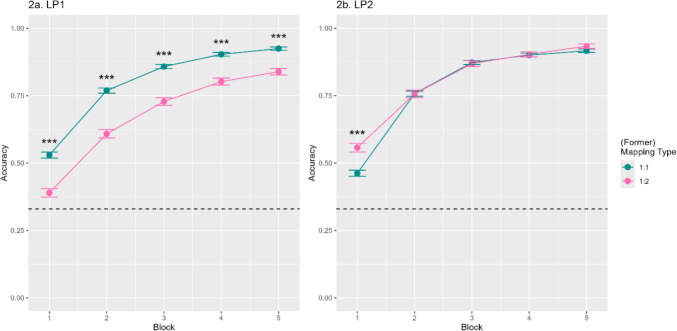
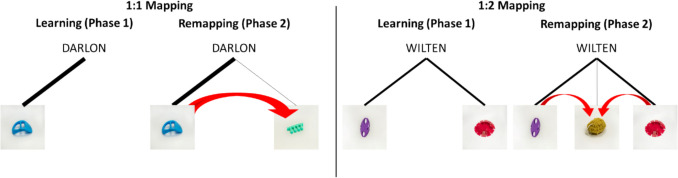
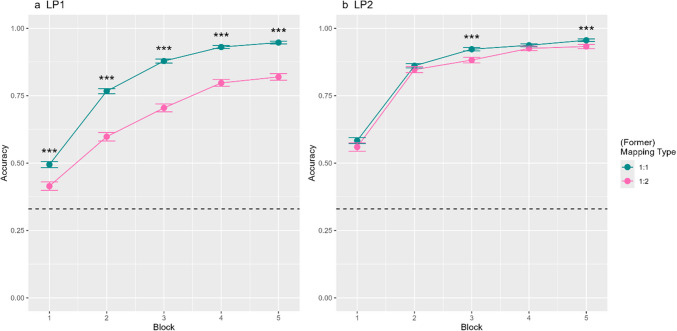
Many words have multiple meanings. It is currently unclear how a word with more than one meaning is acquired or stored long-term. One possibility is that each word's meaning is less robustly encoded; this, in turn, may make it easier to acquire additional meanings. We investigated this hypothesis across three cross-situational statistical learning experiments (N1 = 62 (in-lab), N2 = 61 (online), N3 = 60 (online)), using the same general procedure: During Learning Phase 1 (LP1), participants acquired both 1:1 (each word has one meaning) and 1:2 (each word has two meanings) mappings. In Learning Phase 2 (LP2), each word received one new meaning. Across experiments, we manipulated the frequency of 1:1 and 1:2 mappings. As expected, 1:2 mappings were always harder to acquire in LP1. However, in the LP2 of Experiment 1, former 1:1 mappings were remapped more easily than former 1:2 ones, while 1:2 mappings were remapped more easily in Experiments 2 and 3. These data suggest that words with multiple meanings are more easily remapped, indicating that each meaning is less robustly associated with the word, which in turn may facilitate the acquisition of an additional meaning. However, the observed inconsistencies in the remapping results between in-lab and online experiments suggest that CSWL may differ across these two settings.
期刊介绍:
Memory & Cognition covers human memory and learning, conceptual processes, psycholinguistics, problem solving, thinking, decision making, and skilled performance, including relevant work in the areas of computer simulation, information processing, mathematical psychology, developmental psychology, and experimental social psychology.



 京公网安备 11010802042870号
京ICP备2023020795号-1
京公网安备 11010802042870号
京ICP备2023020795号-1

 分享
分享
 求助内容:
求助内容: 应助结果提醒方式:
 扫码关注我们
