Profiles of control, value and achievement emotions in primary school mathematics lessons

IF 3.6 2区 心理学 Q1 PSYCHOLOGY, EDUCATIONAL British Journal of Educational Psychology Pub Date : 2025-03-25 DOI:10.1111/bjep.12768
Wendy Symes, Stephanie Lichtenfeld, Peter Wood, David W. Putwain
{"title":"Profiles of control, value and achievement emotions in primary school mathematics lessons","authors":"Wendy Symes,&nbsp;Stephanie Lichtenfeld,&nbsp;Peter Wood,&nbsp;David W. Putwain","doi":"10.1111/bjep.12768","DOIUrl":null,"url":null,"abstract":"<div>\n \n \n <section>\n \n <h3> Background</h3>\n \n <p>Achievement emotions are important for mathematical achievement. However, it is currently unclear how specific combinations of emotions—and their associated control and value appraisals—relate to mathematics performance, especially in younger students.</p>\n </section>\n \n <section>\n \n <h3> Aims</h3>\n \n <p>The aims of this study were to (i) identify heterogeneous profiles of control, value and achievement emotions (enjoyment, boredom and anxiety) experienced during primary-school mathematics lessons, and to explore how profile membership related to (ii) mathematics test scores and (iii) gender.</p>\n </section>\n \n <section>\n \n <h3> Sample</h3>\n \n <p>Our sample comprised 883 students (50% girls, <i>M</i><sub>age</sub> = 9.34 years, <i>SD</i> = .48) from 23 primary schools in England.</p>\n </section>\n \n <section>\n \n <h3> Methods</h3>\n \n <p>Data were collected longitudinally over one academic year. Students completed mathematics tests at T<sub>1</sub> and T<sub>3</sub>, and self-reported their control, value and achievement emotions in mathematics lessons at T<sub>2</sub>. A latent profile analysis was conducted to identify profiles of appraisals and emotions. To validate the profiles, T<sub>3</sub> mathematics test scores and gender were included as covariates of profile membership.</p>\n </section>\n \n <section>\n \n <h3> Results</h3>\n \n <p>Three profiles were identified: The <i>Positive</i> profile, <i>Negative</i> profile and <i>Mixed</i> profile. Students in the <i>Positive</i> profile had significantly higher mathematics test scores at T<sub>3</sub> than students in the <i>Mixed</i> profile. Being a girl increased the likelihood of belonging to the <i>Mixed</i> or <i>Negative</i> profile relative to the <i>Positive</i> profile.</p>\n </section>\n \n <section>\n \n <h3> Conclusions</h3>\n \n <p>Primary school students' control and value appraisals and achievement emotions co-occur in line with the theoretical assumptions of CVT. Combinations of emotions should be considered when exploring the impact of emotions on student learning and achievement in mathematics.</p>\n </section>\n </div>","PeriodicalId":51367,"journal":{"name":"British Journal of Educational Psychology","volume":"95 3","pages":"888-902"},"PeriodicalIF":3.6000,"publicationDate":"2025-03-25","publicationTypes":"Journal Article","fieldsOfStudy":null,"isOpenAccess":false,"openAccessPdf":"https://onlinelibrary.wiley.com/doi/epdf/10.1111/bjep.12768","citationCount":"0","resultStr":null,"platform":"Semanticscholar","paperid":null,"PeriodicalName":"British Journal of Educational Psychology","FirstCategoryId":"102","ListUrlMain":"https://bpspsychub.onlinelibrary.wiley.com/doi/10.1111/bjep.12768","RegionNum":2,"RegionCategory":"心理学","ArticlePicture":[],"TitleCN":null,"AbstractTextCN":null,"PMCID":null,"EPubDate":"","PubModel":"","JCR":"Q1","JCRName":"PSYCHOLOGY, EDUCATIONAL","Score":null,"Total":0}
引用次数: 0

Abstract

Background

Achievement emotions are important for mathematical achievement. However, it is currently unclear how specific combinations of emotions—and their associated control and value appraisals—relate to mathematics performance, especially in younger students.

Aims

The aims of this study were to (i) identify heterogeneous profiles of control, value and achievement emotions (enjoyment, boredom and anxiety) experienced during primary-school mathematics lessons, and to explore how profile membership related to (ii) mathematics test scores and (iii) gender.

Sample

Our sample comprised 883 students (50% girls, Mage = 9.34 years, SD = .48) from 23 primary schools in England.

Methods

Data were collected longitudinally over one academic year. Students completed mathematics tests at T1 and T3, and self-reported their control, value and achievement emotions in mathematics lessons at T2. A latent profile analysis was conducted to identify profiles of appraisals and emotions. To validate the profiles, T3 mathematics test scores and gender were included as covariates of profile membership.

Results

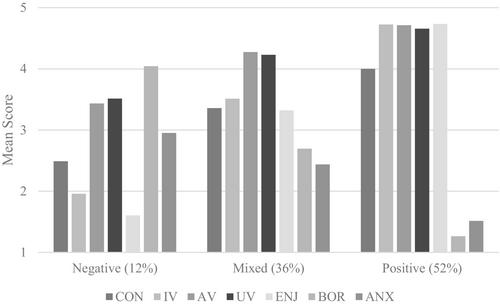
Three profiles were identified: The Positive profile, Negative profile and Mixed profile. Students in the Positive profile had significantly higher mathematics test scores at T3 than students in the Mixed profile. Being a girl increased the likelihood of belonging to the Mixed or Negative profile relative to the Positive profile.

Conclusions

Primary school students' control and value appraisals and achievement emotions co-occur in line with the theoretical assumptions of CVT. Combinations of emotions should be considered when exploring the impact of emotions on student learning and achievement in mathematics.
Abstract Image

Abstract Image

Abstract Image

Abstract Image

查看原文
分享 分享
微信好友 朋友圈 QQ好友 复制链接
本刊更多论文
小学数学课堂控制情绪、价值情绪和成就情绪的特征。
背景:成就情绪对数学成绩非常重要。目的:本研究的目的是:(i) 确定在小学数学课上体验到的控制、价值和成就情绪(愉快、无聊和焦虑)的异质性特征,并探讨特征成员与(ii) 数学考试成绩和(iii) 性别之间的关系:我们的样本包括来自英格兰 23 所小学的 883 名学生(50% 为女生,年龄 = 9.34 岁,标准差 = .48):方法:纵向收集一学年的数据。学生在第一学年和第三学年完成数学测试,并在第二学年自我报告他们在数学课上的控制、价值和成就情绪。通过潜在特征分析,确定了评价和情绪的特征。为了验证这些特征,将 T3 数学考试分数和性别作为特征成员的协变量:结果:确定了三种特征:结果:确定了三种特征:积极特征、消极特征和混合特征。正面形象的学生在 T3 阶段的数学考试成绩明显高于混合形象的学生。作为女生,相对于积极型而言,属于混合型或消极型的可能性更大:小学生的控制和价值评价与成就情绪同时出现,符合 CVT 的理论假设。在探索情绪对学生数学学习和成绩的影响时,应考虑情绪的组合。
本文章由计算机程序翻译,如有差异,请以英文原文为准。
求助全文
约1分钟内获得全文 去求助
来源期刊
CiteScore
7.70
自引率
2.70%
发文量
82
期刊介绍: The British Journal of Educational Psychology publishes original psychological research pertaining to education across all ages and educational levels including: - cognition - learning - motivation - literacy - numeracy and language - behaviour - social-emotional development - developmental difficulties linked to educational psychology or the psychology of education
期刊最新文献
Anchors or relational risks? Educator and psychologist narratives of attachment in child-robot relationships. Unravelling dynamic trajectories of epistemic emotions in a technology-enhanced problem-solving task: A multimodal data approach. Cognitive test anxiety and student well-being: An examination of bidirectional effects. Seeking effective school and family supports for adolescents' curiosity in learning: A cross-country comparison among China, the USA and Finland. Students' willingness to communicate in the foreign language learning classroom: Exploring the roles of classroom support and psychological needs satisfaction.
×
引用
GB/T 7714-2015
复制
MLA
复制
APA
复制
导出至
BibTeX EndNote RefMan NoteFirst NoteExpress
×
×
提示
您的信息不完整,为了账户安全,请先补充。
现在去补充
×
提示
您因"违规操作"
具体请查看互助需知
我知道了
×
提示
现在去查看 取消
×
提示
确定
0
微信
客服QQ
Book学术公众号 扫码关注我们
反馈
×
意见反馈
请填写您的意见或建议
请填写您的手机或邮箱
已复制链接
已复制链接
快去分享给好友吧!
我知道了
×
扫码分享
扫码分享
Book学术官方微信
Book学术文献互助
Book学术文献互助群
群 号:604180095
Book学术
文献互助 智能选刊 最新文献 互助须知 联系我们:info@booksci.cn
Book学术提供免费学术资源搜索服务,方便国内外学者检索中英文文献。致力于提供最便捷和优质的服务体验。
Copyright © 2023 Book学术 All rights reserved.
ghs 京公网安备 11010802042870号 京ICP备2023020795号-1






