Yi-Hsun Chen, Ping-Yuan Lo, Kyle W. Boschen, Chih-En Hsu, Yung-Ning Hsu, Luke N. Holtzman, Guan-Hao Peng, Chun-Jui Huang, Madisen Holbrook, Wei-Hua Wang, Katayun Barmak, James Hone, Pawel Hawrylak, Hung-Chung Hsueh, Jeffrey A. Davis, Shun-Jen Cheng, Michael S. Fuhrer, Shao-Yu Chen
{"title":"Efficient light upconversion via resonant exciton-exciton annihilation of dark excitons in few-layer transition metal dichalcogenides","authors":"Yi-Hsun Chen, Ping-Yuan Lo, Kyle W. Boschen, Chih-En Hsu, Yung-Ning Hsu, Luke N. Holtzman, Guan-Hao Peng, Chun-Jui Huang, Madisen Holbrook, Wei-Hua Wang, Katayun Barmak, James Hone, Pawel Hawrylak, Hung-Chung Hsueh, Jeffrey A. Davis, Shun-Jen Cheng, Michael S. Fuhrer, Shao-Yu Chen","doi":"10.1038/s41467-025-57991-4","DOIUrl":null,"url":null,"abstract":"<p>Materials capable of light upconversion—transforming low-energy photons into higher-energy ones—are pivotal in advancing optoelectronics, energy solutions, and photocatalysis. However, the discovery in various materials pays little attention on few-layer transition metal dichalcogenides, primarily due to their indirect bandgaps and weaker light-matter interactions. Here, we report a pronounced light upconversion in few-layer transition metal dichalcogenides through upconversion photoluminescence spectroscopy. Our joint theory-experiment study attributes the upconversion photoluminescence to a resonant exciton-exciton annihilation involving a pair of dark excitons with opposite momenta, followed by the spontaneous emission of upconverted bright excitons, which can have a high upconversion efficiency. Additionally, the upconversion photoluminescence is generic in MoS<sub>2</sub>, MoSe<sub>2</sub>, WS<sub>2</sub>, and WSe<sub>2</sub>, showing a high tuneability from green to ultraviolet light (2.34–3.1 eV). The findings pave the way for further exploration of light upconversion regarding fundamental properties and device applications in two-dimensional semiconductors.</p>","PeriodicalId":19066,"journal":{"name":"Nature Communications","volume":"183 1","pages":""},"PeriodicalIF":15.7000,"publicationDate":"2025-03-26","publicationTypes":"Journal Article","fieldsOfStudy":null,"isOpenAccess":false,"openAccessPdf":"","citationCount":"0","resultStr":null,"platform":"Semanticscholar","paperid":null,"PeriodicalName":"Nature Communications","FirstCategoryId":"103","ListUrlMain":"https://doi.org/10.1038/s41467-025-57991-4","RegionNum":1,"RegionCategory":"综合性期刊","ArticlePicture":[],"TitleCN":null,"AbstractTextCN":null,"PMCID":null,"EPubDate":"","PubModel":"","JCR":"Q1","JCRName":"MULTIDISCIPLINARY SCIENCES","Score":null,"Total":0}
引用次数: 0
Abstract
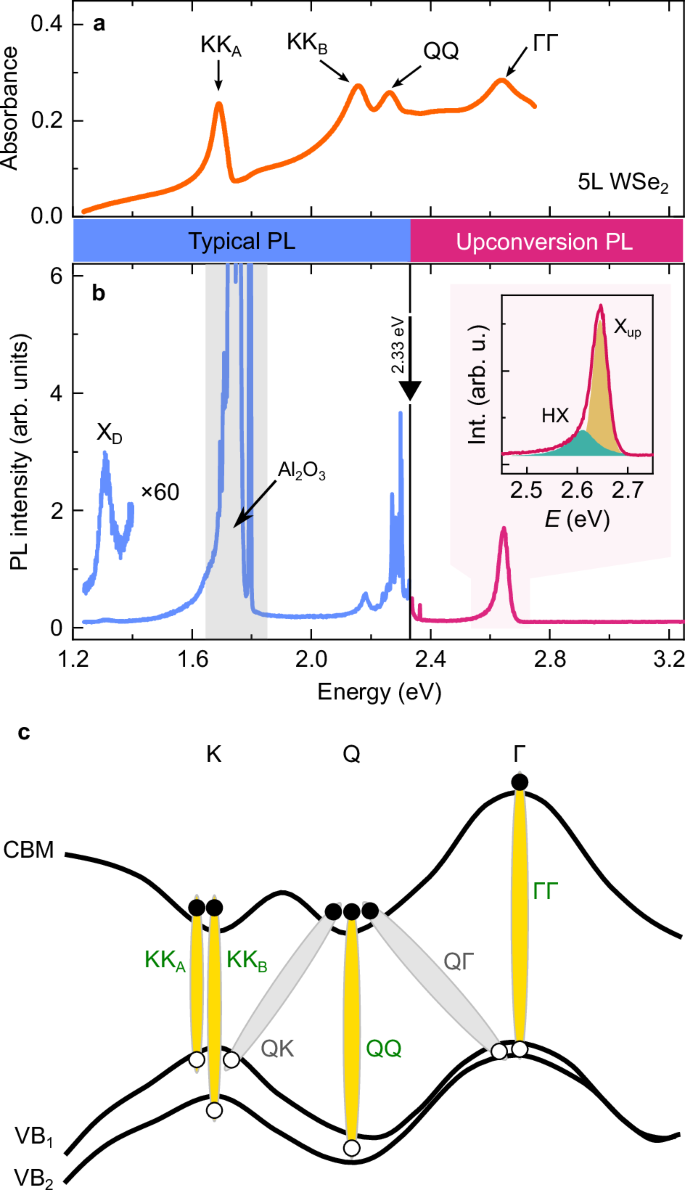
Materials capable of light upconversion—transforming low-energy photons into higher-energy ones—are pivotal in advancing optoelectronics, energy solutions, and photocatalysis. However, the discovery in various materials pays little attention on few-layer transition metal dichalcogenides, primarily due to their indirect bandgaps and weaker light-matter interactions. Here, we report a pronounced light upconversion in few-layer transition metal dichalcogenides through upconversion photoluminescence spectroscopy. Our joint theory-experiment study attributes the upconversion photoluminescence to a resonant exciton-exciton annihilation involving a pair of dark excitons with opposite momenta, followed by the spontaneous emission of upconverted bright excitons, which can have a high upconversion efficiency. Additionally, the upconversion photoluminescence is generic in MoS2, MoSe2, WS2, and WSe2, showing a high tuneability from green to ultraviolet light (2.34–3.1 eV). The findings pave the way for further exploration of light upconversion regarding fundamental properties and device applications in two-dimensional semiconductors.
期刊介绍:
Nature Communications, an open-access journal, publishes high-quality research spanning all areas of the natural sciences. Papers featured in the journal showcase significant advances relevant to specialists in each respective field. With a 2-year impact factor of 16.6 (2022) and a median time of 8 days from submission to the first editorial decision, Nature Communications is committed to rapid dissemination of research findings. As a multidisciplinary journal, it welcomes contributions from biological, health, physical, chemical, Earth, social, mathematical, applied, and engineering sciences, aiming to highlight important breakthroughs within each domain.




 京公网安备 11010802042870号
京ICP备2023020795号-1
京公网安备 11010802042870号
京ICP备2023020795号-1

 分享
分享
 求助内容:
求助内容: 应助结果提醒方式:
 扫码关注我们
