Carlos A. Alvarez, Mathieu G. A. Lapôtre, Christy Swann, Ryan C. Ewing
{"title":"Ripples formed in low-pressure wind tunnels suggest Mars’s large windblown ripples are not impact ripples","authors":"Carlos A. Alvarez, Mathieu G. A. Lapôtre, Christy Swann, Ryan C. Ewing","doi":"10.1038/s41467-025-58140-7","DOIUrl":null,"url":null,"abstract":"<p>Sand ripples record interactions between planetary surfaces and environmental flows, providing paleoenvironmental archives when preserved into rocks. Two main ripple types form in sand: drag ripples, common in water, and impact ripples, exclusive to windblown surfaces. Enigmatic meter-scale aeolian ripples on Mars have been assumed to be impact ripples, though ground and orbiter-based observations suggest they may be drag ripples instead. Here, we report on low-pressure wind tunnel experiments in which large ripples formed and evolved from a flat bed. Observations demonstrate that impact and large ripples grow from distinct mechanisms. Large-ripple size aligns with predictions from drag-ripple theory, and associated sand fluxes are greater than predicted for impact ripples. These findings are inconsistent with an impact-ripple origin and instead suggest that large martian ripples are drag ripples. Windblown drag ripples constitute an untapped record of atmospheric evolution on planetary bodies with tenuous or ephemeral atmospheres across the Solar System.</p>","PeriodicalId":19066,"journal":{"name":"Nature Communications","volume":"99 1","pages":""},"PeriodicalIF":15.7000,"publicationDate":"2025-03-26","publicationTypes":"Journal Article","fieldsOfStudy":null,"isOpenAccess":false,"openAccessPdf":"","citationCount":"0","resultStr":null,"platform":"Semanticscholar","paperid":null,"PeriodicalName":"Nature Communications","FirstCategoryId":"103","ListUrlMain":"https://doi.org/10.1038/s41467-025-58140-7","RegionNum":1,"RegionCategory":"综合性期刊","ArticlePicture":[],"TitleCN":null,"AbstractTextCN":null,"PMCID":null,"EPubDate":"","PubModel":"","JCR":"Q1","JCRName":"MULTIDISCIPLINARY SCIENCES","Score":null,"Total":0}
引用次数: 0
Abstract
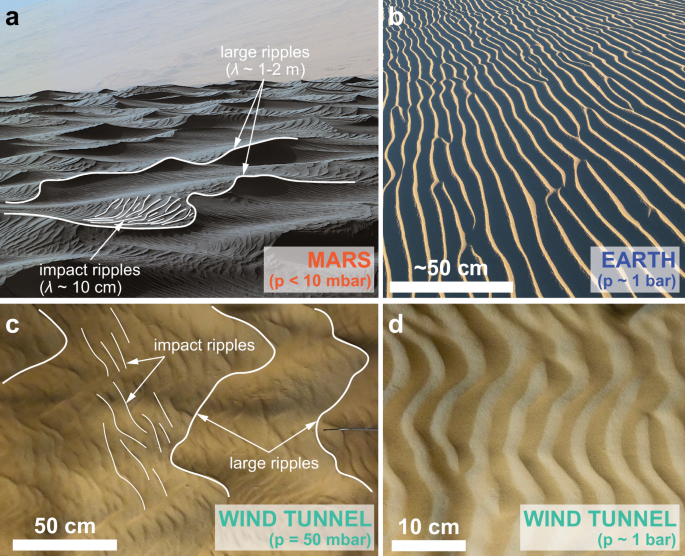
Sand ripples record interactions between planetary surfaces and environmental flows, providing paleoenvironmental archives when preserved into rocks. Two main ripple types form in sand: drag ripples, common in water, and impact ripples, exclusive to windblown surfaces. Enigmatic meter-scale aeolian ripples on Mars have been assumed to be impact ripples, though ground and orbiter-based observations suggest they may be drag ripples instead. Here, we report on low-pressure wind tunnel experiments in which large ripples formed and evolved from a flat bed. Observations demonstrate that impact and large ripples grow from distinct mechanisms. Large-ripple size aligns with predictions from drag-ripple theory, and associated sand fluxes are greater than predicted for impact ripples. These findings are inconsistent with an impact-ripple origin and instead suggest that large martian ripples are drag ripples. Windblown drag ripples constitute an untapped record of atmospheric evolution on planetary bodies with tenuous or ephemeral atmospheres across the Solar System.
期刊介绍:
Nature Communications, an open-access journal, publishes high-quality research spanning all areas of the natural sciences. Papers featured in the journal showcase significant advances relevant to specialists in each respective field. With a 2-year impact factor of 16.6 (2022) and a median time of 8 days from submission to the first editorial decision, Nature Communications is committed to rapid dissemination of research findings. As a multidisciplinary journal, it welcomes contributions from biological, health, physical, chemical, Earth, social, mathematical, applied, and engineering sciences, aiming to highlight important breakthroughs within each domain.




 京公网安备 11010802042870号
京ICP备2023020795号-1
京公网安备 11010802042870号
京ICP备2023020795号-1

 分享
分享
 求助内容:
求助内容: 应助结果提醒方式:
 扫码关注我们
