Eun Jung Lee, Museong Kim, Sooyeon Park, Ji Hyeon Shim, Hyun-Ju Cho, Jung Ah Park, Kihyun Park, Dongeun Lee, Jeong Hwan Kim, Haeun Jeong, Fumio Matsuzaki, Seon-Young Kim, Jaehoon Kim, Hanseul Yang, Jeong-Soo Lee, Jin Woo Kim
{"title":"Restoration of retinal regenerative potential of Müller glia by disrupting intercellular Prox1 transfer","authors":"Eun Jung Lee, Museong Kim, Sooyeon Park, Ji Hyeon Shim, Hyun-Ju Cho, Jung Ah Park, Kihyun Park, Dongeun Lee, Jeong Hwan Kim, Haeun Jeong, Fumio Matsuzaki, Seon-Young Kim, Jaehoon Kim, Hanseul Yang, Jeong-Soo Lee, Jin Woo Kim","doi":"10.1038/s41467-025-58290-8","DOIUrl":null,"url":null,"abstract":"<p>Individuals with retinal degenerative diseases struggle to restore vision due to the inability to regenerate retinal cells. Unlike cold-blooded vertebrates, mammals lack Müller glia (MG)-mediated retinal regeneration, indicating the limited regenerative capacity of mammalian MG. Here, we identify prospero-related homeobox 1 (Prox1) as a key factor restricting this process. Prox1 accumulates in MG of degenerating human and mouse retinas but not in regenerating zebrafish. In mice, Prox1 in MG originates from neighboring retinal neurons via intercellular transfer. Blocking this transfer enables MG reprogramming into retinal progenitor cells in injured mouse retinas. Moreover, adeno-associated viral delivery of an anti-Prox1 antibody, which sequesters extracellular Prox1, promotes retinal neuron regeneration and delays vision loss in a retinitis pigmentosa model. These findings establish Prox1 as a barrier to MG-mediated regeneration and highlight anti-Prox1 therapy as a promising strategy for restoring retinal regeneration in mammals.</p>","PeriodicalId":19066,"journal":{"name":"Nature Communications","volume":"57 1","pages":""},"PeriodicalIF":15.7000,"publicationDate":"2025-03-25","publicationTypes":"Journal Article","fieldsOfStudy":null,"isOpenAccess":false,"openAccessPdf":"","citationCount":"0","resultStr":null,"platform":"Semanticscholar","paperid":null,"PeriodicalName":"Nature Communications","FirstCategoryId":"103","ListUrlMain":"https://doi.org/10.1038/s41467-025-58290-8","RegionNum":1,"RegionCategory":"综合性期刊","ArticlePicture":[],"TitleCN":null,"AbstractTextCN":null,"PMCID":null,"EPubDate":"","PubModel":"","JCR":"Q1","JCRName":"MULTIDISCIPLINARY SCIENCES","Score":null,"Total":0}
引用次数: 0
Abstract
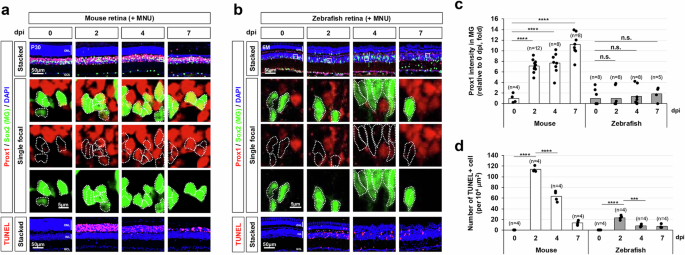
Individuals with retinal degenerative diseases struggle to restore vision due to the inability to regenerate retinal cells. Unlike cold-blooded vertebrates, mammals lack Müller glia (MG)-mediated retinal regeneration, indicating the limited regenerative capacity of mammalian MG. Here, we identify prospero-related homeobox 1 (Prox1) as a key factor restricting this process. Prox1 accumulates in MG of degenerating human and mouse retinas but not in regenerating zebrafish. In mice, Prox1 in MG originates from neighboring retinal neurons via intercellular transfer. Blocking this transfer enables MG reprogramming into retinal progenitor cells in injured mouse retinas. Moreover, adeno-associated viral delivery of an anti-Prox1 antibody, which sequesters extracellular Prox1, promotes retinal neuron regeneration and delays vision loss in a retinitis pigmentosa model. These findings establish Prox1 as a barrier to MG-mediated regeneration and highlight anti-Prox1 therapy as a promising strategy for restoring retinal regeneration in mammals.
期刊介绍:
Nature Communications, an open-access journal, publishes high-quality research spanning all areas of the natural sciences. Papers featured in the journal showcase significant advances relevant to specialists in each respective field. With a 2-year impact factor of 16.6 (2022) and a median time of 8 days from submission to the first editorial decision, Nature Communications is committed to rapid dissemination of research findings. As a multidisciplinary journal, it welcomes contributions from biological, health, physical, chemical, Earth, social, mathematical, applied, and engineering sciences, aiming to highlight important breakthroughs within each domain.



 京公网安备 11010802042870号
京ICP备2023020795号-1
京公网安备 11010802042870号
京ICP备2023020795号-1

 分享
分享
 求助内容:
求助内容: 应助结果提醒方式:
 扫码关注我们
