Chongchong Qi, Tao Hu, Yi Zheng, Mengting Wu, Fiona H. M. Tang, Min Liu, Bintian Zhang, Sybil Derrible, Qiusong Chen, Gongren Hu, Liyuan Chai, Zhang Lin
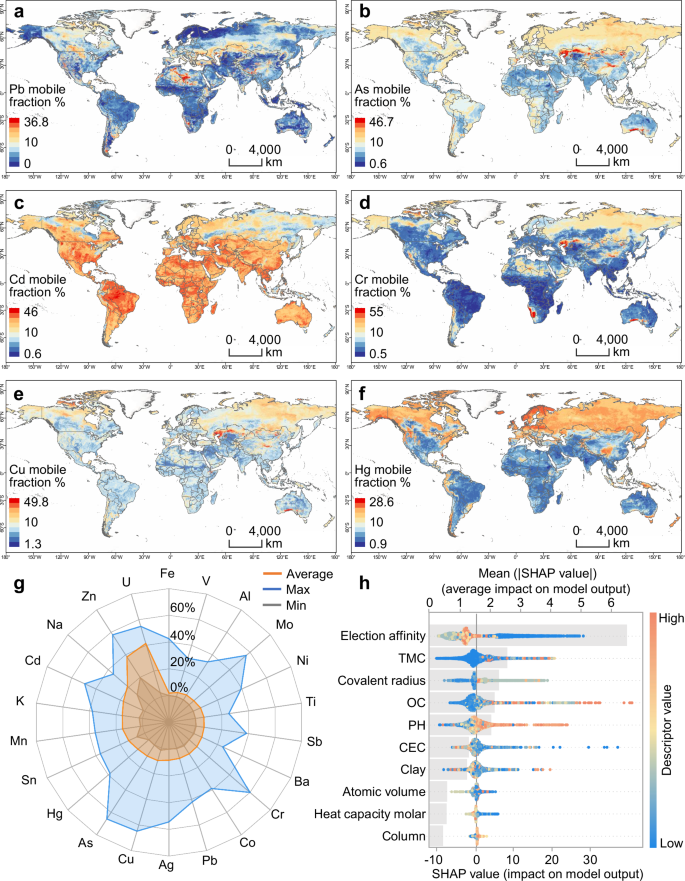
{"title":"Global and regional patterns of soil metal(loid) mobility and associated risks","authors":"Chongchong Qi, Tao Hu, Yi Zheng, Mengting Wu, Fiona H. M. Tang, Min Liu, Bintian Zhang, Sybil Derrible, Qiusong Chen, Gongren Hu, Liyuan Chai, Zhang Lin","doi":"10.1038/s41467-025-58026-8","DOIUrl":null,"url":null,"abstract":"<p>Soil contamination by metals and metalloids (metal[loid]s) is a global issue with significant risks to human health, ecosystems, and food security. Accurate risk assessment depends on understanding metal(loid) mobility, which dictates bioavailability and environmental impact. Here we show a theory-guided machine learning model that predicts soil metal(loid) fractionation across the globe. Our model identifies total metal(loid) content and soil organic carbon as primary drivers of metal(loid) mobility. We find that 37% of the world’s land is at medium-to-high mobilization risk, with hotspots in Russia, Chile, Canada, and Namibia. Our analysis indicates that global efforts to enhance soil carbon sequestration may inadvertently increase metal(loid) mobility. Furthermore, in Europe, the divergence between spatial distributions of total and mobile metal(loid)s is uncovered. These findings offer crucial insights into global distributions and drivers of soil metal(loid) mobility, providing a robust tool for prioritizing metal(loid) mobility testing, raising awareness, and informing sustainable soil management practices.</p>","PeriodicalId":19066,"journal":{"name":"Nature Communications","volume":"19 1","pages":""},"PeriodicalIF":15.7000,"publicationDate":"2025-03-26","publicationTypes":"Journal Article","fieldsOfStudy":null,"isOpenAccess":false,"openAccessPdf":"","citationCount":"0","resultStr":null,"platform":"Semanticscholar","paperid":null,"PeriodicalName":"Nature Communications","FirstCategoryId":"103","ListUrlMain":"https://doi.org/10.1038/s41467-025-58026-8","RegionNum":1,"RegionCategory":"综合性期刊","ArticlePicture":[],"TitleCN":null,"AbstractTextCN":null,"PMCID":null,"EPubDate":"","PubModel":"","JCR":"Q1","JCRName":"MULTIDISCIPLINARY SCIENCES","Score":null,"Total":0}
引用次数: 0
Abstract
Soil contamination by metals and metalloids (metal[loid]s) is a global issue with significant risks to human health, ecosystems, and food security. Accurate risk assessment depends on understanding metal(loid) mobility, which dictates bioavailability and environmental impact. Here we show a theory-guided machine learning model that predicts soil metal(loid) fractionation across the globe. Our model identifies total metal(loid) content and soil organic carbon as primary drivers of metal(loid) mobility. We find that 37% of the world’s land is at medium-to-high mobilization risk, with hotspots in Russia, Chile, Canada, and Namibia. Our analysis indicates that global efforts to enhance soil carbon sequestration may inadvertently increase metal(loid) mobility. Furthermore, in Europe, the divergence between spatial distributions of total and mobile metal(loid)s is uncovered. These findings offer crucial insights into global distributions and drivers of soil metal(loid) mobility, providing a robust tool for prioritizing metal(loid) mobility testing, raising awareness, and informing sustainable soil management practices.
期刊介绍:
Nature Communications, an open-access journal, publishes high-quality research spanning all areas of the natural sciences. Papers featured in the journal showcase significant advances relevant to specialists in each respective field. With a 2-year impact factor of 16.6 (2022) and a median time of 8 days from submission to the first editorial decision, Nature Communications is committed to rapid dissemination of research findings. As a multidisciplinary journal, it welcomes contributions from biological, health, physical, chemical, Earth, social, mathematical, applied, and engineering sciences, aiming to highlight important breakthroughs within each domain.




 京公网安备 11010802042870号
京ICP备2023020795号-1
京公网安备 11010802042870号
京ICP备2023020795号-1

 分享
分享
 求助内容:
求助内容: 应助结果提醒方式:
 扫码关注我们
