Jiao Zong, Benmin Hu, Shihui Li, Lei Li, Bo Liu and Dongmei Cui
{"title":"Plastic–rubber diblock copolymers obtained from copolymerization of dimethyl-1,3-butadiene and butadiene using rare-earth metal catalysts†","authors":"Jiao Zong, Benmin Hu, Shihui Li, Lei Li, Bo Liu and Dongmei Cui","doi":"10.1039/D4PY01446D","DOIUrl":null,"url":null,"abstract":"<p >Coordination polymerization of 2,3-dimethyl-1,3-butadiene (DMB) has been investigated by using rare-earth metal catalysts. Of which, the ligand-free gadolinium dibenzyl chloride precursor exhibits the highest activity and perfect <em>cis</em>-1,4 selectivity for DMB homopolymerization and copolymerization with butadiene (BD) to afford plastic poly(2,3-dimethyl-1,3-butadiene) (PDMB) and the plastic–rubber diblock copolymer PDMB-<em>b</em>-PBD, respectively. In solution, PDMB-<em>b</em>-PBD self-assembles into a “core–shell” morphology with the crystalline <em>cis</em>-1,4 regulated PDMB segment as the core and the amorphous <em>cis</em>-1,4 stereoregular PBD unit as the shell, while in the melt state, the PDMB block forms physical cross-linking in the PBD rubbery matrix, endowing the material with unusually high stress accompanied by excellent elongation.</p>","PeriodicalId":100,"journal":{"name":"Polymer Chemistry","volume":" 18","pages":" 2083-2088"},"PeriodicalIF":3.9000,"publicationDate":"2025-03-26","publicationTypes":"Journal Article","fieldsOfStudy":null,"isOpenAccess":false,"openAccessPdf":"","citationCount":"0","resultStr":null,"platform":"Semanticscholar","paperid":null,"PeriodicalName":"Polymer Chemistry","FirstCategoryId":"92","ListUrlMain":"https://pubs.rsc.org/en/content/articlelanding/2025/py/d4py01446d","RegionNum":2,"RegionCategory":"化学","ArticlePicture":[],"TitleCN":null,"AbstractTextCN":null,"PMCID":null,"EPubDate":"","PubModel":"","JCR":"Q2","JCRName":"POLYMER SCIENCE","Score":null,"Total":0}
引用次数: 0
Abstract
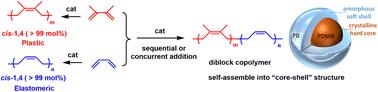
Coordination polymerization of 2,3-dimethyl-1,3-butadiene (DMB) has been investigated by using rare-earth metal catalysts. Of which, the ligand-free gadolinium dibenzyl chloride precursor exhibits the highest activity and perfect cis-1,4 selectivity for DMB homopolymerization and copolymerization with butadiene (BD) to afford plastic poly(2,3-dimethyl-1,3-butadiene) (PDMB) and the plastic–rubber diblock copolymer PDMB-b-PBD, respectively. In solution, PDMB-b-PBD self-assembles into a “core–shell” morphology with the crystalline cis-1,4 regulated PDMB segment as the core and the amorphous cis-1,4 stereoregular PBD unit as the shell, while in the melt state, the PDMB block forms physical cross-linking in the PBD rubbery matrix, endowing the material with unusually high stress accompanied by excellent elongation.
期刊介绍:
Polymer Chemistry welcomes submissions in all areas of polymer science that have a strong focus on macromolecular chemistry. Manuscripts may cover a broad range of fields, yet no direct application focus is required.



 京公网安备 11010802042870号
京ICP备2023020795号-1
京公网安备 11010802042870号
京ICP备2023020795号-1

 分享
分享
 求助内容:
求助内容: 应助结果提醒方式:
 扫码关注我们
