Yurong Wu, Ziyun Zhang, Jiangshan Huo, Runguo Zheng, Zhishuang Song, Zhiyuan Wang, Yanguo Liu and Dan Wang
{"title":"Anionic F-doping-induced engineering of P2-type layered cathode materials for high-performance potassium-ion batteries†","authors":"Yurong Wu, Ziyun Zhang, Jiangshan Huo, Runguo Zheng, Zhishuang Song, Zhiyuan Wang, Yanguo Liu and Dan Wang","doi":"10.1039/D5QI00385G","DOIUrl":null,"url":null,"abstract":"<p >P2-type layered oxides have emerged as promising cathode candidate materials for potassium-ion batteries. Nevertheless, unsatisfactory cycling stability hinders their practical application, chiefly arising from deleterious phase transitions and the Jahn–Teller distortion of Mn<small><sup>3+</sup></small>. Herein, an anion-doping strategy where F<small><sup>−</sup></small> is incorporated into P2-K<small><sub>0.6</sub></small>Zn<small><sub>0.1</sub></small>Ti<small><sub>0.05</sub></small>Al<small><sub>0.05</sub></small>Mn<small><sub>0.8</sub></small>O<small><sub>2</sub></small> (KTMO) cathode materials is proposed. Raman spectroscopy was employed to investigate the local chemical environment of these materials. The results revealed a slight shift to higher wavenumbers in the E<small><sub>g</sub></small> and A<small><sub>1g</sub></small> peaks, which was ascribed to the shortening of the average TM–O bond length triggered by the addition of F. <em>Ex situ</em> XRD analysis revealed that the material K<small><sub>0.6</sub></small>Zn<small><sub>0.1</sub></small>Ti<small><sub>0.05</sub></small>Al<small><sub>0.05</sub></small>Mn<small><sub>0.8</sub></small>O<small><sub>1.93</sub></small>F<small><sub>0.07</sub></small> effectively suppresses undesirable phase transitions. Moreover, the maximum variation in the lattice parameter <em>c</em> is only 2.2% during potassium insertion/extraction, which fully demonstrates the outstanding performance of this material in terms of structural stability. This strategy brings about excellent cycling stability with a reversible capacity of 131.8 mA h g<small><sup>−1</sup></small> and capacity retention of 76.8% after 100 cycles, within a voltage range of 2.0–4.0 V. These findings offer novel insights into the design of cathode materials possessing optimized structures and enhanced performance for potassium-ion batteries.</p>","PeriodicalId":79,"journal":{"name":"Inorganic Chemistry Frontiers","volume":" 13","pages":" 4237-4246"},"PeriodicalIF":6.4000,"publicationDate":"2025-03-26","publicationTypes":"Journal Article","fieldsOfStudy":null,"isOpenAccess":false,"openAccessPdf":"","citationCount":"0","resultStr":null,"platform":"Semanticscholar","paperid":null,"PeriodicalName":"Inorganic Chemistry Frontiers","FirstCategoryId":"92","ListUrlMain":"https://pubs.rsc.org/en/content/articlelanding/2025/qi/d5qi00385g","RegionNum":1,"RegionCategory":"化学","ArticlePicture":[],"TitleCN":null,"AbstractTextCN":null,"PMCID":null,"EPubDate":"","PubModel":"","JCR":"Q1","JCRName":"CHEMISTRY, INORGANIC & NUCLEAR","Score":null,"Total":0}
引用次数: 0
Abstract
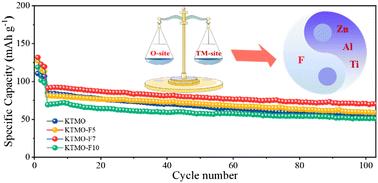
P2-type layered oxides have emerged as promising cathode candidate materials for potassium-ion batteries. Nevertheless, unsatisfactory cycling stability hinders their practical application, chiefly arising from deleterious phase transitions and the Jahn–Teller distortion of Mn3+. Herein, an anion-doping strategy where F− is incorporated into P2-K0.6Zn0.1Ti0.05Al0.05Mn0.8O2 (KTMO) cathode materials is proposed. Raman spectroscopy was employed to investigate the local chemical environment of these materials. The results revealed a slight shift to higher wavenumbers in the Eg and A1g peaks, which was ascribed to the shortening of the average TM–O bond length triggered by the addition of F. Ex situ XRD analysis revealed that the material K0.6Zn0.1Ti0.05Al0.05Mn0.8O1.93F0.07 effectively suppresses undesirable phase transitions. Moreover, the maximum variation in the lattice parameter c is only 2.2% during potassium insertion/extraction, which fully demonstrates the outstanding performance of this material in terms of structural stability. This strategy brings about excellent cycling stability with a reversible capacity of 131.8 mA h g−1 and capacity retention of 76.8% after 100 cycles, within a voltage range of 2.0–4.0 V. These findings offer novel insights into the design of cathode materials possessing optimized structures and enhanced performance for potassium-ion batteries.



 京公网安备 11010802042870号
京ICP备2023020795号-1
京公网安备 11010802042870号
京ICP备2023020795号-1

 分享
分享
 求助内容:
求助内容: 应助结果提醒方式:
 扫码关注我们
