Hyunjin Cho, Yujin Kim, Whi Dong Kim, Young-Shin Park, Ju Young Woo, Hyung-Kyu Lim and Doh C. Lee
{"title":"Ligand-driven facet control of InAs-based quantum dots for enhanced near- and shortwave infrared emission†","authors":"Hyunjin Cho, Yujin Kim, Whi Dong Kim, Young-Shin Park, Ju Young Woo, Hyung-Kyu Lim and Doh C. Lee","doi":"10.1039/D5QI00142K","DOIUrl":null,"url":null,"abstract":"<p >InAs-based quantum dots (QDs) are promising heavy-metal-free semiconductors for infrared emission technologies, offering tunable bandgaps <em>via</em> quantum confinement and excellent charge-carrier transport properties. Building on these advantages, we report the synthesis of QDs tailored for emission in the near-infrared (NIR) and short-wave infrared (SWIR) regions, emphasizing the critical role of capping ligands in controlling surface facet populations and nanocrystal morphology. Specifically, we demonstrate that the choice of ligand plays a critical role in determining the morphology and surface characteristics of InAs QDs. Using dioctylamine as a ligand results in InAs QDs with a spherical or tetrapod morphology, where nonpolar (110) facets are predominantly exposed on the surface. In contrast, oleic acid as a ligand promotes the formation of tetrahedral-shaped QDs with polar (111) crystalline planes being more prominently exposed. Using a one-pot synthesis approach, we successfully synthesized InAs/InZnP/ZnSe/ZnS core-multi-shell structures that effectively minimize interfacial defects. QDs with dioctylamine-capped core exhibit significantly higher photoluminescence quantum yield (PLQY) compared to those with oleic acid-capped cores. We achieved a PLQY of 39% at 1260 nm and 7.3% at 1420 nm with QDs using dioctylamine, representing efficiency values among the best reported in both the NIR and SWIR regions. Transient absorption (TA) spectroscopy reveals that dioctylamine-capped QDs exhibit reduced ground-state bleaching differences across excitation wavelengths compared to oleic acid-capped QDs, indicating significantly reduced interfacial trap states. These findings highlight the importance of ligand-driven facet control in the context of minimizing interfacial defect formation.</p>","PeriodicalId":79,"journal":{"name":"Inorganic Chemistry Frontiers","volume":" 12","pages":" 4019-4031"},"PeriodicalIF":6.4000,"publicationDate":"2025-03-25","publicationTypes":"Journal Article","fieldsOfStudy":null,"isOpenAccess":false,"openAccessPdf":"https://pubs.rsc.org/en/content/articlepdf/2025/qi/d5qi00142k?page=search","citationCount":"0","resultStr":null,"platform":"Semanticscholar","paperid":null,"PeriodicalName":"Inorganic Chemistry Frontiers","FirstCategoryId":"92","ListUrlMain":"https://pubs.rsc.org/en/content/articlelanding/2025/qi/d5qi00142k","RegionNum":1,"RegionCategory":"化学","ArticlePicture":[],"TitleCN":null,"AbstractTextCN":null,"PMCID":null,"EPubDate":"","PubModel":"","JCR":"Q1","JCRName":"CHEMISTRY, INORGANIC & NUCLEAR","Score":null,"Total":0}
引用次数: 0
Abstract
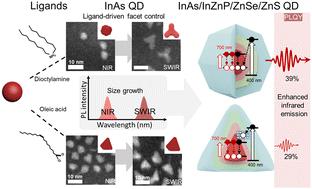
InAs-based quantum dots (QDs) are promising heavy-metal-free semiconductors for infrared emission technologies, offering tunable bandgaps via quantum confinement and excellent charge-carrier transport properties. Building on these advantages, we report the synthesis of QDs tailored for emission in the near-infrared (NIR) and short-wave infrared (SWIR) regions, emphasizing the critical role of capping ligands in controlling surface facet populations and nanocrystal morphology. Specifically, we demonstrate that the choice of ligand plays a critical role in determining the morphology and surface characteristics of InAs QDs. Using dioctylamine as a ligand results in InAs QDs with a spherical or tetrapod morphology, where nonpolar (110) facets are predominantly exposed on the surface. In contrast, oleic acid as a ligand promotes the formation of tetrahedral-shaped QDs with polar (111) crystalline planes being more prominently exposed. Using a one-pot synthesis approach, we successfully synthesized InAs/InZnP/ZnSe/ZnS core-multi-shell structures that effectively minimize interfacial defects. QDs with dioctylamine-capped core exhibit significantly higher photoluminescence quantum yield (PLQY) compared to those with oleic acid-capped cores. We achieved a PLQY of 39% at 1260 nm and 7.3% at 1420 nm with QDs using dioctylamine, representing efficiency values among the best reported in both the NIR and SWIR regions. Transient absorption (TA) spectroscopy reveals that dioctylamine-capped QDs exhibit reduced ground-state bleaching differences across excitation wavelengths compared to oleic acid-capped QDs, indicating significantly reduced interfacial trap states. These findings highlight the importance of ligand-driven facet control in the context of minimizing interfacial defect formation.



 京公网安备 11010802042870号
京ICP备2023020795号-1
京公网安备 11010802042870号
京ICP备2023020795号-1

 分享
分享
 求助内容:
求助内容: 应助结果提醒方式:
 扫码关注我们
