{"title":"Graphene quantum dots reduce oxidation behavior and mechanical damage of epoxy resin irradiated by γ-rays","authors":"Shengkai Liu, Zhisong Li, Jinxia Hou, Peiwen Yang, Chunying Min, Siqi Liu, Xiaoyuan Pei, Ruiqi Shao, Amna Siddique and Zhiwei Xu","doi":"10.1039/D5CP00080G","DOIUrl":null,"url":null,"abstract":"<p >Epoxy resin is a widely used polymer, but it generates highly reactive free radicals under gamma ray irradiation, which reduces its structural integrity. Compared with traditional carbon nanomaterials such as carbon nanotubes and graphene oxide, graphene quantum dots (GQDs) exhibit excellent radiation resistance due to their zero-dimensional high specific surface area, strong ability to remove free radicals through surface defects, and real-time oxidation monitoring based on fluorescence. This study explores the role of graphene quantum dots in mitigating radiation damage and the microscopic mechanisms behind their protective effects. GQDs were incorporated into EP (1 wt%) to scavenge free radicals and reduce radiation induced spatial heterogeneity. After 1 MGy gamma ray irradiation, GQD/EP showed a relatively thin oxide layer of 180 μm (pure EP was 480 μm, a decrease of 62.5%) and maintained 67% of the initial mechanical strength (pure EP maintained 51%). The glass transition temperature (<em>T</em><small><sub>g</sub></small>) increased by 2.2 °C (while that of pure EP decreased by 1.6 °C), which is related to the decrease in free radical content. Micromechanical nanoindentation indicates that the modulus of the outer oxide layer is higher than that of the inner layer, which is due to the densification effect caused by irradiation. Fourier transform infrared spectroscopy analysis showed that the expressions for C<img>C (1605 cm<small><sup>−1</sup></small>) and carbonyl (1725 cm<small><sup>−1</sup></small>) were suppressed in GQD/EP, confirming the surface defect and hydrogen donor scavenging effects of GQDs on free radicals. The key is that GQDs minimize oxidation cascades by neutralizing peroxyl radicals, as demonstrated by fluorescence quenching proportional to radical neutralization. This dual function – structural reinforcement and real-time damage sensing – provides a mechanical framework for designing radiation resistant composite materials. This study deepens our understanding of the radiation resistance mediated by nanomaterials, linking macroscopic properties with atomic scale interactions in polymer matrices.</p>","PeriodicalId":99,"journal":{"name":"Physical Chemistry Chemical Physics","volume":" 17","pages":" 8920-8931"},"PeriodicalIF":2.9000,"publicationDate":"2025-03-26","publicationTypes":"Journal Article","fieldsOfStudy":null,"isOpenAccess":false,"openAccessPdf":"","citationCount":"0","resultStr":null,"platform":"Semanticscholar","paperid":null,"PeriodicalName":"Physical Chemistry Chemical Physics","FirstCategoryId":"92","ListUrlMain":"https://pubs.rsc.org/en/content/articlelanding/2025/cp/d5cp00080g","RegionNum":3,"RegionCategory":"化学","ArticlePicture":[],"TitleCN":null,"AbstractTextCN":null,"PMCID":null,"EPubDate":"","PubModel":"","JCR":"Q3","JCRName":"CHEMISTRY, PHYSICAL","Score":null,"Total":0}
引用次数: 0
Abstract
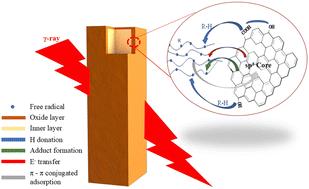
Epoxy resin is a widely used polymer, but it generates highly reactive free radicals under gamma ray irradiation, which reduces its structural integrity. Compared with traditional carbon nanomaterials such as carbon nanotubes and graphene oxide, graphene quantum dots (GQDs) exhibit excellent radiation resistance due to their zero-dimensional high specific surface area, strong ability to remove free radicals through surface defects, and real-time oxidation monitoring based on fluorescence. This study explores the role of graphene quantum dots in mitigating radiation damage and the microscopic mechanisms behind their protective effects. GQDs were incorporated into EP (1 wt%) to scavenge free radicals and reduce radiation induced spatial heterogeneity. After 1 MGy gamma ray irradiation, GQD/EP showed a relatively thin oxide layer of 180 μm (pure EP was 480 μm, a decrease of 62.5%) and maintained 67% of the initial mechanical strength (pure EP maintained 51%). The glass transition temperature (Tg) increased by 2.2 °C (while that of pure EP decreased by 1.6 °C), which is related to the decrease in free radical content. Micromechanical nanoindentation indicates that the modulus of the outer oxide layer is higher than that of the inner layer, which is due to the densification effect caused by irradiation. Fourier transform infrared spectroscopy analysis showed that the expressions for CC (1605 cm−1) and carbonyl (1725 cm−1) were suppressed in GQD/EP, confirming the surface defect and hydrogen donor scavenging effects of GQDs on free radicals. The key is that GQDs minimize oxidation cascades by neutralizing peroxyl radicals, as demonstrated by fluorescence quenching proportional to radical neutralization. This dual function – structural reinforcement and real-time damage sensing – provides a mechanical framework for designing radiation resistant composite materials. This study deepens our understanding of the radiation resistance mediated by nanomaterials, linking macroscopic properties with atomic scale interactions in polymer matrices.
期刊介绍:
Physical Chemistry Chemical Physics (PCCP) is an international journal co-owned by 19 physical chemistry and physics societies from around the world. This journal publishes original, cutting-edge research in physical chemistry, chemical physics and biophysical chemistry. To be suitable for publication in PCCP, articles must include significant innovation and/or insight into physical chemistry; this is the most important criterion that reviewers and Editors will judge against when evaluating submissions.
The journal has a broad scope and welcomes contributions spanning experiment, theory, computation and data science. Topical coverage includes spectroscopy, dynamics, kinetics, statistical mechanics, thermodynamics, electrochemistry, catalysis, surface science, quantum mechanics, quantum computing and machine learning. Interdisciplinary research areas such as polymers and soft matter, materials, nanoscience, energy, surfaces/interfaces, and biophysical chemistry are welcomed if they demonstrate significant innovation and/or insight into physical chemistry. Joined experimental/theoretical studies are particularly appreciated when complementary and based on up-to-date approaches.




 京公网安备 11010802042870号
京ICP备2023020795号-1
京公网安备 11010802042870号
京ICP备2023020795号-1

 分享
分享
 求助内容:
求助内容: 应助结果提醒方式:
 扫码关注我们
