Maria V. Pagliaro, Francesca Bruni, Werner Oberhauser, Laura Capozzoli, Enrico Berretti, Francesco Bartoli, Marco Bellini, Lorenzo Poggini, Claudio Evangelisti, Jacopo Orsilli, Hamish A. Miller, Francesco Vizza
{"title":"Hydrogen and High-Value-Added Chemicals from Glycerol Electroreforming Using a Highly Efficient and Selective Ligand-Stabilized PdCu Catalyst","authors":"Maria V. Pagliaro, Francesca Bruni, Werner Oberhauser, Laura Capozzoli, Enrico Berretti, Francesco Bartoli, Marco Bellini, Lorenzo Poggini, Claudio Evangelisti, Jacopo Orsilli, Hamish A. Miller, Francesco Vizza","doi":"10.1021/acssuschemeng.4c09284","DOIUrl":null,"url":null,"abstract":"PdCu alloy nanoparticles stabilized by a secondary diamine ligand (<b>L</b>) bearing C16-alkyl chains at the nitrogen atoms were successfully synthesized. The <b>PdCuL</b> supported on Vulcan XC-72 (<b>C</b><sup><b>v</b></sup>) with a very low metal loading (1 wt %) was applied in alkaline glycerol electroreforming experiments for both hydrogen generation and chemicals. The <b>PdCuL/C</b><sup><b>v</b></sup> electrocatalyst exhibited excellent activity as an anode material for glycerol oxidation with a specific activity of 6 A mg<sub>Pd</sub><sup>–1</sup> at 1 V and a notable selectivity (up to 95%) for high-value C3 oxidation products (glycerate and tartronate). Sterically demanding <b>L</b> allows the obtaining of small and stable size-controlled nanoparticles (<i>d</i><sub>m</sub> 1.9 ± 0.7 nm) observed through high-resolution transmission electron microscopy (TEM) analysis before and after catalysis testing. The catalyst was also thoroughly investigated by X-ray photoelectron spectroscopy (XPS) and X-ray absorption spectroscopy (XAS) techniques. The Pd–Cu synergistic effect on alcohol oxidation catalysis was verified through electrochemical experiments, which highlight the superior catalytic activity of <b>PdCuL/C</b><sup><b>v</b></sup> (up to 3 times) compared to a monometallic catalyst.","PeriodicalId":25,"journal":{"name":"ACS Sustainable Chemistry & Engineering","volume":"18 1","pages":""},"PeriodicalIF":7.3000,"publicationDate":"2025-03-26","publicationTypes":"Journal Article","fieldsOfStudy":null,"isOpenAccess":false,"openAccessPdf":"","citationCount":"0","resultStr":null,"platform":"Semanticscholar","paperid":null,"PeriodicalName":"ACS Sustainable Chemistry & Engineering","FirstCategoryId":"92","ListUrlMain":"https://doi.org/10.1021/acssuschemeng.4c09284","RegionNum":1,"RegionCategory":"化学","ArticlePicture":[],"TitleCN":null,"AbstractTextCN":null,"PMCID":null,"EPubDate":"","PubModel":"","JCR":"Q1","JCRName":"CHEMISTRY, MULTIDISCIPLINARY","Score":null,"Total":0}
引用次数: 0
Abstract
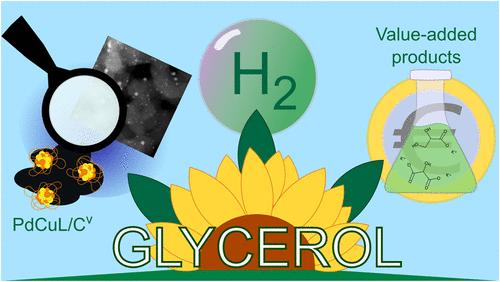
PdCu alloy nanoparticles stabilized by a secondary diamine ligand (L) bearing C16-alkyl chains at the nitrogen atoms were successfully synthesized. The PdCuL supported on Vulcan XC-72 (Cv) with a very low metal loading (1 wt %) was applied in alkaline glycerol electroreforming experiments for both hydrogen generation and chemicals. The PdCuL/Cv electrocatalyst exhibited excellent activity as an anode material for glycerol oxidation with a specific activity of 6 A mgPd–1 at 1 V and a notable selectivity (up to 95%) for high-value C3 oxidation products (glycerate and tartronate). Sterically demanding L allows the obtaining of small and stable size-controlled nanoparticles (dm 1.9 ± 0.7 nm) observed through high-resolution transmission electron microscopy (TEM) analysis before and after catalysis testing. The catalyst was also thoroughly investigated by X-ray photoelectron spectroscopy (XPS) and X-ray absorption spectroscopy (XAS) techniques. The Pd–Cu synergistic effect on alcohol oxidation catalysis was verified through electrochemical experiments, which highlight the superior catalytic activity of PdCuL/Cv (up to 3 times) compared to a monometallic catalyst.
期刊介绍:
ACS Sustainable Chemistry & Engineering is a prestigious weekly peer-reviewed scientific journal published by the American Chemical Society. Dedicated to advancing the principles of green chemistry and green engineering, it covers a wide array of research topics including green chemistry, green engineering, biomass, alternative energy, and life cycle assessment.
The journal welcomes submissions in various formats, including Letters, Articles, Features, and Perspectives (Reviews), that address the challenges of sustainability in the chemical enterprise and contribute to the advancement of sustainable practices. Join us in shaping the future of sustainable chemistry and engineering.



 京公网安备 11010802042870号
京ICP备2023020795号-1
京公网安备 11010802042870号
京ICP备2023020795号-1

 分享
分享
 求助内容:
求助内容: 应助结果提醒方式:
 扫码关注我们
