{"title":"Thermal Induction-Driven Optimization of Nafion Structures for Enhanced Triple Phase Interfaces in CO2 Reduction Reaction","authors":"Tianzi Bi, Yuxuan Wei, Jiabin You, Guiru Zhang, Yongjian Su, Xiaojing Cheng, Xiaohui Yan, Huiyuan Li, Shuiyun Shen, Junliang Zhang","doi":"10.1021/acssuschemeng.4c10950","DOIUrl":null,"url":null,"abstract":"Cobalt phthalocyanine (CoPc) is a widely utilized molecular catalyst for converting CO<sub>2</sub> to CO in the CO<sub>2</sub> reduction reaction (CO<sub>2</sub>RR). However, achieving high selectivity at high current densities remains significant challenges, such as mass transport and interfacial microenvironment. In this study, CoPc-based gas diffusion electrodes with thermal induction treatments are investigated to reach high performance and stability. At a current density of 300 mA/cm<sup>2</sup>, the cell voltage is 2.9 V, with a CO selectivity of 95%, representing nearly a 5-fold improvement compared to the pristine electrode. Additionally, at a current density of 150 mA/cm<sup>2</sup>, the electrode demonstrates long-term durability, maintaining stable performance for 45 h. The structural changes and underlying mechanisms of the Nafion ionomer induced by thermal treatment are investigated via microscopic characterization and molecular dynamics simulations. It is revealed that thermal induction at temperatures slightly above Nafion’s glass transition point could enhance ionomer phase separation, resulting in the formation of additional hydrophilic–hydrophobic interfaces that facilitate CO<sub>2</sub> mass transport. Moreover, the rearrangement of Nafion chains during thermal induction produces a denser structure that restricts OH<sup>–</sup> release. This localized retention of OH<sup>–</sup> raises the pH near the catalyst, thereby improving the efficiency of the CO<sub>2</sub>RR. This work offers valuable insights into the design of CoPc-based gas diffusion electrodes with high selectivity at elevated current densities and provides guidance for post-treatment processes in the field of CO<sub>2</sub>RR.","PeriodicalId":25,"journal":{"name":"ACS Sustainable Chemistry & Engineering","volume":"4 1","pages":""},"PeriodicalIF":7.3000,"publicationDate":"2025-03-26","publicationTypes":"Journal Article","fieldsOfStudy":null,"isOpenAccess":false,"openAccessPdf":"","citationCount":"0","resultStr":null,"platform":"Semanticscholar","paperid":null,"PeriodicalName":"ACS Sustainable Chemistry & Engineering","FirstCategoryId":"92","ListUrlMain":"https://doi.org/10.1021/acssuschemeng.4c10950","RegionNum":1,"RegionCategory":"化学","ArticlePicture":[],"TitleCN":null,"AbstractTextCN":null,"PMCID":null,"EPubDate":"","PubModel":"","JCR":"Q1","JCRName":"CHEMISTRY, MULTIDISCIPLINARY","Score":null,"Total":0}
引用次数: 0
Abstract
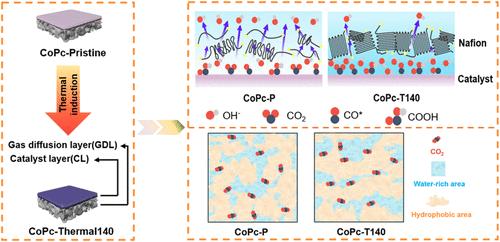
Cobalt phthalocyanine (CoPc) is a widely utilized molecular catalyst for converting CO2 to CO in the CO2 reduction reaction (CO2RR). However, achieving high selectivity at high current densities remains significant challenges, such as mass transport and interfacial microenvironment. In this study, CoPc-based gas diffusion electrodes with thermal induction treatments are investigated to reach high performance and stability. At a current density of 300 mA/cm2, the cell voltage is 2.9 V, with a CO selectivity of 95%, representing nearly a 5-fold improvement compared to the pristine electrode. Additionally, at a current density of 150 mA/cm2, the electrode demonstrates long-term durability, maintaining stable performance for 45 h. The structural changes and underlying mechanisms of the Nafion ionomer induced by thermal treatment are investigated via microscopic characterization and molecular dynamics simulations. It is revealed that thermal induction at temperatures slightly above Nafion’s glass transition point could enhance ionomer phase separation, resulting in the formation of additional hydrophilic–hydrophobic interfaces that facilitate CO2 mass transport. Moreover, the rearrangement of Nafion chains during thermal induction produces a denser structure that restricts OH– release. This localized retention of OH– raises the pH near the catalyst, thereby improving the efficiency of the CO2RR. This work offers valuable insights into the design of CoPc-based gas diffusion electrodes with high selectivity at elevated current densities and provides guidance for post-treatment processes in the field of CO2RR.
期刊介绍:
ACS Sustainable Chemistry & Engineering is a prestigious weekly peer-reviewed scientific journal published by the American Chemical Society. Dedicated to advancing the principles of green chemistry and green engineering, it covers a wide array of research topics including green chemistry, green engineering, biomass, alternative energy, and life cycle assessment.
The journal welcomes submissions in various formats, including Letters, Articles, Features, and Perspectives (Reviews), that address the challenges of sustainability in the chemical enterprise and contribute to the advancement of sustainable practices. Join us in shaping the future of sustainable chemistry and engineering.




 京公网安备 11010802042870号
京ICP备2023020795号-1
京公网安备 11010802042870号
京ICP备2023020795号-1

 分享
分享
 求助内容:
求助内容: 应助结果提醒方式:
 扫码关注我们
