Hongda Zhu, Timothy A. Jackson, Aaron J. Teator, Bala Subramaniam
{"title":"Oxidative Functionalization of Solvent-Pretreated Polyethylene by Ozone","authors":"Hongda Zhu, Timothy A. Jackson, Aaron J. Teator, Bala Subramaniam","doi":"10.1021/acssuschemeng.4c09279","DOIUrl":null,"url":null,"abstract":"Recently, there has been much interest in editing polymers to either endow them with improved properties or facilitate their deconstruction post-use. Such editing often requires the addition of functional groups, which can be especially challenging in the case of highly crystalline and recalcitrant polymers. Herein, we introduce a relatively simple dual-step technique for functionalizing high-density polyethylene (HDPE) using ozone. The method involves first treating the polymer in either supercritical carbon dioxide or paraffinic solvents such as isobutane or <i>n</i>-hexane at 110–120 °C to enhance ozone’s accessibility to the C–H bonds. This step is then followed by exposing the pretreated polymer to ozone either in a gaseous form or dissolved in liquid carbon dioxide at ambient temperature. Nitrogen sorption results and scanning electron micrographs confirmed increased porosity in the solvent-pretreated HDPE samples. Infrared and NMR spectroscopic analyses reveal the formation of carbonyl groups in the pretreated polymer samples upon ozonation. Further, high-temperature GPC analyses indicate that ozonation reduced the molecular weights of the pretreated HDPE samples, suggesting that ozone also induces C–C scission. This method uses benign reagents to induce porosity in the polymer and its functionalization. Our results demonstrate the need to improve ozone utilization to maximize resource efficiency.","PeriodicalId":25,"journal":{"name":"ACS Sustainable Chemistry & Engineering","volume":"11 1","pages":""},"PeriodicalIF":7.3000,"publicationDate":"2025-03-25","publicationTypes":"Journal Article","fieldsOfStudy":null,"isOpenAccess":false,"openAccessPdf":"","citationCount":"0","resultStr":null,"platform":"Semanticscholar","paperid":null,"PeriodicalName":"ACS Sustainable Chemistry & Engineering","FirstCategoryId":"92","ListUrlMain":"https://doi.org/10.1021/acssuschemeng.4c09279","RegionNum":1,"RegionCategory":"化学","ArticlePicture":[],"TitleCN":null,"AbstractTextCN":null,"PMCID":null,"EPubDate":"","PubModel":"","JCR":"Q1","JCRName":"CHEMISTRY, MULTIDISCIPLINARY","Score":null,"Total":0}
引用次数: 0
Abstract
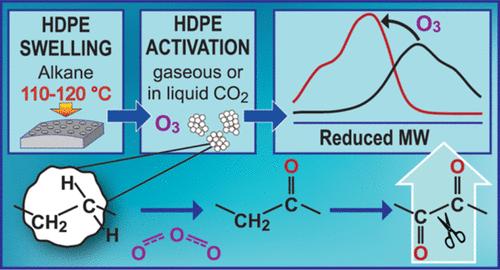
Recently, there has been much interest in editing polymers to either endow them with improved properties or facilitate their deconstruction post-use. Such editing often requires the addition of functional groups, which can be especially challenging in the case of highly crystalline and recalcitrant polymers. Herein, we introduce a relatively simple dual-step technique for functionalizing high-density polyethylene (HDPE) using ozone. The method involves first treating the polymer in either supercritical carbon dioxide or paraffinic solvents such as isobutane or n-hexane at 110–120 °C to enhance ozone’s accessibility to the C–H bonds. This step is then followed by exposing the pretreated polymer to ozone either in a gaseous form or dissolved in liquid carbon dioxide at ambient temperature. Nitrogen sorption results and scanning electron micrographs confirmed increased porosity in the solvent-pretreated HDPE samples. Infrared and NMR spectroscopic analyses reveal the formation of carbonyl groups in the pretreated polymer samples upon ozonation. Further, high-temperature GPC analyses indicate that ozonation reduced the molecular weights of the pretreated HDPE samples, suggesting that ozone also induces C–C scission. This method uses benign reagents to induce porosity in the polymer and its functionalization. Our results demonstrate the need to improve ozone utilization to maximize resource efficiency.
期刊介绍:
ACS Sustainable Chemistry & Engineering is a prestigious weekly peer-reviewed scientific journal published by the American Chemical Society. Dedicated to advancing the principles of green chemistry and green engineering, it covers a wide array of research topics including green chemistry, green engineering, biomass, alternative energy, and life cycle assessment.
The journal welcomes submissions in various formats, including Letters, Articles, Features, and Perspectives (Reviews), that address the challenges of sustainability in the chemical enterprise and contribute to the advancement of sustainable practices. Join us in shaping the future of sustainable chemistry and engineering.



 京公网安备 11010802042870号
京ICP备2023020795号-1
京公网安备 11010802042870号
京ICP备2023020795号-1

 分享
分享
 求助内容:
求助内容: 应助结果提醒方式:
 扫码关注我们
