{"title":"Structural, physical, and energy storage properties of La2CrMnO6 double perovskite microcubes synthesized by molten-salt method","authors":"Liangdong Chen, Jie Ding, Xinhua Zhu","doi":"10.1016/j.jallcom.2025.180044","DOIUrl":null,"url":null,"abstract":"Microcube-shaped La<sub>2</sub>CrMnO<sub>6</sub> double perovskite oxides (LCMO DPOs) were successfully synthesized utilizing molten-salt method. The LCMO DPO microcubes possessed an orthorhombic structure with <em>Pbnm</em> space group and their average size was about 2.3 <em>μ</em>m. XPS spectra confirmed the mixed valence states of chromium (Cr<sup>2+</sup>/Cr<sup>3+</sup>) and manganese (Mn<sup>3+</sup>/Mn<sup>4+</sup>) ions. The optical absorption spectrum revealed the semiconductor characteristics of the LCMO microcubes with an optical bandgap of 1.01<!-- --> <!-- -->eV. Impedance spectroscopy demonstrated that both the grains and grain boundaries contributed to the conduction process with a non-Debye type relaxation behavior. Magnetic measurements showed predominant ferromagnetic interactions at low temperatures with magnetic Curie temperature of 149<!-- --> <!-- -->K. Due to the mixed oxidation states at B-site and structural distortions, Griffiths phase was also observed in the LCMO microcubes with spin-glass states. Electrical transport studies demonstrated that the complex magnetic structures affected the transport properties. At low temperatures, charge transport followed a variable-range hopping (VRH) mechanism for small polarons, while at high temperatures, it conformed to a nearest-neighbor hopping mechanism under thermal activation. Furthermore, the LCMO microcube-based electrodes exhibited an improved electrochemical performance, achieving a specific capacitance close to 100<!-- --> <!-- -->F/g at 1<!-- --> <!-- -->A/g with about 50% capacitance retention after 5000 life cycles at 10<!-- --> <!-- -->A/g. Moreover, an energy density of 3.40<!-- --> <!-- -->W·h/kg (@1<!-- --> <!-- -->A/g) and a power density of 2.50<!-- --> <!-- -->kW/kg (@10<!-- --> <!-- -->A/g) were also achieved. The present work emphasizes the promising applications of LCMO microcubes in energy storage and spintronic technologies.","PeriodicalId":344,"journal":{"name":"Journal of Alloys and Compounds","volume":"215 1","pages":""},"PeriodicalIF":6.3000,"publicationDate":"2025-03-26","publicationTypes":"Journal Article","fieldsOfStudy":null,"isOpenAccess":false,"openAccessPdf":"","citationCount":"0","resultStr":null,"platform":"Semanticscholar","paperid":null,"PeriodicalName":"Journal of Alloys and Compounds","FirstCategoryId":"88","ListUrlMain":"https://doi.org/10.1016/j.jallcom.2025.180044","RegionNum":2,"RegionCategory":"材料科学","ArticlePicture":[],"TitleCN":null,"AbstractTextCN":null,"PMCID":null,"EPubDate":"","PubModel":"","JCR":"Q2","JCRName":"CHEMISTRY, PHYSICAL","Score":null,"Total":0}
引用次数: 0
Abstract
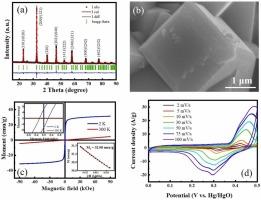
Microcube-shaped La2CrMnO6 double perovskite oxides (LCMO DPOs) were successfully synthesized utilizing molten-salt method. The LCMO DPO microcubes possessed an orthorhombic structure with Pbnm space group and their average size was about 2.3 μm. XPS spectra confirmed the mixed valence states of chromium (Cr2+/Cr3+) and manganese (Mn3+/Mn4+) ions. The optical absorption spectrum revealed the semiconductor characteristics of the LCMO microcubes with an optical bandgap of 1.01 eV. Impedance spectroscopy demonstrated that both the grains and grain boundaries contributed to the conduction process with a non-Debye type relaxation behavior. Magnetic measurements showed predominant ferromagnetic interactions at low temperatures with magnetic Curie temperature of 149 K. Due to the mixed oxidation states at B-site and structural distortions, Griffiths phase was also observed in the LCMO microcubes with spin-glass states. Electrical transport studies demonstrated that the complex magnetic structures affected the transport properties. At low temperatures, charge transport followed a variable-range hopping (VRH) mechanism for small polarons, while at high temperatures, it conformed to a nearest-neighbor hopping mechanism under thermal activation. Furthermore, the LCMO microcube-based electrodes exhibited an improved electrochemical performance, achieving a specific capacitance close to 100 F/g at 1 A/g with about 50% capacitance retention after 5000 life cycles at 10 A/g. Moreover, an energy density of 3.40 W·h/kg (@1 A/g) and a power density of 2.50 kW/kg (@10 A/g) were also achieved. The present work emphasizes the promising applications of LCMO microcubes in energy storage and spintronic technologies.
期刊介绍:
The Journal of Alloys and Compounds is intended to serve as an international medium for the publication of work on solid materials comprising compounds as well as alloys. Its great strength lies in the diversity of discipline which it encompasses, drawing together results from materials science, solid-state chemistry and physics.



 京公网安备 11010802042870号
京ICP备2023020795号-1
京公网安备 11010802042870号
京ICP备2023020795号-1

 分享
分享
 求助内容:
求助内容: 应助结果提醒方式:
 扫码关注我们
