Tingqiang Yang, Matthias Boepple, Anne Hémeryck, Antoine Jay, Sara Karwounopoulos, Udo Weimar, Nicolae Barsan
{"title":"H2S Sensing with SnO2-Based Gas Sensors: Sulfur Poisoning Mechanism Revealed by Operando DRIFTS and DFT Calculations","authors":"Tingqiang Yang, Matthias Boepple, Anne Hémeryck, Antoine Jay, Sara Karwounopoulos, Udo Weimar, Nicolae Barsan","doi":"10.1002/anie.202504696","DOIUrl":null,"url":null,"abstract":"<p>Real-time detection of toxic and flammable H<sub>2</sub>S remains challenging for cost-effective semiconducting metal oxide (SMOX) sensors due to the insufficient focus on and inherently poor understanding of the sulfur-poisoning effect. This research, focusing on SnO<sub>2</sub> as a model for SMOX sensors, identifies the formation of sticky sulfite and sulfate surface species as the root cause of poisoning through the detailed analyses of results obtained from operando diffuse reflectance infrared Fourier transform spectroscopy (DRIFTS) experiments and density functional theory (DFT) calculations. The formation of the poisoning species is highly energetically favorable. Meanwhile, the decomposition of sulfite and sulfate appears unfavorable at the typical operating temperature of 300 °C and is only feasible around the literature-reported 500 °C. The sulfur poisoning effect is also likely to occur with SO<sub>2</sub> and other sulfur-containing volatile organic compounds (VOCs). Overcoming this issue is expected to require surface additives and/or alternative SMOX materials capable of providing different reaction pathways. The significance of metal-sulfur-oxygen chemistry extends beyond SMOX gas sensors to desulfurization catalysts, denitration catalysts, and solid oxide fuel cells.</p>","PeriodicalId":125,"journal":{"name":"Angewandte Chemie International Edition","volume":"64 23","pages":""},"PeriodicalIF":16.9000,"publicationDate":"2025-03-26","publicationTypes":"Journal Article","fieldsOfStudy":null,"isOpenAccess":false,"openAccessPdf":"https://onlinelibrary.wiley.com/doi/epdf/10.1002/anie.202504696","citationCount":"0","resultStr":null,"platform":"Semanticscholar","paperid":null,"PeriodicalName":"Angewandte Chemie International Edition","FirstCategoryId":"92","ListUrlMain":"https://onlinelibrary.wiley.com/doi/10.1002/anie.202504696","RegionNum":1,"RegionCategory":"化学","ArticlePicture":[],"TitleCN":null,"AbstractTextCN":null,"PMCID":null,"EPubDate":"","PubModel":"","JCR":"Q1","JCRName":"CHEMISTRY, MULTIDISCIPLINARY","Score":null,"Total":0}
引用次数: 0
Abstract
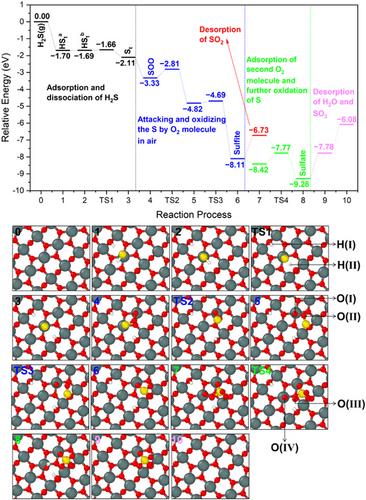
Real-time detection of toxic and flammable H2S remains challenging for cost-effective semiconducting metal oxide (SMOX) sensors due to the insufficient focus on and inherently poor understanding of the sulfur-poisoning effect. This research, focusing on SnO2 as a model for SMOX sensors, identifies the formation of sticky sulfite and sulfate surface species as the root cause of poisoning through the detailed analyses of results obtained from operando diffuse reflectance infrared Fourier transform spectroscopy (DRIFTS) experiments and density functional theory (DFT) calculations. The formation of the poisoning species is highly energetically favorable. Meanwhile, the decomposition of sulfite and sulfate appears unfavorable at the typical operating temperature of 300 °C and is only feasible around the literature-reported 500 °C. The sulfur poisoning effect is also likely to occur with SO2 and other sulfur-containing volatile organic compounds (VOCs). Overcoming this issue is expected to require surface additives and/or alternative SMOX materials capable of providing different reaction pathways. The significance of metal-sulfur-oxygen chemistry extends beyond SMOX gas sensors to desulfurization catalysts, denitration catalysts, and solid oxide fuel cells.
期刊介绍:
Angewandte Chemie, a journal of the German Chemical Society (GDCh), maintains a leading position among scholarly journals in general chemistry with an impressive Impact Factor of 16.6 (2022 Journal Citation Reports, Clarivate, 2023). Published weekly in a reader-friendly format, it features new articles almost every day. Established in 1887, Angewandte Chemie is a prominent chemistry journal, offering a dynamic blend of Review-type articles, Highlights, Communications, and Research Articles on a weekly basis, making it unique in the field.



 京公网安备 11010802042870号
京ICP备2023020795号-1
京公网安备 11010802042870号
京ICP备2023020795号-1

 分享
分享
 求助内容:
求助内容: 应助结果提醒方式:
 扫码关注我们
