John Kauffman , Jake Cuevas , Janaya Feiner , Margaret Metzger , Gauri Shetye , Baojie Wan , Mallique Qader , Duc Nguyen , Angela Nugent , Akil Hossain , Scott Franzblau , Francis E. Umesiri
{"title":"Discovery of ultra short β-peptoids with selective activity against drug-resistant Mycobacterium tuberculosis","authors":"John Kauffman , Jake Cuevas , Janaya Feiner , Margaret Metzger , Gauri Shetye , Baojie Wan , Mallique Qader , Duc Nguyen , Angela Nugent , Akil Hossain , Scott Franzblau , Francis E. Umesiri","doi":"10.1016/j.ejmech.2025.117531","DOIUrl":null,"url":null,"abstract":"<div><div>There is an urgent need to develop new anti-tuberculosis (<em>anti</em>-TB) drugs to tackle drug-resistant strains of <em>Mycobacterium tuberculosis</em> (<em>M.tb</em>). Whereas antimicrobial peptides (AMPs) have received attention because of their antibacterial properties, oligo-<em>N</em>-substituted glycines (peptoids) are now seen as favorable alternatives to AMPs because they are more stable and less vulnerable to protease degradation, less expensive to produce, and better suited to potential pharmaceutical adoption and development. In this work, therefore, we designed, synthesized, and screened 22 new α- and β-peptoids against drug susceptible <em>M. tb</em> strain H37Rv using the Microplate Alamar Blue assay (MABA) to evaluate minimum inhibitory concentration (MIC). Eight compounds (JC5, MM2, MM5, MM9, MM10, MM11, JF11, and JF13) had MICs of less than 10 μg/ml, the most potent of which were JC5 and MM2, with MICs of 1.48 μg/ml and 2.97 μg/ml, respectively. JC5 and MM2 also retained potency against strains mono-resistant to isoniazid and rifampin, and against five of the global <em>M. tb</em> clade representatives. Furthermore, peptoids JC5 and MM2 showed minimum bactericidal concentration (MBC) of 3.02 μg/ml and 5.48 μg/ml respectively. Intracellular activity by luminescence showed a macrophage EC90 of less than 10 μg/ml for both JC5 and MM2. In addition, both compounds showed remarkable narrow spectrum activity. Selectivity with respect to Vero cells was modest but sufficient to consider these classes of alpha and beta-peptoids as good leads for further development of <em>anti</em>-TB drugs.</div></div>","PeriodicalId":314,"journal":{"name":"European Journal of Medicinal Chemistry","volume":"290 ","pages":"Article 117531"},"PeriodicalIF":5.9000,"publicationDate":"2025-03-26","publicationTypes":"Journal Article","fieldsOfStudy":null,"isOpenAccess":false,"openAccessPdf":"","citationCount":"0","resultStr":null,"platform":"Semanticscholar","paperid":null,"PeriodicalName":"European Journal of Medicinal Chemistry","FirstCategoryId":"3","ListUrlMain":"https://www.sciencedirect.com/science/article/pii/S022352342500296X","RegionNum":2,"RegionCategory":"医学","ArticlePicture":[],"TitleCN":null,"AbstractTextCN":null,"PMCID":null,"EPubDate":"","PubModel":"","JCR":"Q1","JCRName":"CHEMISTRY, MEDICINAL","Score":null,"Total":0}
引用次数: 0
Abstract
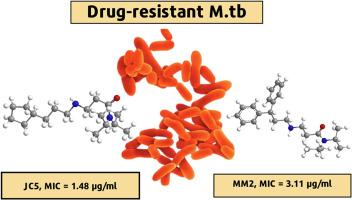
There is an urgent need to develop new anti-tuberculosis (anti-TB) drugs to tackle drug-resistant strains of Mycobacterium tuberculosis (M.tb). Whereas antimicrobial peptides (AMPs) have received attention because of their antibacterial properties, oligo-N-substituted glycines (peptoids) are now seen as favorable alternatives to AMPs because they are more stable and less vulnerable to protease degradation, less expensive to produce, and better suited to potential pharmaceutical adoption and development. In this work, therefore, we designed, synthesized, and screened 22 new α- and β-peptoids against drug susceptible M. tb strain H37Rv using the Microplate Alamar Blue assay (MABA) to evaluate minimum inhibitory concentration (MIC). Eight compounds (JC5, MM2, MM5, MM9, MM10, MM11, JF11, and JF13) had MICs of less than 10 μg/ml, the most potent of which were JC5 and MM2, with MICs of 1.48 μg/ml and 2.97 μg/ml, respectively. JC5 and MM2 also retained potency against strains mono-resistant to isoniazid and rifampin, and against five of the global M. tb clade representatives. Furthermore, peptoids JC5 and MM2 showed minimum bactericidal concentration (MBC) of 3.02 μg/ml and 5.48 μg/ml respectively. Intracellular activity by luminescence showed a macrophage EC90 of less than 10 μg/ml for both JC5 and MM2. In addition, both compounds showed remarkable narrow spectrum activity. Selectivity with respect to Vero cells was modest but sufficient to consider these classes of alpha and beta-peptoids as good leads for further development of anti-TB drugs.
期刊介绍:
The European Journal of Medicinal Chemistry is a global journal that publishes studies on all aspects of medicinal chemistry. It provides a medium for publication of original papers and also welcomes critical review papers.
A typical paper would report on the organic synthesis, characterization and pharmacological evaluation of compounds. Other topics of interest are drug design, QSAR, molecular modeling, drug-receptor interactions, molecular aspects of drug metabolism, prodrug synthesis and drug targeting. The journal expects manuscripts to present the rational for a study, provide insight into the design of compounds or understanding of mechanism, or clarify the targets.



 京公网安备 11010802042870号
京ICP备2023020795号-1
京公网安备 11010802042870号
京ICP备2023020795号-1

 分享
分享
 求助内容:
求助内容: 应助结果提醒方式:
 扫码关注我们
