Changqing Xian, Tao Deng, Bocun Sun, Wenbo Yang, Boyan Li, Youbing Li, Tian Xia, Chaolong Yang, Yi Yang
{"title":"Castor oil-segmented polyurethanes with disulfide bonds: excellent self-healing and mechanical properties","authors":"Changqing Xian, Tao Deng, Bocun Sun, Wenbo Yang, Boyan Li, Youbing Li, Tian Xia, Chaolong Yang, Yi Yang","doi":"10.1007/s10965-025-04341-z","DOIUrl":null,"url":null,"abstract":"<div><p> Self-healing polyurethanes are garnering attention as a smart material, and has significant application potential in aerospace, biomedical, and electronics fields. In this paper, castor oil is selected as a soft segment in place of petroleum-based polyol to enhance the mechanical properties of polyurethane while improving the mobility of molecular chains. Meanwhile, a polyurethane with good self-healing properties was successfully prepared by selecting 2,2`-Diaminodiphenyl disulfide (DTDA) containing disulfide bonds as a chain extender. As the proportion of DTDA increases, the initial thermal decomposition temperature of polyurethane decreases by 21°C. Cutting and tensile tests confirmed the high mechanical properties and self-healing characteristics of the polyurethane network. And the self-healing efficiency of the polyurethane materials was improved by prolonging the healing time and increasing the healing temperature. As the content of disulfide bonds and hard segments increased, the tensile strength of polyurethane increases progressively, the elongation at break decreased, and the R(stress) and R(strain) of each specimen tended to increase and then decrease. The healing efficiency of the specimen with a disulfide bond content of 13.45% was optimal, with both R(stress) and R(strain) reaching more than 99%.</p></div>","PeriodicalId":658,"journal":{"name":"Journal of Polymer Research","volume":"32 4","pages":""},"PeriodicalIF":2.8000,"publicationDate":"2025-03-27","publicationTypes":"Journal Article","fieldsOfStudy":null,"isOpenAccess":false,"openAccessPdf":"","citationCount":"0","resultStr":null,"platform":"Semanticscholar","paperid":null,"PeriodicalName":"Journal of Polymer Research","FirstCategoryId":"92","ListUrlMain":"https://link.springer.com/article/10.1007/s10965-025-04341-z","RegionNum":4,"RegionCategory":"化学","ArticlePicture":[],"TitleCN":null,"AbstractTextCN":null,"PMCID":null,"EPubDate":"","PubModel":"","JCR":"Q3","JCRName":"POLYMER SCIENCE","Score":null,"Total":0}
引用次数: 0
Abstract
Self-healing polyurethanes are garnering attention as a smart material, and has significant application potential in aerospace, biomedical, and electronics fields. In this paper, castor oil is selected as a soft segment in place of petroleum-based polyol to enhance the mechanical properties of polyurethane while improving the mobility of molecular chains. Meanwhile, a polyurethane with good self-healing properties was successfully prepared by selecting 2,2`-Diaminodiphenyl disulfide (DTDA) containing disulfide bonds as a chain extender. As the proportion of DTDA increases, the initial thermal decomposition temperature of polyurethane decreases by 21°C. Cutting and tensile tests confirmed the high mechanical properties and self-healing characteristics of the polyurethane network. And the self-healing efficiency of the polyurethane materials was improved by prolonging the healing time and increasing the healing temperature. As the content of disulfide bonds and hard segments increased, the tensile strength of polyurethane increases progressively, the elongation at break decreased, and the R(stress) and R(strain) of each specimen tended to increase and then decrease. The healing efficiency of the specimen with a disulfide bond content of 13.45% was optimal, with both R(stress) and R(strain) reaching more than 99%.
期刊介绍:
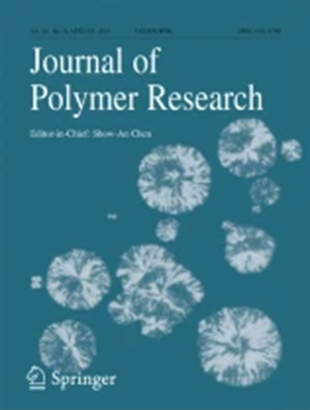
Journal of Polymer Research provides a forum for the prompt publication of articles concerning the fundamental and applied research of polymers. Its great feature lies in the diversity of content which it encompasses, drawing together results from all aspects of polymer science and technology.
As polymer research is rapidly growing around the globe, the aim of this journal is to establish itself as a significant information tool not only for the international polymer researchers in academia but also for those working in industry. The scope of the journal covers a wide range of the highly interdisciplinary field of polymer science and technology, including:
polymer synthesis;
polymer reactions;
polymerization kinetics;
polymer physics;
morphology;
structure-property relationships;
polymer analysis and characterization;
physical and mechanical properties;
electrical and optical properties;
polymer processing and rheology;
application of polymers;
supramolecular science of polymers;
polymer composites.



 京公网安备 11010802042870号
京ICP备2023020795号-1
京公网安备 11010802042870号
京ICP备2023020795号-1

 分享
分享
 求助内容:
求助内容: 应助结果提醒方式:
 扫码关注我们
