{"title":"Fragment Autoantigens Stimulated T-Cell-Immunotherapy (FAST) as a Fast Autologous Cancer Vaccine","authors":"Yuan Li, Huiqin Chen, Qiaofeng Shen, Yingshuang Liu, Pingping Li, Yuqi Ma, Yugang Wang, Shengkai Li, Xueqing Yan, Liyu Liu, Jianwei Shuai, Min Wu, Qi Ouyang, Feng-Ming (Spring) Kong, Gen Yang","doi":"10.1002/advs.202502937","DOIUrl":null,"url":null,"abstract":"<p>Tumor cells often down-regulate antigen presentation and mount an immunosuppressive microenvironment, hindering successful cancer immunotherapy and vaccine development. Additionally, due to genomic instability, tumor cells are usually heterogeneous and constantly evolving. Therefore, vaccines need broad antigen coverage and rapid preparation. Here, a personalized whole tumor cell vaccine (TCV), termed fragment autoantigens stimulated T-cell-immunotherapy (FAST) is developed. In 7 h, tumor cells are treated with irradiation and cryoablation. Personalized fragmented antigens (FAs) from these treated cells are used as TCVs. In breast, colon, and melanoma mouse models, FAST achieved significant tumor regression, less metastasis, and longer survival. Notably, FAST outperforms other advanced TCVs, especially in curbing metastasis. Mechanistically, FAs activate efficient, broad-spectrum antigen presentation due to upregulation of immunogenic cell death, MHC-I, and damage-associated molecular patterns. Concurrently, FAST also enhances anti-tumor immunity by reshaping immune microenvironments. Analysis of clinical data shows FAST-associated proteins have prognostic and therapeutic value in patients with liver, stomach, rectal cancers, and melanoma. These results suggest FAST has high anti-tumor efficacy and potential as a personalized TCV platform. The relevant clinical trial NCT06756295 is under initiation with approval of ethics.</p>","PeriodicalId":117,"journal":{"name":"Advanced Science","volume":"12 26","pages":""},"PeriodicalIF":14.1000,"publicationDate":"2025-03-26","publicationTypes":"Journal Article","fieldsOfStudy":null,"isOpenAccess":false,"openAccessPdf":"https://onlinelibrary.wiley.com/doi/epdf/10.1002/advs.202502937","citationCount":"0","resultStr":null,"platform":"Semanticscholar","paperid":null,"PeriodicalName":"Advanced Science","FirstCategoryId":"88","ListUrlMain":"https://advanced.onlinelibrary.wiley.com/doi/10.1002/advs.202502937","RegionNum":1,"RegionCategory":"材料科学","ArticlePicture":[],"TitleCN":null,"AbstractTextCN":null,"PMCID":null,"EPubDate":"","PubModel":"","JCR":"Q1","JCRName":"CHEMISTRY, MULTIDISCIPLINARY","Score":null,"Total":0}
引用次数: 0
Abstract
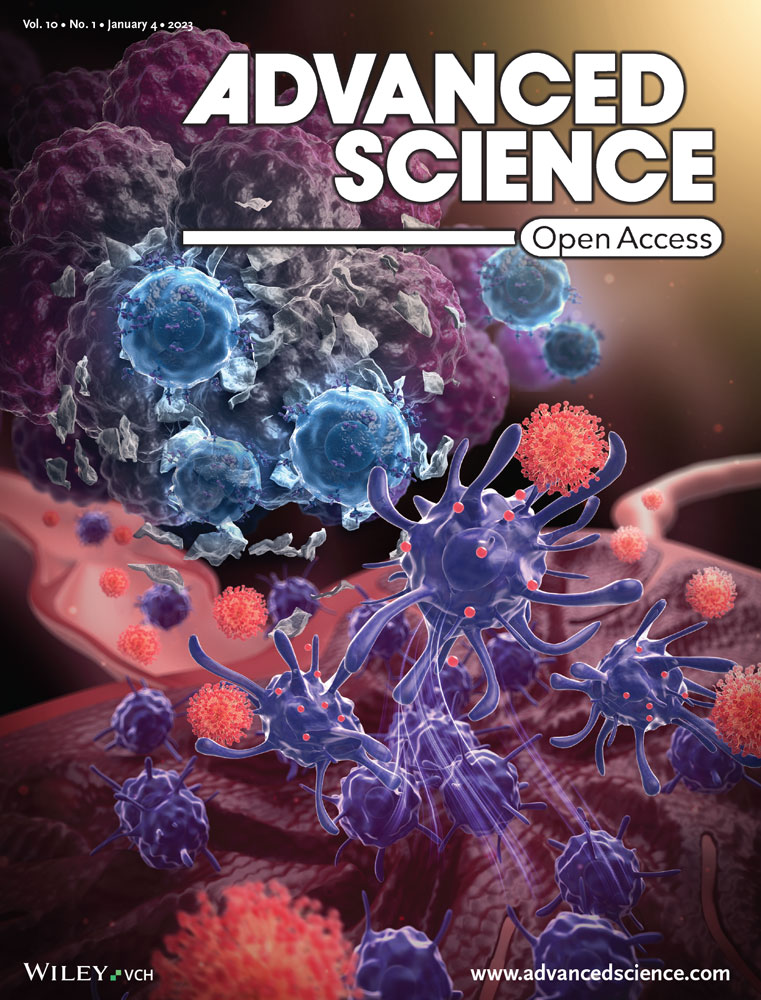
Tumor cells often down-regulate antigen presentation and mount an immunosuppressive microenvironment, hindering successful cancer immunotherapy and vaccine development. Additionally, due to genomic instability, tumor cells are usually heterogeneous and constantly evolving. Therefore, vaccines need broad antigen coverage and rapid preparation. Here, a personalized whole tumor cell vaccine (TCV), termed fragment autoantigens stimulated T-cell-immunotherapy (FAST) is developed. In 7 h, tumor cells are treated with irradiation and cryoablation. Personalized fragmented antigens (FAs) from these treated cells are used as TCVs. In breast, colon, and melanoma mouse models, FAST achieved significant tumor regression, less metastasis, and longer survival. Notably, FAST outperforms other advanced TCVs, especially in curbing metastasis. Mechanistically, FAs activate efficient, broad-spectrum antigen presentation due to upregulation of immunogenic cell death, MHC-I, and damage-associated molecular patterns. Concurrently, FAST also enhances anti-tumor immunity by reshaping immune microenvironments. Analysis of clinical data shows FAST-associated proteins have prognostic and therapeutic value in patients with liver, stomach, rectal cancers, and melanoma. These results suggest FAST has high anti-tumor efficacy and potential as a personalized TCV platform. The relevant clinical trial NCT06756295 is under initiation with approval of ethics.
期刊介绍:
Advanced Science is a prestigious open access journal that focuses on interdisciplinary research in materials science, physics, chemistry, medical and life sciences, and engineering. The journal aims to promote cutting-edge research by employing a rigorous and impartial review process. It is committed to presenting research articles with the highest quality production standards, ensuring maximum accessibility of top scientific findings. With its vibrant and innovative publication platform, Advanced Science seeks to revolutionize the dissemination and organization of scientific knowledge.





 京公网安备 11010802042870号
京ICP备2023020795号-1
京公网安备 11010802042870号
京ICP备2023020795号-1

 分享
分享
 求助内容:
求助内容: 应助结果提醒方式:
 扫码关注我们
