{"title":"Single-Trial Electroencephalography Discrimination of Real, Regulated, Isometric Wrist Extension and Wrist Flexion.","authors":"Abdul-Khaaliq Mohamed, Vered Aharonson","doi":"10.3390/biomimetics10030187","DOIUrl":null,"url":null,"abstract":"<p><p>Improved interpretation of electroencephalography (EEG) associated with the neural control of essential hand movements, including wrist extension (WE) and wrist flexion (WF), could improve the performance of brain-computer interfaces (BCIs). These BCIs could control a prosthetic or orthotic hand to enable motor-impaired individuals to regain the performance of activities of daily living. This study investigated the interpretation of neural signal patterns associated with kinematic differences between real, regulated, isometric WE and WF movements from recorded EEG data. We used 128-channel EEG data recorded from 14 participants performing repetitions of the wrist movements, where the force, speed, and range of motion were regulated. The data were filtered into four frequency bands: delta and theta, mu and beta, low gamma, and high gamma. Within each frequency band, independent component analysis was used to isolate signals originating from seven cortical regions of interest. Features were extracted from these signals using a time-frequency algorithm and classified using Mahalanobis distance clustering. We successfully classified bilateral and unilateral WE and WF movements, with respective accuracies of 90.68% and 69.80%. The results also demonstrated that all frequency bands and regions of interest contained motor-related discriminatory information. Bilateral discrimination relied more on the mu and beta bands, while unilateral discrimination favoured the gamma bands. These results suggest that EEG-based BCIs could benefit from the extraction of features from multiple frequencies and cortical regions.</p>","PeriodicalId":8907,"journal":{"name":"Biomimetics","volume":"10 3","pages":""},"PeriodicalIF":3.9000,"publicationDate":"2025-03-18","publicationTypes":"Journal Article","fieldsOfStudy":null,"isOpenAccess":false,"openAccessPdf":"https://www.ncbi.nlm.nih.gov/pmc/articles/PMC11939923/pdf/","citationCount":"0","resultStr":null,"platform":"Semanticscholar","paperid":null,"PeriodicalName":"Biomimetics","FirstCategoryId":"5","ListUrlMain":"https://doi.org/10.3390/biomimetics10030187","RegionNum":3,"RegionCategory":"医学","ArticlePicture":[],"TitleCN":null,"AbstractTextCN":null,"PMCID":null,"EPubDate":"","PubModel":"","JCR":"Q1","JCRName":"ENGINEERING, MULTIDISCIPLINARY","Score":null,"Total":0}
引用次数: 0
Abstract
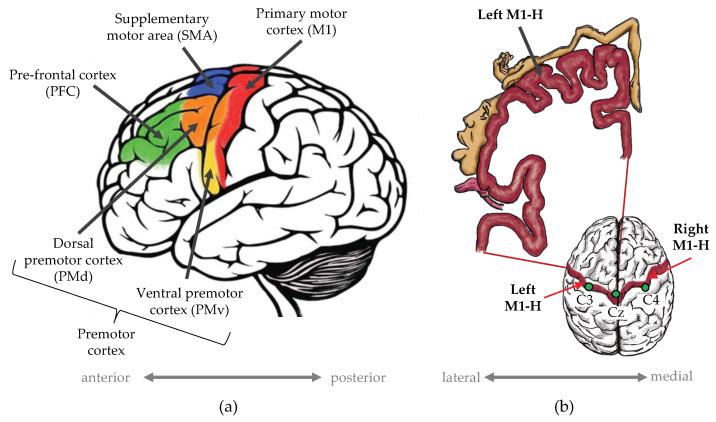
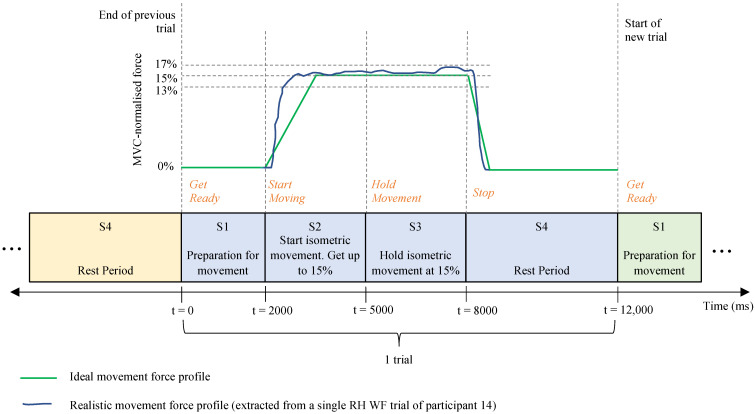
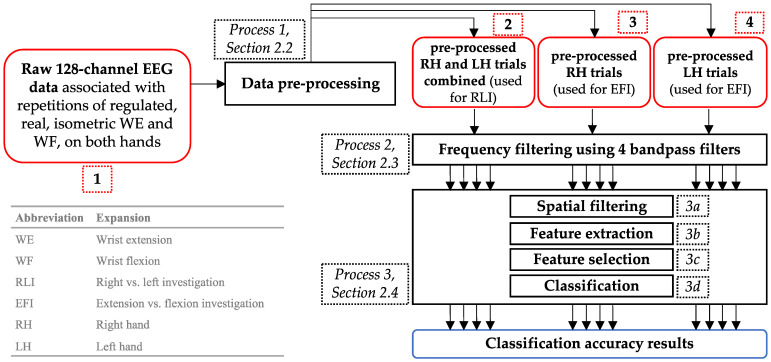
Improved interpretation of electroencephalography (EEG) associated with the neural control of essential hand movements, including wrist extension (WE) and wrist flexion (WF), could improve the performance of brain-computer interfaces (BCIs). These BCIs could control a prosthetic or orthotic hand to enable motor-impaired individuals to regain the performance of activities of daily living. This study investigated the interpretation of neural signal patterns associated with kinematic differences between real, regulated, isometric WE and WF movements from recorded EEG data. We used 128-channel EEG data recorded from 14 participants performing repetitions of the wrist movements, where the force, speed, and range of motion were regulated. The data were filtered into four frequency bands: delta and theta, mu and beta, low gamma, and high gamma. Within each frequency band, independent component analysis was used to isolate signals originating from seven cortical regions of interest. Features were extracted from these signals using a time-frequency algorithm and classified using Mahalanobis distance clustering. We successfully classified bilateral and unilateral WE and WF movements, with respective accuracies of 90.68% and 69.80%. The results also demonstrated that all frequency bands and regions of interest contained motor-related discriminatory information. Bilateral discrimination relied more on the mu and beta bands, while unilateral discrimination favoured the gamma bands. These results suggest that EEG-based BCIs could benefit from the extraction of features from multiple frequencies and cortical regions.




 京公网安备 11010802042870号
京ICP备2023020795号-1
京公网安备 11010802042870号
京ICP备2023020795号-1

 分享
分享
 求助内容:
求助内容: 应助结果提醒方式:
 扫码关注我们
