{"title":"Genome-wide identification of the AAT gene family in quinoa and analysis of its expression pattern under abiotic stresses.","authors":"Hanxue Li, Chunhe Jiang, Junna Liu, Ping Zhang, Li Li, Rongbo Li, Liubin Huang, Xuqin Wang, Guofei Jiang, Yutao Bai, Lingyuan Zhang, Peng Qin","doi":"10.1186/s12864-025-11491-3","DOIUrl":null,"url":null,"abstract":"<p><strong>Background: </strong>Plant amino acid transporters play an important role in the absorption of soil amino acids by roots, the transport of amino acids between xylem and phloem, plant growth and development, and response to abiotic stress.</p><p><strong>Result: </strong>In this study, we identified 147 AAT genes in the quinoa genome sequence and categorized them into 12 subfamilies on the basis of their similarity and phylogenetic relationships with AAT found in Arabidopsis thaliana. Interestingly, these AAT genes are not evenly distributed on the quinoa chromosomes. Instead, most of these genes are centrally located on the outer edges of the chromosome arms. After performing motif analysis and gene structure analysis, we observed the consistent presence of similar motifs and intron-exon distribution patterns among subfamilies. Tissue expression analysis revealed that CqAAT gene was less expressed in fruits and more expressed in roots, stems, leaves and flowers. Meanwhile, expression analysis under four adversities of high temperature, low temperature, waterlogging, and drought and different treatments of nitrogen, phosphorus, and potash fertilizers found that two genes of the CqGAT subfamily, AUR62031750 and AUR62023955 were up-regulated expressed under abiotic stresses.</p><p><strong>Conclusions: </strong>In summary, there is a significant differentiation in the tissue expression and stress expression of the CqAAT gene, indicating that CqAATs play a role in regulating growth and development under abiotic stress.</p>","PeriodicalId":9030,"journal":{"name":"BMC Genomics","volume":"26 1","pages":"298"},"PeriodicalIF":3.7000,"publicationDate":"2025-03-25","publicationTypes":"Journal Article","fieldsOfStudy":null,"isOpenAccess":false,"openAccessPdf":"https://www.ncbi.nlm.nih.gov/pmc/articles/PMC11938623/pdf/","citationCount":"0","resultStr":null,"platform":"Semanticscholar","paperid":null,"PeriodicalName":"BMC Genomics","FirstCategoryId":"99","ListUrlMain":"https://doi.org/10.1186/s12864-025-11491-3","RegionNum":2,"RegionCategory":"生物学","ArticlePicture":[],"TitleCN":null,"AbstractTextCN":null,"PMCID":null,"EPubDate":"","PubModel":"","JCR":"Q2","JCRName":"BIOTECHNOLOGY & APPLIED MICROBIOLOGY","Score":null,"Total":0}
引用次数: 0
Abstract
Background: Plant amino acid transporters play an important role in the absorption of soil amino acids by roots, the transport of amino acids between xylem and phloem, plant growth and development, and response to abiotic stress.
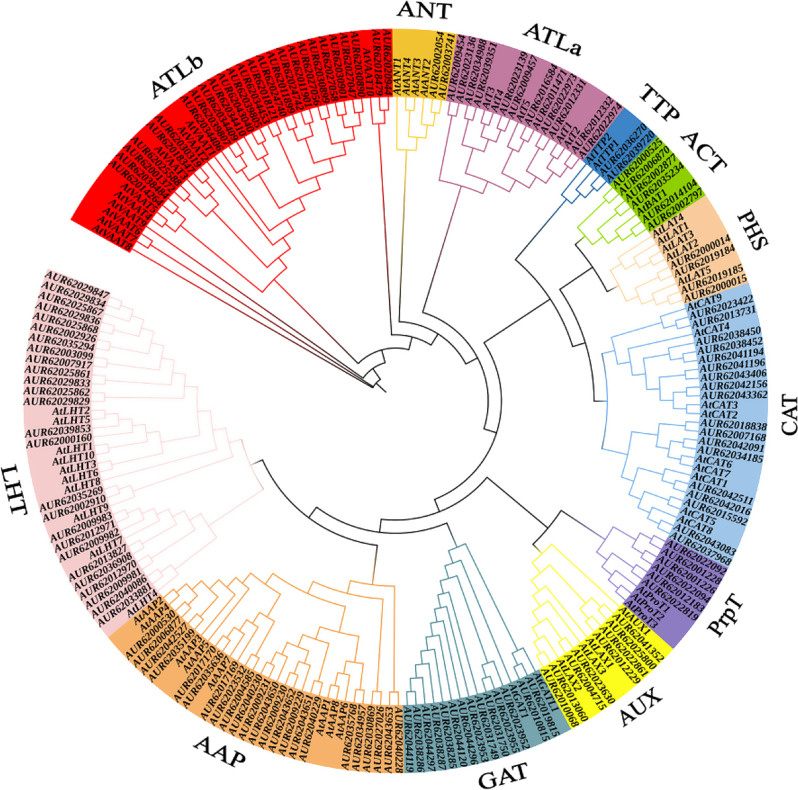
Result: In this study, we identified 147 AAT genes in the quinoa genome sequence and categorized them into 12 subfamilies on the basis of their similarity and phylogenetic relationships with AAT found in Arabidopsis thaliana. Interestingly, these AAT genes are not evenly distributed on the quinoa chromosomes. Instead, most of these genes are centrally located on the outer edges of the chromosome arms. After performing motif analysis and gene structure analysis, we observed the consistent presence of similar motifs and intron-exon distribution patterns among subfamilies. Tissue expression analysis revealed that CqAAT gene was less expressed in fruits and more expressed in roots, stems, leaves and flowers. Meanwhile, expression analysis under four adversities of high temperature, low temperature, waterlogging, and drought and different treatments of nitrogen, phosphorus, and potash fertilizers found that two genes of the CqGAT subfamily, AUR62031750 and AUR62023955 were up-regulated expressed under abiotic stresses.
Conclusions: In summary, there is a significant differentiation in the tissue expression and stress expression of the CqAAT gene, indicating that CqAATs play a role in regulating growth and development under abiotic stress.
期刊介绍:
BMC Genomics is an open access, peer-reviewed journal that considers articles on all aspects of genome-scale analysis, functional genomics, and proteomics.
BMC Genomics is part of the BMC series which publishes subject-specific journals focused on the needs of individual research communities across all areas of biology and medicine. We offer an efficient, fair and friendly peer review service, and are committed to publishing all sound science, provided that there is some advance in knowledge presented by the work.






 京公网安备 11010802042870号
京ICP备2023020795号-1
京公网安备 11010802042870号
京ICP备2023020795号-1

 分享
分享
 求助内容:
求助内容: 应助结果提醒方式:
 扫码关注我们
