Valerio Basile, Alessandro Allegra, Herbert Ryan Marini, Massimiliano Berretta, Barbara Granata, José Freni, Domenico Puzzolo, Fabio Stagno, Paola Midiri, Valentina Urzì Brancati, Letteria Minutoli
{"title":"Influence of Vitamin D and Its Analogues in Type-B Lymphomas.","authors":"Valerio Basile, Alessandro Allegra, Herbert Ryan Marini, Massimiliano Berretta, Barbara Granata, José Freni, Domenico Puzzolo, Fabio Stagno, Paola Midiri, Valentina Urzì Brancati, Letteria Minutoli","doi":"10.3390/curroncol32030135","DOIUrl":null,"url":null,"abstract":"<p><p>Lymphomas represent a heterogeneous group of blood tumors, generally divided into non-Hodgkin lymphoma (NHL) (90% of all lymphomas) and Hodgkin lymphoma (HL). High-grade NHL can rapidly progress so that new strategies and potentially therapeutical options are needed. Recently, it was shown that Vitamin D (VitD) inhibits the growth of cancer cells, controls their invasion and metastasis, and strengthens the antitumor activity of various types of chemotherapeutic anticancer agents. Therefore, we reviewed the recent literature about the influence of VitD and its analogues (VDAs) on the treatment and the prognosis of B-cell lymphomas. As to the in vitro studies in different cell lines, VitD3 and VDAs enhanced the anti-proliferative efficacy of various chemotherapeutics and increased the expression of VitD receptor. In in vivo studies, blood levels of VitD were considered: higher values of plasma bioavailable VitD were correlated with better progression-free survival (PFS) and overall survival (OS), while an unfavorable PFS and OS were observed in VitD deficient groups. No clinical trial was made on the analogs, thus confirming the absence of in vivo positive role of these synthetic drugs. In conclusion, higher levels of circulating VitD are related to improved OS, reduced cancer-specific mortality, and better disease-free survival. VitD and analogs showed also positive effects in in vitro studies, while only VitD was able to improve clinical parameters. Furthermore, a complex approach with plant-based diet, adequate levels for motor exercise, and/or eventual VitD supplementation could be a valuable strategy to challenge lymphomas.</p>","PeriodicalId":11012,"journal":{"name":"Current oncology","volume":"32 3","pages":""},"PeriodicalIF":3.4000,"publicationDate":"2025-02-26","publicationTypes":"Journal Article","fieldsOfStudy":null,"isOpenAccess":false,"openAccessPdf":"https://www.ncbi.nlm.nih.gov/pmc/articles/PMC11941339/pdf/","citationCount":"0","resultStr":null,"platform":"Semanticscholar","paperid":null,"PeriodicalName":"Current oncology","FirstCategoryId":"3","ListUrlMain":"https://doi.org/10.3390/curroncol32030135","RegionNum":4,"RegionCategory":"医学","ArticlePicture":[],"TitleCN":null,"AbstractTextCN":null,"PMCID":null,"EPubDate":"","PubModel":"","JCR":"Q2","JCRName":"ONCOLOGY","Score":null,"Total":0}
引用次数: 0
Abstract
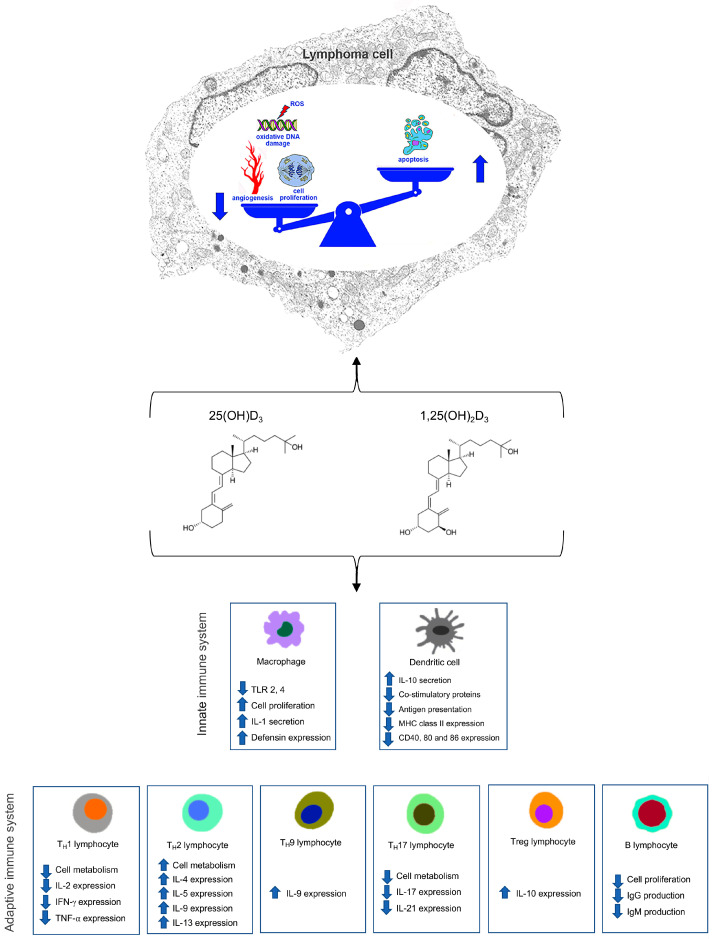
Lymphomas represent a heterogeneous group of blood tumors, generally divided into non-Hodgkin lymphoma (NHL) (90% of all lymphomas) and Hodgkin lymphoma (HL). High-grade NHL can rapidly progress so that new strategies and potentially therapeutical options are needed. Recently, it was shown that Vitamin D (VitD) inhibits the growth of cancer cells, controls their invasion and metastasis, and strengthens the antitumor activity of various types of chemotherapeutic anticancer agents. Therefore, we reviewed the recent literature about the influence of VitD and its analogues (VDAs) on the treatment and the prognosis of B-cell lymphomas. As to the in vitro studies in different cell lines, VitD3 and VDAs enhanced the anti-proliferative efficacy of various chemotherapeutics and increased the expression of VitD receptor. In in vivo studies, blood levels of VitD were considered: higher values of plasma bioavailable VitD were correlated with better progression-free survival (PFS) and overall survival (OS), while an unfavorable PFS and OS were observed in VitD deficient groups. No clinical trial was made on the analogs, thus confirming the absence of in vivo positive role of these synthetic drugs. In conclusion, higher levels of circulating VitD are related to improved OS, reduced cancer-specific mortality, and better disease-free survival. VitD and analogs showed also positive effects in in vitro studies, while only VitD was able to improve clinical parameters. Furthermore, a complex approach with plant-based diet, adequate levels for motor exercise, and/or eventual VitD supplementation could be a valuable strategy to challenge lymphomas.
期刊介绍:
Current Oncology is a peer-reviewed, Canadian-based and internationally respected journal. Current Oncology represents a multidisciplinary medium encompassing health care workers in the field of cancer therapy in Canada to report upon and to review progress in the management of this disease.
We encourage submissions from all fields of cancer medicine, including radiation oncology, surgical oncology, medical oncology, pediatric oncology, pathology, and cancer rehabilitation and survivorship. Articles published in the journal typically contain information that is relevant directly to clinical oncology practice, and have clear potential for application to the current or future practice of cancer medicine.





 京公网安备 11010802042870号
京ICP备2023020795号-1
京公网安备 11010802042870号
京ICP备2023020795号-1

 分享
分享
 求助内容:
求助内容: 应助结果提醒方式:
 扫码关注我们
