Giuseppe Vadalà, Cristina Madaudo, Alessandra Fontana, Vincenzo Sucato, Gioele Bicelli, Laura Maniscalco, Antonio Luca Maria Parlati, Giovanna Panarello, Sergio Sciacca, Michele Pilato, Manlio Cipriani, Alfredo Ruggero Galassi
{"title":"Gastrointestinal Bleeding During Long-Term Left Ventricular Assist Device Support: External Validation of UTAH Bleeding Risk Score.","authors":"Giuseppe Vadalà, Cristina Madaudo, Alessandra Fontana, Vincenzo Sucato, Gioele Bicelli, Laura Maniscalco, Antonio Luca Maria Parlati, Giovanna Panarello, Sergio Sciacca, Michele Pilato, Manlio Cipriani, Alfredo Ruggero Galassi","doi":"10.3390/jcdd12030105","DOIUrl":null,"url":null,"abstract":"<p><strong>Background: </strong>Gastrointestinal bleeding (GIB) is a common complication of left ventricular assist device (LVAD) support. The UTAH bleeding risk score (UBRS) is the only dedicated GIB prediction model, but its efficacy has not been confirmed in an external validation cohort. Furthermore, the reliability of other bleeding risk scores, such as ARC-HBR and HASBLED, has never been tested in this specific population. This study aims to validate the UBRS and compare its accuracy with the ARC-HBR and HASBLED scores.</p><p><strong>Methods: </strong>Major adverse events (MAEs) and bleeding events of 75 consecutive patients who had undergone LVAD implantation between 2010 and 2021 at a referral hospital for a heart transplant were retrospectively analyzed. The accuracy of the UBRS, ARC-HBR and HASBLED scores was evaluated using a ROC curve model.</p><p><strong>Results: </strong>At a mean follow-up of 905.9 ± 724 days, 58 (77.3%) patients had an MAE and 28 (37.3%) had a major bleeding event. Out of the 39 major bleeding events, the majority were GI (43%) and intracranial bleeding (33.3%). Compared with patients without major bleeding, those who experienced major bleeding showed a lower survival probability, regardless of the nature of the bleeding (GIB vs. other bleeding events). The UBRS effectively stratified the bleeding risk with an AUC of 0.86. In contrast, the ARC-HBR and HASBLED scores demonstrated lower discriminatory power, with AUCs of 0.61 and 0.52, respectively.</p><p><strong>Conclusions: </strong>UBRS accuracy was confirmed in our study population. Gastrointestinal bleeding is a common life-threatening complication and one of the main causes of re-hospitalization during VAD support, leading to a lower patient survival probability.</p>","PeriodicalId":15197,"journal":{"name":"Journal of Cardiovascular Development and Disease","volume":"12 3","pages":""},"PeriodicalIF":2.3000,"publicationDate":"2025-03-19","publicationTypes":"Journal Article","fieldsOfStudy":null,"isOpenAccess":false,"openAccessPdf":"https://www.ncbi.nlm.nih.gov/pmc/articles/PMC11943341/pdf/","citationCount":"0","resultStr":null,"platform":"Semanticscholar","paperid":null,"PeriodicalName":"Journal of Cardiovascular Development and Disease","FirstCategoryId":"3","ListUrlMain":"https://doi.org/10.3390/jcdd12030105","RegionNum":4,"RegionCategory":"医学","ArticlePicture":[],"TitleCN":null,"AbstractTextCN":null,"PMCID":null,"EPubDate":"","PubModel":"","JCR":"Q2","JCRName":"CARDIAC & CARDIOVASCULAR SYSTEMS","Score":null,"Total":0}
引用次数: 0
Abstract
Background: Gastrointestinal bleeding (GIB) is a common complication of left ventricular assist device (LVAD) support. The UTAH bleeding risk score (UBRS) is the only dedicated GIB prediction model, but its efficacy has not been confirmed in an external validation cohort. Furthermore, the reliability of other bleeding risk scores, such as ARC-HBR and HASBLED, has never been tested in this specific population. This study aims to validate the UBRS and compare its accuracy with the ARC-HBR and HASBLED scores.
Methods: Major adverse events (MAEs) and bleeding events of 75 consecutive patients who had undergone LVAD implantation between 2010 and 2021 at a referral hospital for a heart transplant were retrospectively analyzed. The accuracy of the UBRS, ARC-HBR and HASBLED scores was evaluated using a ROC curve model.
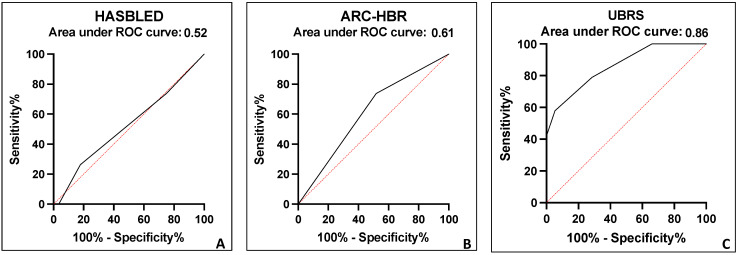
Results: At a mean follow-up of 905.9 ± 724 days, 58 (77.3%) patients had an MAE and 28 (37.3%) had a major bleeding event. Out of the 39 major bleeding events, the majority were GI (43%) and intracranial bleeding (33.3%). Compared with patients without major bleeding, those who experienced major bleeding showed a lower survival probability, regardless of the nature of the bleeding (GIB vs. other bleeding events). The UBRS effectively stratified the bleeding risk with an AUC of 0.86. In contrast, the ARC-HBR and HASBLED scores demonstrated lower discriminatory power, with AUCs of 0.61 and 0.52, respectively.
Conclusions: UBRS accuracy was confirmed in our study population. Gastrointestinal bleeding is a common life-threatening complication and one of the main causes of re-hospitalization during VAD support, leading to a lower patient survival probability.




 京公网安备 11010802042870号
京ICP备2023020795号-1
京公网安备 11010802042870号
京ICP备2023020795号-1

 分享
分享
 求助内容:
求助内容: 应助结果提醒方式:
 扫码关注我们
