{"title":"Sex difference in genetic risk in the prevalence of atrial fibrillation","authors":"Sayuri Tokioka MD, MPH , Masato Takase PhD , Naoki Nakaya PhD , Rieko Hatanaka PhD , Kumi Nakaya PhD , Mana Kogure PhD , Ippei Chiba PhD , Kotaro Nochioka MD, PhD , Hirohito Metoki MD, PhD , Tomohiro Nakamura PhD , Mami Ishikuro PhD , Taku Obara PhD , Yohei Hamanaka MD, PhD , Masatsugu Orui MD, PhD , Tomoko Kobayashi MD, PhD , Akira Uruno MD, PhD , Eiichi N. Kodama MD, PhD , Satoshi Nagaie PhD , Soichi Ogishima PhD , Yoko Izumi MD, PhD , Atsushi Hozawa MD, PhD","doi":"10.1016/j.hrthm.2025.03.1974","DOIUrl":null,"url":null,"abstract":"<div><h3>Background</h3><div><span>Early detection and management of atrial fibrillation (AF) are crucial. Combined models incorporating </span>genetic<span> risks and clinical risks have been developed to improve predictive ability. Although sex differences<span> have been reported in many aspects of AF, sex differences in genetic risk have not been studied.</span></span></div></div><div><h3>Objective</h3><div>The purpose of this study was to assess the sex difference in the effect of polygenic risk score for AF (AF-PRS) on AF prevalence using cross-sectional data from the Tohoku Medical Megabank Project Community-Based Cohort Study in Japan.</div></div><div><h3>Methods</h3><div>AF-PRS and Cohorts for Heart and Aging Research in Genomic Epidemiology Atrial Fibrillation (CHARGE-AF) score were used for genetic AF risks and clinical AF risks, respectively. Sex differences in the association of AF-PRS with the prevalence of AF were evaluated.</div></div><div><h3>Results</h3><div>Among 16,853 participants (mean age 63.4 years; 5182, 30.7% men), the prevalence of AF was 255 (4.9%) in men and 130 (1.1%) in women. In the group with high AF-PRS and high CHARGE-AF score, the odds ratio for AF was highest in men and women (8.2 in men and 9.4 in women), compared with that in the group with low AF-PRS and low CHARGE-AF score. Integrating AF-PRS into the CHARGE-AF score significantly enhanced the area under the receiver operating characteristic curve for AF in men (from 0.639 to 0.749) but not in women (from 0.710 to 0.733).</div></div><div><h3>Conclusion</h3><div>Our study is the first to show a sex difference in the association of AF-PRS and AF prevalence. AF-PRS is more closely associated with the prevalence of AF in men than in women.</div></div>","PeriodicalId":12886,"journal":{"name":"Heart rhythm","volume":"22 9","pages":"Pages e631-e639"},"PeriodicalIF":5.7000,"publicationDate":"2025-09-01","publicationTypes":"Journal Article","fieldsOfStudy":null,"isOpenAccess":false,"openAccessPdf":"","citationCount":"0","resultStr":null,"platform":"Semanticscholar","paperid":null,"PeriodicalName":"Heart rhythm","FirstCategoryId":"3","ListUrlMain":"https://www.sciencedirect.com/science/article/pii/S1547527125022362","RegionNum":2,"RegionCategory":"医学","ArticlePicture":[],"TitleCN":null,"AbstractTextCN":null,"PMCID":null,"EPubDate":"2025/3/23 0:00:00","PubModel":"Epub","JCR":"Q1","JCRName":"CARDIAC & CARDIOVASCULAR SYSTEMS","Score":null,"Total":0}
引用次数: 0
Abstract
Background
Early detection and management of atrial fibrillation (AF) are crucial. Combined models incorporating genetic risks and clinical risks have been developed to improve predictive ability. Although sex differences have been reported in many aspects of AF, sex differences in genetic risk have not been studied.
Objective
The purpose of this study was to assess the sex difference in the effect of polygenic risk score for AF (AF-PRS) on AF prevalence using cross-sectional data from the Tohoku Medical Megabank Project Community-Based Cohort Study in Japan.
Methods
AF-PRS and Cohorts for Heart and Aging Research in Genomic Epidemiology Atrial Fibrillation (CHARGE-AF) score were used for genetic AF risks and clinical AF risks, respectively. Sex differences in the association of AF-PRS with the prevalence of AF were evaluated.
Results
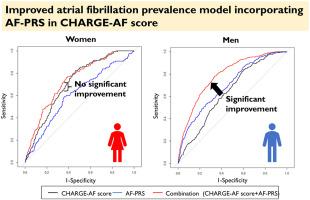
Among 16,853 participants (mean age 63.4 years; 5182, 30.7% men), the prevalence of AF was 255 (4.9%) in men and 130 (1.1%) in women. In the group with high AF-PRS and high CHARGE-AF score, the odds ratio for AF was highest in men and women (8.2 in men and 9.4 in women), compared with that in the group with low AF-PRS and low CHARGE-AF score. Integrating AF-PRS into the CHARGE-AF score significantly enhanced the area under the receiver operating characteristic curve for AF in men (from 0.639 to 0.749) but not in women (from 0.710 to 0.733).
Conclusion
Our study is the first to show a sex difference in the association of AF-PRS and AF prevalence. AF-PRS is more closely associated with the prevalence of AF in men than in women.
期刊介绍:
HeartRhythm, the official Journal of the Heart Rhythm Society and the Cardiac Electrophysiology Society, is a unique journal for fundamental discovery and clinical applicability.
HeartRhythm integrates the entire cardiac electrophysiology (EP) community from basic and clinical academic researchers, private practitioners, engineers, allied professionals, industry, and trainees, all of whom are vital and interdependent members of our EP community.
The Heart Rhythm Society is the international leader in science, education, and advocacy for cardiac arrhythmia professionals and patients, and the primary information resource on heart rhythm disorders. Its mission is to improve the care of patients by promoting research, education, and optimal health care policies and standards.




 京公网安备 11010802042870号
京ICP备2023020795号-1
京公网安备 11010802042870号
京ICP备2023020795号-1

 分享
分享
 求助内容:
求助内容: 应助结果提醒方式:
 扫码关注我们
