Real-world use of finerenone in patients with chronic kidney disease and type 2 diabetes based on large-scale clinical studies: FIDELIO-DKD and FIGARO-DKD
{"title":"Real-world use of finerenone in patients with chronic kidney disease and type 2 diabetes based on large-scale clinical studies: FIDELIO-DKD and FIGARO-DKD","authors":"Atsuhisa Sato, Mitsuhiro Nishimoto","doi":"10.1038/s41440-025-02175-2","DOIUrl":null,"url":null,"abstract":"Finerenone is a new mineralocorticoid receptor antagonist that does not have a steroid skeleton, and in two large-scale clinical studies targeting patients with chronic kidney disease (CKD) complicated with type 2 diabetes (FIDELIO-DKD and FIGARO-DKD), it significantly reduced the composite endpoints due to the progression of renal disease, and the composite endpoints of cardiovascular disease. Recently, we published two databases summarizing how finerenone is used in clinical practice in Japan (FINEROD). In this paper, we examines how best to use finerenone to get the most out of its effects. The most important side effect of finerenone is hyperkalemia, and the risk of hyperkalemia increases as renal function declines. By starting treatment early when eGFR is maintained, it is expected that side effects will be reduced. Furthermore, the FIDELITY analysis (a pooled analysis of FIDELIO-DKD and FIGARO-DKD) has shown that the clinical effect is stronger when finerenone treatment is started at an early stage of CKD. The simultaneous use of RAS inhibitors (ACE inhibitor or ARB), finerenone, and SGLT2 inhibitors appears to be a promising treatment. Further, it is important to continue the medications of RAS inhibitors and MR antagonists as long as possible. To prevent hyperkalemia, the most reliable and safest method is to use a new oral potassium adsorbent. It is important to think of a new oral potassium adsorbent not as something that will lower serum potassium levels, but as something that will allow you to avoid discontinuing or increase the dose of RAS inhibitors or MR antagonists.","PeriodicalId":13029,"journal":{"name":"Hypertension Research","volume":"48 6","pages":"1929-1938"},"PeriodicalIF":4.6000,"publicationDate":"2025-03-25","publicationTypes":"Journal Article","fieldsOfStudy":null,"isOpenAccess":false,"openAccessPdf":"","citationCount":"0","resultStr":null,"platform":"Semanticscholar","paperid":null,"PeriodicalName":"Hypertension Research","FirstCategoryId":"3","ListUrlMain":"https://www.nature.com/articles/s41440-025-02175-2","RegionNum":2,"RegionCategory":"医学","ArticlePicture":[],"TitleCN":null,"AbstractTextCN":null,"PMCID":null,"EPubDate":"","PubModel":"","JCR":"Q1","JCRName":"PERIPHERAL VASCULAR DISEASE","Score":null,"Total":0}
引用次数: 0
Abstract
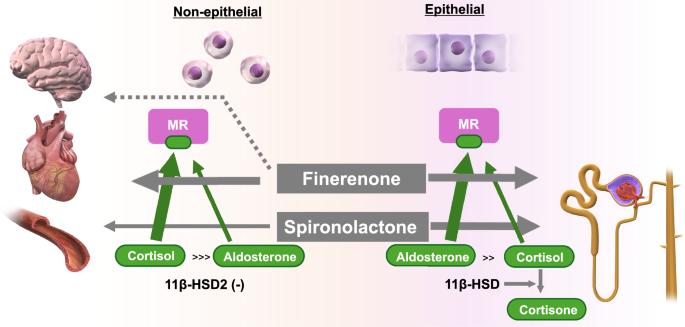
Finerenone is a new mineralocorticoid receptor antagonist that does not have a steroid skeleton, and in two large-scale clinical studies targeting patients with chronic kidney disease (CKD) complicated with type 2 diabetes (FIDELIO-DKD and FIGARO-DKD), it significantly reduced the composite endpoints due to the progression of renal disease, and the composite endpoints of cardiovascular disease. Recently, we published two databases summarizing how finerenone is used in clinical practice in Japan (FINEROD). In this paper, we examines how best to use finerenone to get the most out of its effects. The most important side effect of finerenone is hyperkalemia, and the risk of hyperkalemia increases as renal function declines. By starting treatment early when eGFR is maintained, it is expected that side effects will be reduced. Furthermore, the FIDELITY analysis (a pooled analysis of FIDELIO-DKD and FIGARO-DKD) has shown that the clinical effect is stronger when finerenone treatment is started at an early stage of CKD. The simultaneous use of RAS inhibitors (ACE inhibitor or ARB), finerenone, and SGLT2 inhibitors appears to be a promising treatment. Further, it is important to continue the medications of RAS inhibitors and MR antagonists as long as possible. To prevent hyperkalemia, the most reliable and safest method is to use a new oral potassium adsorbent. It is important to think of a new oral potassium adsorbent not as something that will lower serum potassium levels, but as something that will allow you to avoid discontinuing or increase the dose of RAS inhibitors or MR antagonists.
期刊介绍:
Hypertension Research is the official publication of the Japanese Society of Hypertension. The journal publishes papers reporting original clinical and experimental research that contribute to the advancement of knowledge in the field of hypertension and related cardiovascular diseases. The journal publishes Review Articles, Articles, Correspondence and Comments.



 京公网安备 11010802042870号
京ICP备2023020795号-1
京公网安备 11010802042870号
京ICP备2023020795号-1

 分享
分享
 求助内容:
求助内容: 应助结果提醒方式:
 扫码关注我们
