{"title":"Trends in Antifungal Resistance Among <i>Candida</i> Species: An Eight-Year Retrospective Study in the Galveston-Houston Gulf Coast Region.","authors":"Michael D Nguyen, Ping Ren","doi":"10.3390/jof11030232","DOIUrl":null,"url":null,"abstract":"<p><p>Fungal systemic infections are a growing global health concern, particularly among immunocompromised individuals. <i>Candida</i> species are the leading cause of invasive fungal infections, with <i>C. albicans</i> historically being the most prevalent. The emergence of <i>C. auris</i>, known for its multidrug resistance, presents additional challenges for treatment and infection control. This study retrospectively analyzed minimal inhibitory concentration (MIC) data for common <i>Candida</i> species isolated from patients in the Galveston-Houston Gulf Coast region from the EPIC Laboratory Information System (LIS) between October 2016 and September 2024. Antifungal susceptibility was assessed using the Sensititre<sup>TM</sup> YeastOne<sup>TM</sup> YO9 AST Plate and interpreted per Clinical and Laboratory Standard Institute (CLSI) guidelines. A total of 1206 clinical yeast isolates from over 29 species were identified, with <i>Candida</i> species accounting for 94.5% (1140). <i>C. albicans</i> (30.7%), <i>C. glabrata</i> (23.5%), <i>C. parapsilosis</i> (12.2%), and <i>C. tropicalis</i> (10.4%) were the most prevalent. <i>C. auris</i> (6.2%) emerged in late 2021 in our region, showing high MICs against fluconazole (92%) and amphotericin B (32.2%). While <i>C. albicans, C. parapsilosis</i>, and <i>C. tropicalis</i> remained susceptible to echinocandins, fluconazole resistance showed an increasing trend. <i>C. glabrata</i> exhibited variable susceptibility to both echinocandins and azoles. These findings highlight the urgent need for enhanced antifungal stewardship, improved diagnostics, and novel therapeutic strategies. Continued regional surveillance and targeted interventions are essential to mitigating the impact of antifungal resistance.</p>","PeriodicalId":15878,"journal":{"name":"Journal of Fungi","volume":"11 3","pages":""},"PeriodicalIF":4.2000,"publicationDate":"2025-03-19","publicationTypes":"Journal Article","fieldsOfStudy":null,"isOpenAccess":false,"openAccessPdf":"https://www.ncbi.nlm.nih.gov/pmc/articles/PMC11943608/pdf/","citationCount":"0","resultStr":null,"platform":"Semanticscholar","paperid":null,"PeriodicalName":"Journal of Fungi","FirstCategoryId":"99","ListUrlMain":"https://doi.org/10.3390/jof11030232","RegionNum":2,"RegionCategory":"生物学","ArticlePicture":[],"TitleCN":null,"AbstractTextCN":null,"PMCID":null,"EPubDate":"","PubModel":"","JCR":"Q2","JCRName":"MICROBIOLOGY","Score":null,"Total":0}
引用次数: 0
Abstract
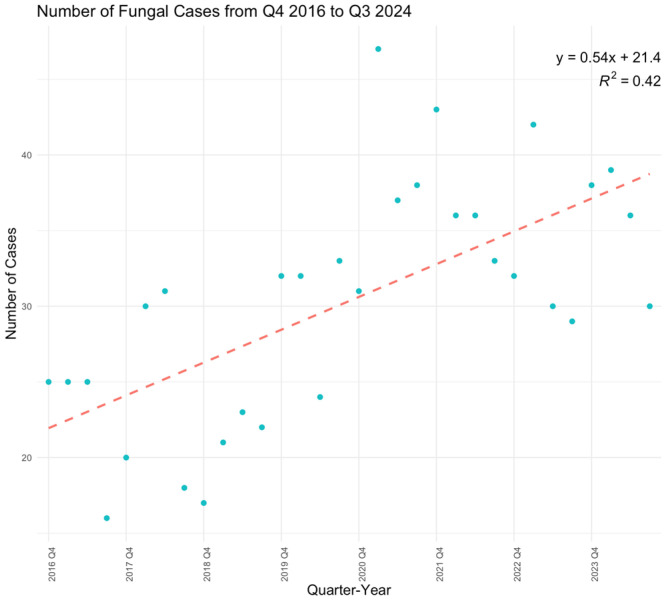
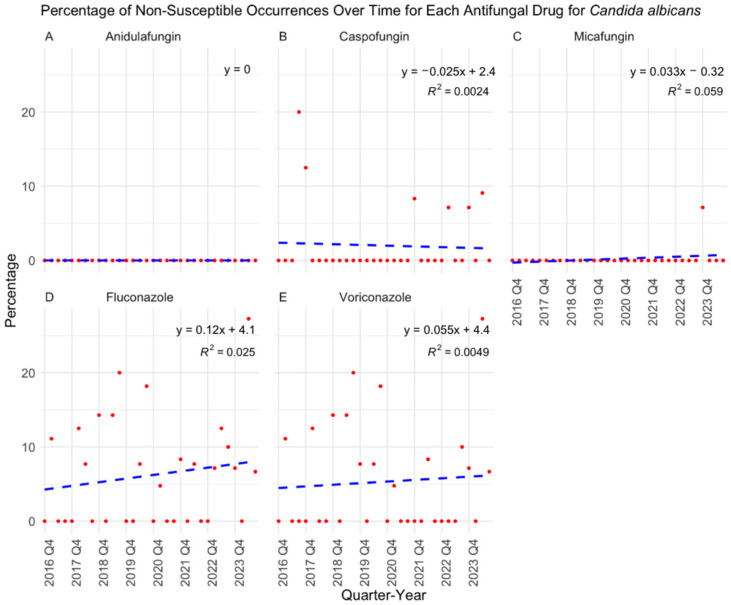
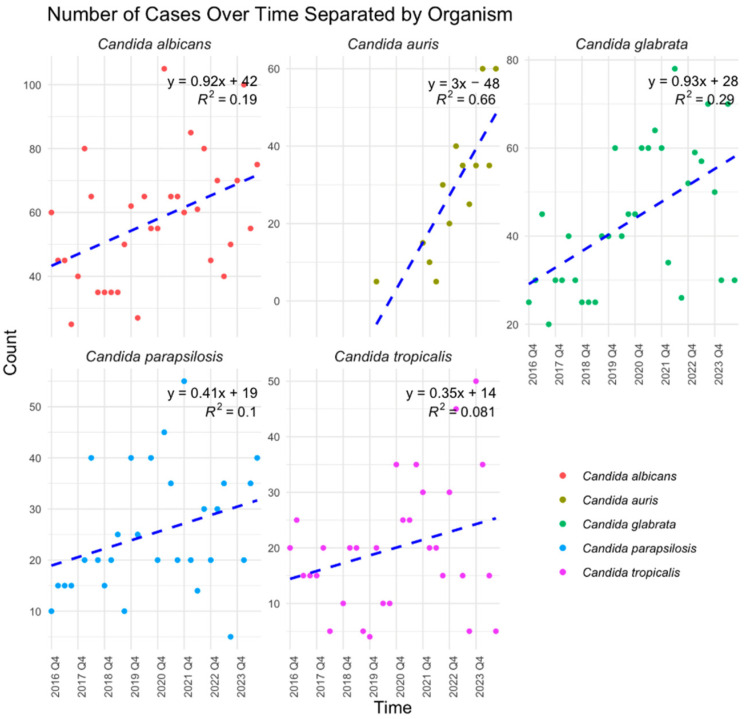
Fungal systemic infections are a growing global health concern, particularly among immunocompromised individuals. Candida species are the leading cause of invasive fungal infections, with C. albicans historically being the most prevalent. The emergence of C. auris, known for its multidrug resistance, presents additional challenges for treatment and infection control. This study retrospectively analyzed minimal inhibitory concentration (MIC) data for common Candida species isolated from patients in the Galveston-Houston Gulf Coast region from the EPIC Laboratory Information System (LIS) between October 2016 and September 2024. Antifungal susceptibility was assessed using the SensititreTM YeastOneTM YO9 AST Plate and interpreted per Clinical and Laboratory Standard Institute (CLSI) guidelines. A total of 1206 clinical yeast isolates from over 29 species were identified, with Candida species accounting for 94.5% (1140). C. albicans (30.7%), C. glabrata (23.5%), C. parapsilosis (12.2%), and C. tropicalis (10.4%) were the most prevalent. C. auris (6.2%) emerged in late 2021 in our region, showing high MICs against fluconazole (92%) and amphotericin B (32.2%). While C. albicans, C. parapsilosis, and C. tropicalis remained susceptible to echinocandins, fluconazole resistance showed an increasing trend. C. glabrata exhibited variable susceptibility to both echinocandins and azoles. These findings highlight the urgent need for enhanced antifungal stewardship, improved diagnostics, and novel therapeutic strategies. Continued regional surveillance and targeted interventions are essential to mitigating the impact of antifungal resistance.
期刊介绍:
Journal of Fungi (ISSN 2309-608X) is an international, peer-reviewed scientific open access journal that provides an advanced forum for studies related to pathogenic fungi, fungal biology, and all other aspects of fungal research. The journal publishes reviews, regular research papers, and communications in quarterly issues. Our aim is to encourage scientists to publish their experimental and theoretical results in as much detail as possible. Therefore, there is no restriction on paper length. Full experimental details must be provided so that the results can be reproduced.



 京公网安备 11010802042870号
京ICP备2023020795号-1
京公网安备 11010802042870号
京ICP备2023020795号-1

 分享
分享
 求助内容:
求助内容: 应助结果提醒方式:
 扫码关注我们
