Erika Sireni Rodríguez-Martínez, Claudio Rios-Velasco, David Roberto Sepúlveda-Ahumada, José Juan Buenrostro-Figueroa, Kamila C Correia, César Guigón-López, Mónica Alvarado-González
{"title":"<i>Trichoderma</i> Species from Semiarid Regions and Their Antagonism Against the Microorganisms That Cause Pepper Wilt.","authors":"Erika Sireni Rodríguez-Martínez, Claudio Rios-Velasco, David Roberto Sepúlveda-Ahumada, José Juan Buenrostro-Figueroa, Kamila C Correia, César Guigón-López, Mónica Alvarado-González","doi":"10.3390/jof11030174","DOIUrl":null,"url":null,"abstract":"<p><p>Chili wilt is a significant challenge in producing jalapeño peppers, which has led to the implementation of strategies to help counteract or combat the microorganisms responsible for it. One of these strategies is the use of biological control microorganisms, such as <i>Trichoderma</i>, a fungus recognized as a natural enemy of the microorganisms that cause chili wilt. Therefore, this study aimed to isolate and identify <i>Trichoderma</i> species from the soils and roots of different plants, and evaluate their antagonism against <i>Rhizoctonia solani</i>, <i>Phytophthora capsici</i>, and <i>Fusarium</i> sp. Due to the complexity in identifying <i>Trichoderma</i> at the species level, performing a multilocus phylogenetic analysis was necessary, using the ITS, RPB2, and TEF1 regions. The species isolated were <i>T. afroharzianum</i>, <i>T. lentiforme</i>, <i>T. rifaii</i>, <i>T. brevicompactum</i>, <i>T. arundinaceum</i>, and <i>T. longibrachiatum</i>. Subsequently, they were used in three antagonism tests (dual culture, non-volatile organic compounds, and volatile organic compounds) against the phytopathogenic microorganisms. The tests demonstrated that the <i>Trichoderma</i> isolates could inhibit the mycelial growth of all three tested pathogens, obtaining the best results with the strains <i>T. brevicompactum</i> (19RCS), <i>T. lentiforme</i> (63DPS), <i>T. longibrachiatum</i> (71JES), <i>T. rifaii</i> (77JCR), and <i>T. afroharzianum</i> (24RQS, 87CCS, 88CCS and 17RCS). The strain with the best results in all three tests was 17RCS.</p>","PeriodicalId":15878,"journal":{"name":"Journal of Fungi","volume":"11 3","pages":""},"PeriodicalIF":4.2000,"publicationDate":"2025-02-21","publicationTypes":"Journal Article","fieldsOfStudy":null,"isOpenAccess":false,"openAccessPdf":"https://www.ncbi.nlm.nih.gov/pmc/articles/PMC11942951/pdf/","citationCount":"0","resultStr":null,"platform":"Semanticscholar","paperid":null,"PeriodicalName":"Journal of Fungi","FirstCategoryId":"99","ListUrlMain":"https://doi.org/10.3390/jof11030174","RegionNum":2,"RegionCategory":"生物学","ArticlePicture":[],"TitleCN":null,"AbstractTextCN":null,"PMCID":null,"EPubDate":"","PubModel":"","JCR":"Q2","JCRName":"MICROBIOLOGY","Score":null,"Total":0}
引用次数: 0
Abstract
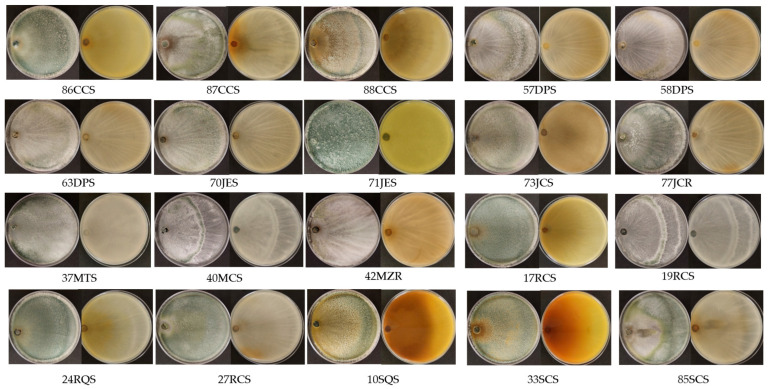
Chili wilt is a significant challenge in producing jalapeño peppers, which has led to the implementation of strategies to help counteract or combat the microorganisms responsible for it. One of these strategies is the use of biological control microorganisms, such as Trichoderma, a fungus recognized as a natural enemy of the microorganisms that cause chili wilt. Therefore, this study aimed to isolate and identify Trichoderma species from the soils and roots of different plants, and evaluate their antagonism against Rhizoctonia solani, Phytophthora capsici, and Fusarium sp. Due to the complexity in identifying Trichoderma at the species level, performing a multilocus phylogenetic analysis was necessary, using the ITS, RPB2, and TEF1 regions. The species isolated were T. afroharzianum, T. lentiforme, T. rifaii, T. brevicompactum, T. arundinaceum, and T. longibrachiatum. Subsequently, they were used in three antagonism tests (dual culture, non-volatile organic compounds, and volatile organic compounds) against the phytopathogenic microorganisms. The tests demonstrated that the Trichoderma isolates could inhibit the mycelial growth of all three tested pathogens, obtaining the best results with the strains T. brevicompactum (19RCS), T. lentiforme (63DPS), T. longibrachiatum (71JES), T. rifaii (77JCR), and T. afroharzianum (24RQS, 87CCS, 88CCS and 17RCS). The strain with the best results in all three tests was 17RCS.
期刊介绍:
Journal of Fungi (ISSN 2309-608X) is an international, peer-reviewed scientific open access journal that provides an advanced forum for studies related to pathogenic fungi, fungal biology, and all other aspects of fungal research. The journal publishes reviews, regular research papers, and communications in quarterly issues. Our aim is to encourage scientists to publish their experimental and theoretical results in as much detail as possible. Therefore, there is no restriction on paper length. Full experimental details must be provided so that the results can be reproduced.




 京公网安备 11010802042870号
京ICP备2023020795号-1
京公网安备 11010802042870号
京ICP备2023020795号-1

 分享
分享
 求助内容:
求助内容: 应助结果提醒方式:
 扫码关注我们
