Ke Liao, Jiayi Yu, Akbarshakh Akhmerov, Zahra Mohammadigoldar, Liang Li, Weixin Liu, Natasha Anders, Ahmed Ge Ibrahim, Eduardo Marbán
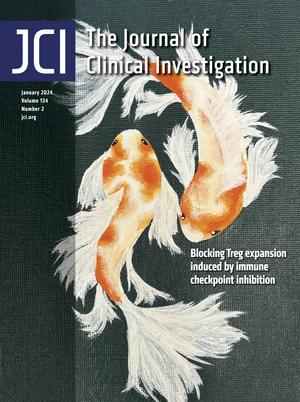
{"title":"Long noncoding RNA BCYRN1 promotes cardioprotection by enhancing human and murine regulatory T cell dynamics.","authors":"Ke Liao, Jiayi Yu, Akbarshakh Akhmerov, Zahra Mohammadigoldar, Liang Li, Weixin Liu, Natasha Anders, Ahmed Ge Ibrahim, Eduardo Marbán","doi":"10.1172/JCI179262","DOIUrl":null,"url":null,"abstract":"<p><p>Regulatory T cells (Tregs) modulate immune responses and attenuate inflammation. Extracellular vesicles from human cardiosphere-derived cells (CDC-EVs) enhance Treg proliferation and IL-10 production, but the mechanisms remain unclear. Here, we focused on BCYRN1, a long noncoding RNA (lncRNA) highly abundant in CDC-EVs, and its role in Treg function. BCYRN1 acts as a \"microRNA sponge,\" inhibiting miR-138, miR-150, and miR-98. Suppression of these miRs leads to increased Treg proliferation via ATG7-dependent autophagy, CCR6-dependent Treg migration, and enhanced Treg IL-10 production. In a mouse model of myocardial infarction, CDC-EVs, particularly those overexpressing BCYRN1, were cardioprotective, reducing infarct size and troponin I levels even when administered after reperfusion. Underlying the cardioprotection, we verified that CDC-EVs overexpressing BCYRN1 increased cardiac Treg infiltration, proliferation, and IL-10 production in vivo. These salutary effects were negated when BCYRN1 levels were reduced in CDC-EVs or when Tregs were depleted systemically. Thus, we have identified BCYRN1 as a booster of Treg number and bioactivity, rationalizing its cardioprotective efficacy. While we studied BCYRN1 overexpression in the context of ischemic injury here, the same approach merits testing in other disease processes (e.g., autoimmunity or transplant rejection) where increased Treg activity is a recognized therapeutic goal.</p>","PeriodicalId":15469,"journal":{"name":"Journal of Clinical Investigation","volume":" ","pages":""},"PeriodicalIF":13.6000,"publicationDate":"2025-03-25","publicationTypes":"Journal Article","fieldsOfStudy":null,"isOpenAccess":false,"openAccessPdf":"https://www.ncbi.nlm.nih.gov/pmc/articles/PMC12043100/pdf/","citationCount":"0","resultStr":null,"platform":"Semanticscholar","paperid":null,"PeriodicalName":"Journal of Clinical Investigation","FirstCategoryId":"3","ListUrlMain":"https://doi.org/10.1172/JCI179262","RegionNum":1,"RegionCategory":"医学","ArticlePicture":[],"TitleCN":null,"AbstractTextCN":null,"PMCID":null,"EPubDate":"2025/5/1 0:00:00","PubModel":"eCollection","JCR":"Q1","JCRName":"MEDICINE, RESEARCH & EXPERIMENTAL","Score":null,"Total":0}
引用次数: 0
Abstract
Regulatory T cells (Tregs) modulate immune responses and attenuate inflammation. Extracellular vesicles from human cardiosphere-derived cells (CDC-EVs) enhance Treg proliferation and IL-10 production, but the mechanisms remain unclear. Here, we focused on BCYRN1, a long noncoding RNA (lncRNA) highly abundant in CDC-EVs, and its role in Treg function. BCYRN1 acts as a "microRNA sponge," inhibiting miR-138, miR-150, and miR-98. Suppression of these miRs leads to increased Treg proliferation via ATG7-dependent autophagy, CCR6-dependent Treg migration, and enhanced Treg IL-10 production. In a mouse model of myocardial infarction, CDC-EVs, particularly those overexpressing BCYRN1, were cardioprotective, reducing infarct size and troponin I levels even when administered after reperfusion. Underlying the cardioprotection, we verified that CDC-EVs overexpressing BCYRN1 increased cardiac Treg infiltration, proliferation, and IL-10 production in vivo. These salutary effects were negated when BCYRN1 levels were reduced in CDC-EVs or when Tregs were depleted systemically. Thus, we have identified BCYRN1 as a booster of Treg number and bioactivity, rationalizing its cardioprotective efficacy. While we studied BCYRN1 overexpression in the context of ischemic injury here, the same approach merits testing in other disease processes (e.g., autoimmunity or transplant rejection) where increased Treg activity is a recognized therapeutic goal.
期刊介绍:
The Journal of Clinical Investigation, established in 1924 by the ASCI, is a prestigious publication that focuses on breakthroughs in basic and clinical biomedical science, with the goal of advancing the field of medicine. With an impressive Impact Factor of 15.9 in 2022, it is recognized as one of the leading journals in the "Medicine, Research & Experimental" category of the Web of Science.
The journal attracts a diverse readership from various medical disciplines and sectors. It publishes a wide range of research articles encompassing all biomedical specialties, including Autoimmunity, Gastroenterology, Immunology, Metabolism, Nephrology, Neuroscience, Oncology, Pulmonology, Vascular Biology, and many others.
The Editorial Board consists of esteemed academic editors who possess extensive expertise in their respective fields. They are actively involved in research, ensuring the journal's high standards of publication and scientific rigor.



 京公网安备 11010802042870号
京ICP备2023020795号-1
京公网安备 11010802042870号
京ICP备2023020795号-1

 分享
分享
 求助内容:
求助内容: 应助结果提醒方式:
 扫码关注我们
