Alessandre Carvalho Junior, Adriane Maria Netto de Oliveira, Camila Daiane Silva, Diéssica Roggia Piexak
{"title":"Spiritual care in the intensive care unit. Is it already a reality?: an integrative review.","authors":"Alessandre Carvalho Junior, Adriane Maria Netto de Oliveira, Camila Daiane Silva, Diéssica Roggia Piexak","doi":"10.31744/einstein_journal/2025RW1081","DOIUrl":null,"url":null,"abstract":"<p><strong>Introduction: </strong>Spirituality has emerged as a phenomenon of interest in various global contexts. The adoption of spirituality as a fundamental aspect of healthcare remains underexplored, especially in critical environments such as intensive care units.</p><p><strong>Objective: </strong>To identify strategies for incorporating spiritual care into adult intensive care environments through an integrative literature review.</p><p><strong>Methods: </strong>An integrative review was conducted using the Embase, Web of Science, Medline/PubMed, PsycINFO, LILACS, and Cochrane Central databases. Twenty-one studies published in English, Spanish, or Portuguese over the last 10 years were selected.</p><p><strong>Results: </strong>Different approaches to spirituality were identified, including training implementation, individual interviews, meetings, educational programs, and practices involving healthcare professionals.</p><p><strong>Conclusion: </strong>Spirituality in the intensive care environment has been a growing reality in recent years through efforts aimed at helping healthcare professionals integrate spirituality into the care provided in clinical practice. Individual interviews were the primary strategy for incorporating spiritual care in intensive care unit settings. Questionnaires were used to support these interviews, and the frequency and duration typically involved a single session, ranging from 15 to 60 min.</p>","PeriodicalId":47359,"journal":{"name":"Einstein-Sao Paulo","volume":"23 spe1","pages":"eRW1081"},"PeriodicalIF":0.9000,"publicationDate":"2025-03-24","publicationTypes":"Journal Article","fieldsOfStudy":null,"isOpenAccess":false,"openAccessPdf":"https://www.ncbi.nlm.nih.gov/pmc/articles/PMC11999060/pdf/","citationCount":"0","resultStr":null,"platform":"Semanticscholar","paperid":null,"PeriodicalName":"Einstein-Sao Paulo","FirstCategoryId":"1085","ListUrlMain":"https://doi.org/10.31744/einstein_journal/2025RW1081","RegionNum":0,"RegionCategory":null,"ArticlePicture":[],"TitleCN":null,"AbstractTextCN":null,"PMCID":null,"EPubDate":"2025/1/1 0:00:00","PubModel":"eCollection","JCR":"Q2","JCRName":"MEDICINE, GENERAL & INTERNAL","Score":null,"Total":0}
引用次数: 0
Abstract
Introduction: Spirituality has emerged as a phenomenon of interest in various global contexts. The adoption of spirituality as a fundamental aspect of healthcare remains underexplored, especially in critical environments such as intensive care units.
Objective: To identify strategies for incorporating spiritual care into adult intensive care environments through an integrative literature review.
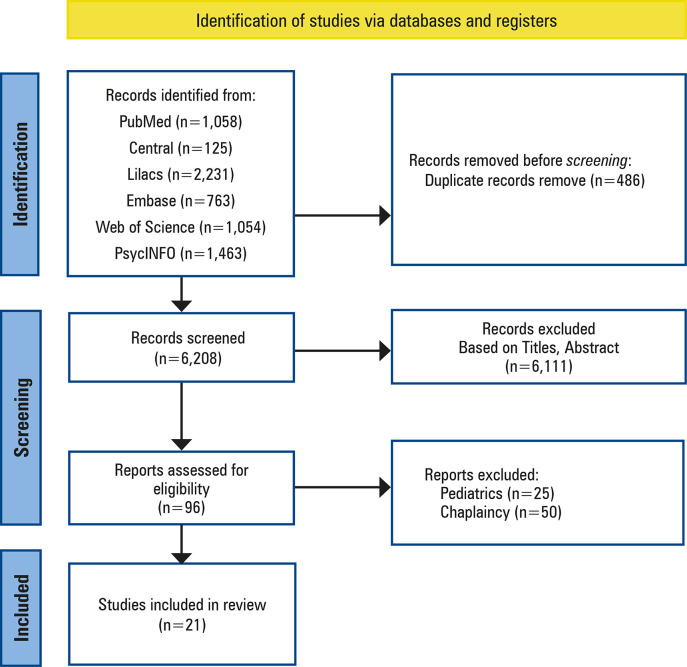
Methods: An integrative review was conducted using the Embase, Web of Science, Medline/PubMed, PsycINFO, LILACS, and Cochrane Central databases. Twenty-one studies published in English, Spanish, or Portuguese over the last 10 years were selected.
Results: Different approaches to spirituality were identified, including training implementation, individual interviews, meetings, educational programs, and practices involving healthcare professionals.
Conclusion: Spirituality in the intensive care environment has been a growing reality in recent years through efforts aimed at helping healthcare professionals integrate spirituality into the care provided in clinical practice. Individual interviews were the primary strategy for incorporating spiritual care in intensive care unit settings. Questionnaires were used to support these interviews, and the frequency and duration typically involved a single session, ranging from 15 to 60 min.
导言:灵性已经成为全球各种背景下的一种有趣现象。采用灵性作为医疗保健的一个基本方面仍未得到充分探索,特别是在重症监护病房等关键环境中。目的:通过综合文献综述,确定将精神护理纳入成人重症监护环境的策略。方法:采用Embase、Web of Science、Medline/PubMed、PsycINFO、LILACS和Cochrane Central数据库进行综合评价。选取了过去10年里用英语、西班牙语或葡萄牙语发表的21项研究。结果:确定了不同的灵性方法,包括培训实施,个人访谈,会议,教育计划和涉及医疗保健专业人员的实践。结论:近年来,通过旨在帮助医疗保健专业人员将灵性融入临床实践中提供的护理的努力,灵性在重症监护环境中已经成为一个日益增长的现实。个人访谈是将精神护理纳入重症监护病房设置的主要策略。调查问卷被用来支持这些访谈,频率和持续时间通常包括一个单独的会话,从15到60分钟不等。




 京公网安备 11010802042870号
京ICP备2023020795号-1
京公网安备 11010802042870号
京ICP备2023020795号-1

 分享
分享
 求助内容:
求助内容: 应助结果提醒方式:
 扫码关注我们
