Vittorio Ivagnes, Elena De Carolis, Carlotta Magrì, Riccardo Torelli, Brunella Posteraro, Maurizio Sanguinetti
{"title":"Advancing Dermatomycosis Diagnosis: Evaluating a Microarray-Based Platform for Rapid and Accurate Fungal Detection-A Pilot Study.","authors":"Vittorio Ivagnes, Elena De Carolis, Carlotta Magrì, Riccardo Torelli, Brunella Posteraro, Maurizio Sanguinetti","doi":"10.3390/jof11030234","DOIUrl":null,"url":null,"abstract":"<p><p>Dermatomycosis, including the most prevalent onychomycosis, significantly impacts patients' quality of life due to its chronic nature and high recurrence rate. Conventional diagnostic methods are often limited by low sensitivity and specificity and prolonged turnaround times. This study evaluates the EUROArray Dermatomycosis Platform, a microarray-based molecular assay, for its performance in identifying fungi causing dermatomycosis. Forty reference fungal strains, covering on-panel and off-panel species, and 120 clinical samples from patients with suspected dermatomycosis were analyzed. The platform's accuracy was compared to microscopy and/or culture as the diagnostic standard. The assay demonstrated 100% analytical sensitivity and 97.1% analytical specificity, correctly identifying 33 of 34 fungal species while misclassifying one. In clinical samples, the assay showed good sensitivity (78.6%) and high specificity (91.7%), detecting additional positive cases missed by culture, which highlights the assay's ability to identify non-viable fungi and low fungal loads. The assay achieved a positive predictive value of 75.9% and a negative predictive value of 92.8%, reinforcing its diagnostic reliability. Despite some discordances, the assay provides rapid results and broad-spectrum fungal detection, positioning it as a valuable complement to conventional diagnostics. Future improvements, including expanding the identification panel and optimizing sample handling, could further enhance its clinical utility.</p>","PeriodicalId":15878,"journal":{"name":"Journal of Fungi","volume":"11 3","pages":""},"PeriodicalIF":4.2000,"publicationDate":"2025-03-19","publicationTypes":"Journal Article","fieldsOfStudy":null,"isOpenAccess":false,"openAccessPdf":"https://www.ncbi.nlm.nih.gov/pmc/articles/PMC11943213/pdf/","citationCount":"0","resultStr":null,"platform":"Semanticscholar","paperid":null,"PeriodicalName":"Journal of Fungi","FirstCategoryId":"99","ListUrlMain":"https://doi.org/10.3390/jof11030234","RegionNum":2,"RegionCategory":"生物学","ArticlePicture":[],"TitleCN":null,"AbstractTextCN":null,"PMCID":null,"EPubDate":"","PubModel":"","JCR":"Q2","JCRName":"MICROBIOLOGY","Score":null,"Total":0}
引用次数: 0
Abstract
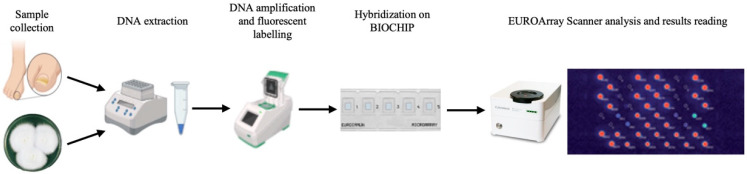
Dermatomycosis, including the most prevalent onychomycosis, significantly impacts patients' quality of life due to its chronic nature and high recurrence rate. Conventional diagnostic methods are often limited by low sensitivity and specificity and prolonged turnaround times. This study evaluates the EUROArray Dermatomycosis Platform, a microarray-based molecular assay, for its performance in identifying fungi causing dermatomycosis. Forty reference fungal strains, covering on-panel and off-panel species, and 120 clinical samples from patients with suspected dermatomycosis were analyzed. The platform's accuracy was compared to microscopy and/or culture as the diagnostic standard. The assay demonstrated 100% analytical sensitivity and 97.1% analytical specificity, correctly identifying 33 of 34 fungal species while misclassifying one. In clinical samples, the assay showed good sensitivity (78.6%) and high specificity (91.7%), detecting additional positive cases missed by culture, which highlights the assay's ability to identify non-viable fungi and low fungal loads. The assay achieved a positive predictive value of 75.9% and a negative predictive value of 92.8%, reinforcing its diagnostic reliability. Despite some discordances, the assay provides rapid results and broad-spectrum fungal detection, positioning it as a valuable complement to conventional diagnostics. Future improvements, including expanding the identification panel and optimizing sample handling, could further enhance its clinical utility.
期刊介绍:
Journal of Fungi (ISSN 2309-608X) is an international, peer-reviewed scientific open access journal that provides an advanced forum for studies related to pathogenic fungi, fungal biology, and all other aspects of fungal research. The journal publishes reviews, regular research papers, and communications in quarterly issues. Our aim is to encourage scientists to publish their experimental and theoretical results in as much detail as possible. Therefore, there is no restriction on paper length. Full experimental details must be provided so that the results can be reproduced.



 京公网安备 11010802042870号
京ICP备2023020795号-1
京公网安备 11010802042870号
京ICP备2023020795号-1

 分享
分享
 求助内容:
求助内容: 应助结果提醒方式:
 扫码关注我们
