Christopher W. Seder MD , Shu-Ching Chang PhD , Christopher W. Towe MD , Varun Puri MD , Justin D. Blasberg MD , Levi Bonnell PhD , Felix G. Fernandez MD , Robert H. Habib PhD , Benjamin D. Kozower MD, MPH
{"title":"Anatomic Lung Resection Is Associated With Improved Survival Compared With Wedge Resection for Stage IA (≤2 cm) NSCLC","authors":"Christopher W. Seder MD , Shu-Ching Chang PhD , Christopher W. Towe MD , Varun Puri MD , Justin D. Blasberg MD , Levi Bonnell PhD , Felix G. Fernandez MD , Robert H. Habib PhD , Benjamin D. Kozower MD, MPH","doi":"10.1016/j.jtho.2025.03.042","DOIUrl":null,"url":null,"abstract":"<div><h3>Introduction</h3><div>Given the uncertain generalizability of recent clinical trial data, a comparative effectiveness analysis evaluating the long-term survival of “real world” patients may clarify the role of lobectomy and sublobar resection (segmentectomy or wedge resection) in the treatment of early stage NSCLC.</div></div><div><h3>Methods</h3><div>Adult patients undergoing lung resection for clinical stage IA NSCLC (≤2 cm) between 2012 and 2022 were identified from the Society of Thoracic Surgeons General Thoracic Surgery Database. Long-term vital status was determined by linkage to the National Death Index and Centers for Medicare & Medicaid Services inpatient data. The primary end point was overall survival (OS); secondary end points included lung cancer-specific survival (LCSS). Stabilized inverse probability weighted Cox regression was used to account for selection bias and derive hazard ratios (HRs) with 95% confidence intervals comparing the lobectomy, segmentectomy, and wedge resection cohorts.</div></div><div><h3>Results</h3><div>Overall, 32,340 patients with stage IA NSCLC (19,778 lobectomies [OS = 71.9% (5 y), 44.8% (10 y)], 4279 segmentectomies [OS = 69.6%, 44.2%], and 8283 wedge resections [OS = 66.3%, 41.4%]) were evaluated. After risk adjustment, lobectomy was associated with improved OS and LCSS compared with sublobar resection (HR [OS] = 0.87 [0.83–0.92]; HR [LCSS] = 0.84 [0.73–0.97]). Both lobectomy (HR [OS] = 0.84 [0.80–0.88]; HR [LCSS] = 0.72 [0.56–0.93]) and segmentectomy (HR [OS] = 0.88 [0.81–0.95]; HR [LCSS] = 0.77 [0.66–0.89]) were associated with improved survival compared with wedge resection. No differences in OS or LCSS were observed between lobectomy and segmentectomy.</div></div><div><h3>Conclusion</h3><div>In routine clinical practice, lobectomy and segmentectomy are associated with improved OS and LCSS compared with wedge resection for stage IA NSCLC (≤2 cm). These findings highlight the potential gap between trial efficacy and real-world effectiveness.</div></div>","PeriodicalId":17515,"journal":{"name":"Journal of Thoracic Oncology","volume":"20 8","pages":"Pages 1075-1085"},"PeriodicalIF":20.8000,"publicationDate":"2025-08-01","publicationTypes":"Journal Article","fieldsOfStudy":null,"isOpenAccess":false,"openAccessPdf":"","citationCount":"0","resultStr":null,"platform":"Semanticscholar","paperid":null,"PeriodicalName":"Journal of Thoracic Oncology","FirstCategoryId":"3","ListUrlMain":"https://www.sciencedirect.com/science/article/pii/S1556086425006410","RegionNum":1,"RegionCategory":"医学","ArticlePicture":[],"TitleCN":null,"AbstractTextCN":null,"PMCID":null,"EPubDate":"2025/3/23 0:00:00","PubModel":"Epub","JCR":"Q1","JCRName":"ONCOLOGY","Score":null,"Total":0}
引用次数: 0
Abstract
Introduction
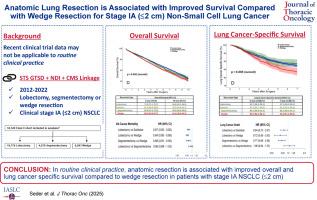
Given the uncertain generalizability of recent clinical trial data, a comparative effectiveness analysis evaluating the long-term survival of “real world” patients may clarify the role of lobectomy and sublobar resection (segmentectomy or wedge resection) in the treatment of early stage NSCLC.
Methods
Adult patients undergoing lung resection for clinical stage IA NSCLC (≤2 cm) between 2012 and 2022 were identified from the Society of Thoracic Surgeons General Thoracic Surgery Database. Long-term vital status was determined by linkage to the National Death Index and Centers for Medicare & Medicaid Services inpatient data. The primary end point was overall survival (OS); secondary end points included lung cancer-specific survival (LCSS). Stabilized inverse probability weighted Cox regression was used to account for selection bias and derive hazard ratios (HRs) with 95% confidence intervals comparing the lobectomy, segmentectomy, and wedge resection cohorts.
Results
Overall, 32,340 patients with stage IA NSCLC (19,778 lobectomies [OS = 71.9% (5 y), 44.8% (10 y)], 4279 segmentectomies [OS = 69.6%, 44.2%], and 8283 wedge resections [OS = 66.3%, 41.4%]) were evaluated. After risk adjustment, lobectomy was associated with improved OS and LCSS compared with sublobar resection (HR [OS] = 0.87 [0.83–0.92]; HR [LCSS] = 0.84 [0.73–0.97]). Both lobectomy (HR [OS] = 0.84 [0.80–0.88]; HR [LCSS] = 0.72 [0.56–0.93]) and segmentectomy (HR [OS] = 0.88 [0.81–0.95]; HR [LCSS] = 0.77 [0.66–0.89]) were associated with improved survival compared with wedge resection. No differences in OS or LCSS were observed between lobectomy and segmentectomy.
Conclusion
In routine clinical practice, lobectomy and segmentectomy are associated with improved OS and LCSS compared with wedge resection for stage IA NSCLC (≤2 cm). These findings highlight the potential gap between trial efficacy and real-world effectiveness.
期刊介绍:
Journal of Thoracic Oncology (JTO), the official journal of the International Association for the Study of Lung Cancer,is the primary educational and informational publication for topics relevant to the prevention, detection, diagnosis, and treatment of all thoracic malignancies.The readship includes epidemiologists, medical oncologists, radiation oncologists, thoracic surgeons, pulmonologists, radiologists, pathologists, nuclear medicine physicians, and research scientists with a special interest in thoracic oncology.




 京公网安备 11010802042870号
京ICP备2023020795号-1
京公网安备 11010802042870号
京ICP备2023020795号-1

 分享
分享
 求助内容:
求助内容: 应助结果提醒方式:
 扫码关注我们
