2024 Royal Australian College of General Practitioners and Healthy Bones Australia guideline for osteoporosis management and fracture prevention in postmenopausal women and men over 50 years of age
Peter Wong, Weiwen Chen, Dan Ewald, Christian Girgis, Morton Rawlin, John Tsingos, Justine Waters
{"title":"2024 Royal Australian College of General Practitioners and Healthy Bones Australia guideline for osteoporosis management and fracture prevention in postmenopausal women and men over 50 years of age","authors":"Peter Wong, Weiwen Chen, Dan Ewald, Christian Girgis, Morton Rawlin, John Tsingos, Justine Waters","doi":"10.5694/mja2.52637","DOIUrl":null,"url":null,"abstract":"<div>\n \n \n <section>\n \n <h3> Introduction</h3>\n \n <p>This updated guideline replaces the previous Royal Australian College of General Practitioners and Osteoporosis Australia (now, Healthy Bones Australia) guideline from 2017. The accumulation of high quality evidence supporting improvements in clinical practice over the past five years, need for expert consensus and opinion, and new developments in pharmacological management of osteoporosis, especially the role of osteoanabolic therapies, prompted this update. The aim was to provide clear, evidence-based recommendations to assist Australian general practitioners in managing patients over 50 years of age with poor bone health. However, it is useful for any health care professional caring for people with poor bone health and for health administrators and bureaucrats responsible for resource provision and allocation.</p>\n </section>\n \n <section>\n \n <h3> Main recommendations</h3>\n \n <div>\n \n <ul>\n \n \n <li>Earlier recognition of poor bone health using clinical risk factors, and use of an absolute fracture risk assessment tool, particularly FRAX (https://fraxplus.org/), is encouraged.</li>\n \n \n <li>Widespread population-based osteoporosis screening is not recommended in Australia due to lack of supporting evidence.</li>\n \n \n <li>It is important to recognise patients with “imminent” or “very high” fracture risk, as this is a group in whom to consider early osteoanabolic therapy.</li>\n \n \n <li>Calcium and vitamin D supplementation are more effective in reducing fracture risk when given to individuals who have calcium and vitamin D deficiency (not to healthy non-institutionalised individuals).</li>\n </ul>\n </div>\n </section>\n \n <section>\n \n <h3> Changes in assessment and management as a result of the guideline</h3>\n \n <p>This guideline provides recommendations for the use of fracture risk assessment tools, particularly FRAX, for risk stratification, addresses the risk of rebound vertebral fracture following denosumab cessation, discusses removal of strontium as a therapy, clarifies “imminent” or “very high” fracture risk in patients and highlights the importance of calcium and vitamin D status, and the early use of osteoanabolic therapies. The full guideline is freely available at https://www.racgp.org.au/clinical-resources/clinical-guidelines/key-racgp-guidelines/view-all-racgp-guidelines/osteoporosis/executive-summary.</p>\n </section>\n </div>","PeriodicalId":18214,"journal":{"name":"Medical Journal of Australia","volume":"222 9","pages":"472-480"},"PeriodicalIF":8.5000,"publicationDate":"2025-03-25","publicationTypes":"Journal Article","fieldsOfStudy":null,"isOpenAccess":false,"openAccessPdf":"https://onlinelibrary.wiley.com/doi/epdf/10.5694/mja2.52637","citationCount":"0","resultStr":null,"platform":"Semanticscholar","paperid":null,"PeriodicalName":"Medical Journal of Australia","FirstCategoryId":"3","ListUrlMain":"https://onlinelibrary.wiley.com/doi/10.5694/mja2.52637","RegionNum":2,"RegionCategory":"医学","ArticlePicture":[],"TitleCN":null,"AbstractTextCN":null,"PMCID":null,"EPubDate":"","PubModel":"","JCR":"Q1","JCRName":"MEDICINE, GENERAL & INTERNAL","Score":null,"Total":0}
引用次数: 0
Abstract
Introduction
This updated guideline replaces the previous Royal Australian College of General Practitioners and Osteoporosis Australia (now, Healthy Bones Australia) guideline from 2017. The accumulation of high quality evidence supporting improvements in clinical practice over the past five years, need for expert consensus and opinion, and new developments in pharmacological management of osteoporosis, especially the role of osteoanabolic therapies, prompted this update. The aim was to provide clear, evidence-based recommendations to assist Australian general practitioners in managing patients over 50 years of age with poor bone health. However, it is useful for any health care professional caring for people with poor bone health and for health administrators and bureaucrats responsible for resource provision and allocation.
Main recommendations
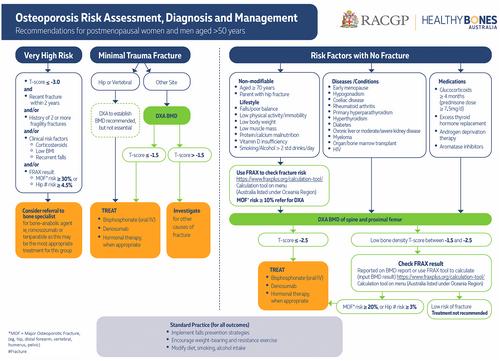
Earlier recognition of poor bone health using clinical risk factors, and use of an absolute fracture risk assessment tool, particularly FRAX (https://fraxplus.org/), is encouraged.
Widespread population-based osteoporosis screening is not recommended in Australia due to lack of supporting evidence.
It is important to recognise patients with “imminent” or “very high” fracture risk, as this is a group in whom to consider early osteoanabolic therapy.
Calcium and vitamin D supplementation are more effective in reducing fracture risk when given to individuals who have calcium and vitamin D deficiency (not to healthy non-institutionalised individuals).
Changes in assessment and management as a result of the guideline
This guideline provides recommendations for the use of fracture risk assessment tools, particularly FRAX, for risk stratification, addresses the risk of rebound vertebral fracture following denosumab cessation, discusses removal of strontium as a therapy, clarifies “imminent” or “very high” fracture risk in patients and highlights the importance of calcium and vitamin D status, and the early use of osteoanabolic therapies. The full guideline is freely available at https://www.racgp.org.au/clinical-resources/clinical-guidelines/key-racgp-guidelines/view-all-racgp-guidelines/osteoporosis/executive-summary.
期刊介绍:
The Medical Journal of Australia (MJA) stands as Australia's foremost general medical journal, leading the dissemination of high-quality research and commentary to shape health policy and influence medical practices within the country. Under the leadership of Professor Virginia Barbour, the expert editorial team at MJA is dedicated to providing authors with a constructive and collaborative peer-review and publication process. Established in 1914, the MJA has evolved into a modern journal that upholds its founding values, maintaining a commitment to supporting the medical profession by delivering high-quality and pertinent information essential to medical practice.



 京公网安备 11010802042870号
京ICP备2023020795号-1
京公网安备 11010802042870号
京ICP备2023020795号-1

 分享
分享
 求助内容:
求助内容: 应助结果提醒方式:
 扫码关注我们
