Soham Bandyopadhyay, Ben Gaastra, Ardalan Zolnourian, Patrick Garland, Chieh-Hsi Wu, Ian Galea, Diederik Bulters
{"title":"Distinct Cytokine Responses in Central and Systemic Compartments after Subarachnoid Haemorrhage.","authors":"Soham Bandyopadhyay, Ben Gaastra, Ardalan Zolnourian, Patrick Garland, Chieh-Hsi Wu, Ian Galea, Diederik Bulters","doi":"10.1007/s12975-025-01348-y","DOIUrl":null,"url":null,"abstract":"<p><strong>Introduction: </strong>Neuroinflammation may contribute to outcomes following subarachnoid haemorrhage (SAH). Human cerebrospinal fluid (CSF) cytokine data is limited and its relationship with systemic inflammation is unknown. This study compares the inflammatory responses in CSF and plasma compartments, and their associations with outcome.</p><p><strong>Methods: </strong>Ten cytokines were measured in CSF and plasma from 98 SAH patients and 18 control patients. Outcome was assessed with the modified Rankin scale (mRS) and Subarachnoid Haemorrhage Outcome Tool (SAHOT) at days 7, 28, 90 and 180. Regression analyses and principal component analysis (PCA) were performed.</p><p><strong>Results: </strong>Median levels of all CSF cytokines and plasma IL-6 were higher in SAH patients than controls (p < 0.001). Plasma IL-6 peaked earlier (3 days after SAH) than CSF cytokines (7-9 days after SAH). On day 7, CSF levels were greater than plasma levels for all cytokines (p < 0.001). There was no correlation between individual cytokines in the plasma and CSF. Only plasma IL-6 levels correlated with long-term outcome (mRS (p = 0.009) and SAHOT (p = 0.007) at day 180), accounting for WFNS and blood volume. Seven principal components of cytokines had an eigenvalue greater than 1. Only the first plasma principal component (dominated by IL-6, IL-8, IL-12, IL-13, and TNF-α) was associated with outcomes (p < 0.05). Mediation analysis suggested the effects of WFNS and blood volume on outcome were not mediated by IL-6 or this principal component.</p><p><strong>Conclusion: </strong>SAH provokes an inflammatory response in CSF and plasma. The response pattern is different and distinct in each compartment. Each compartment's relationship with outcomes differ, suggesting separate roles in SAH pathophysiology. Plasma IL-6 is independently associated with outcomes.</p>","PeriodicalId":23237,"journal":{"name":"Translational Stroke Research","volume":" ","pages":"1766-1782"},"PeriodicalIF":4.3000,"publicationDate":"2025-10-01","publicationTypes":"Journal Article","fieldsOfStudy":null,"isOpenAccess":false,"openAccessPdf":"https://www.ncbi.nlm.nih.gov/pmc/articles/PMC12391180/pdf/","citationCount":"0","resultStr":null,"platform":"Semanticscholar","paperid":null,"PeriodicalName":"Translational Stroke Research","FirstCategoryId":"3","ListUrlMain":"https://doi.org/10.1007/s12975-025-01348-y","RegionNum":2,"RegionCategory":"医学","ArticlePicture":[],"TitleCN":null,"AbstractTextCN":null,"PMCID":null,"EPubDate":"2025/3/25 0:00:00","PubModel":"Epub","JCR":"Q1","JCRName":"CLINICAL NEUROLOGY","Score":null,"Total":0}
引用次数: 0
Abstract
Introduction: Neuroinflammation may contribute to outcomes following subarachnoid haemorrhage (SAH). Human cerebrospinal fluid (CSF) cytokine data is limited and its relationship with systemic inflammation is unknown. This study compares the inflammatory responses in CSF and plasma compartments, and their associations with outcome.
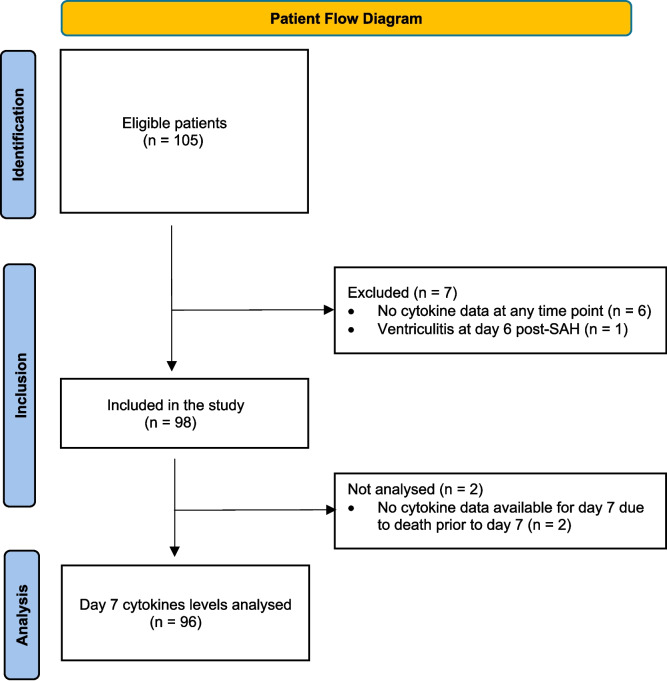
Methods: Ten cytokines were measured in CSF and plasma from 98 SAH patients and 18 control patients. Outcome was assessed with the modified Rankin scale (mRS) and Subarachnoid Haemorrhage Outcome Tool (SAHOT) at days 7, 28, 90 and 180. Regression analyses and principal component analysis (PCA) were performed.
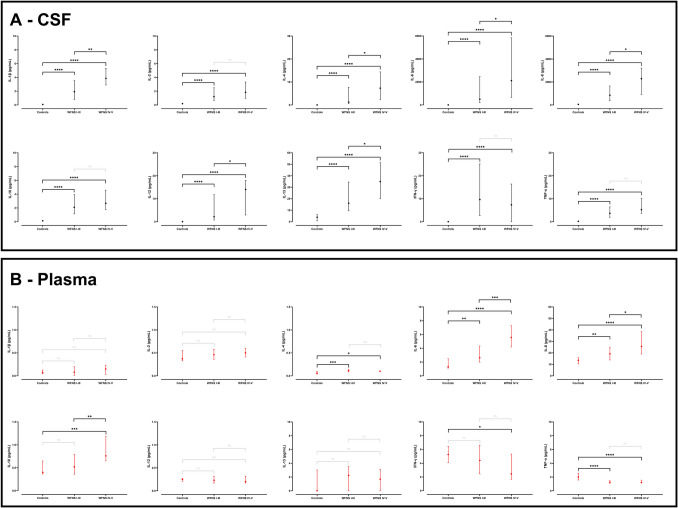
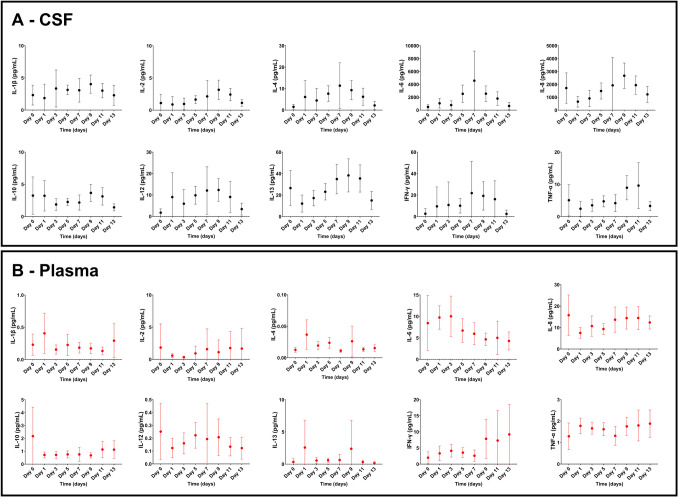
Results: Median levels of all CSF cytokines and plasma IL-6 were higher in SAH patients than controls (p < 0.001). Plasma IL-6 peaked earlier (3 days after SAH) than CSF cytokines (7-9 days after SAH). On day 7, CSF levels were greater than plasma levels for all cytokines (p < 0.001). There was no correlation between individual cytokines in the plasma and CSF. Only plasma IL-6 levels correlated with long-term outcome (mRS (p = 0.009) and SAHOT (p = 0.007) at day 180), accounting for WFNS and blood volume. Seven principal components of cytokines had an eigenvalue greater than 1. Only the first plasma principal component (dominated by IL-6, IL-8, IL-12, IL-13, and TNF-α) was associated with outcomes (p < 0.05). Mediation analysis suggested the effects of WFNS and blood volume on outcome were not mediated by IL-6 or this principal component.
Conclusion: SAH provokes an inflammatory response in CSF and plasma. The response pattern is different and distinct in each compartment. Each compartment's relationship with outcomes differ, suggesting separate roles in SAH pathophysiology. Plasma IL-6 is independently associated with outcomes.
期刊介绍:
Translational Stroke Research covers basic, translational, and clinical studies. The Journal emphasizes novel approaches to help both to understand clinical phenomenon through basic science tools, and to translate basic science discoveries into the development of new strategies for the prevention, assessment, treatment, and enhancement of central nervous system repair after stroke and other forms of neurotrauma.
Translational Stroke Research focuses on translational research and is relevant to both basic scientists and physicians, including but not restricted to neuroscientists, vascular biologists, neurologists, neuroimagers, and neurosurgeons.



 京公网安备 11010802042870号
京ICP备2023020795号-1
京公网安备 11010802042870号
京ICP备2023020795号-1

 分享
分享
 求助内容:
求助内容: 应助结果提醒方式:
 扫码关注我们
