Hassan Hachem, Houssein H Ayoub, Laith J Abu-Raddad
{"title":"Age-Dependent Assortativeness in Herpes Simplex Virus Type 1 Oral Transmission in the United States: A Mathematical Modeling Analysis.","authors":"Hassan Hachem, Houssein H Ayoub, Laith J Abu-Raddad","doi":"10.1093/infdis/jiaf157","DOIUrl":null,"url":null,"abstract":"<p><strong>Background: </strong>Herpes simplex virus type 1 (HSV-1) is a highly infectious, globally prevalent lifelong infection. Despite advancements in understanding its epidemiology, the assortativeness in the age-dependent transmission patterns remains unclear. This study aimed to estimate the degree of assortativeness in age group mixing for oral-to-oral HSV-1 transmission within the United States (US) population.</p><p><strong>Methods: </strong>An age-structured mathematical model was employed to describe HSV-1 transmission dynamics in the US population, incorporating its different modes of transmission. The model was fitted to nationally representative HSV-1 data from the National Health and Nutrition Examination Survey (NHANES) spanning 1976-2016 using a Bayesian inference framework. The degree of assortativeness in age group mixing was calibrated on a scale from 0 (no age group bias in close-proximity interactions) to 1 (exclusive mixing within the same age group).</p><p><strong>Results: </strong>The model demonstrated robust fits to US demographics, age-specific HSV-1 prevalence, and temporal trends in both HSV-1 prevalence and ever-symptomatic HSV-1 genital herpes prevalence. The degree of assortativeness was estimated as 0.87 (95% credible interval [CrI], .64-.99) for children, indicating strong age-based assortativity, and as 0.04 (95% CrI, .004-.10) for adults, indicating weak age-based assortativity.</p><p><strong>Conclusions: </strong>Most HSV-1 infections among children are acquired from peers within their own age group, whereas adults acquire HSV-1 infections from a broad range of age groups.</p>","PeriodicalId":50179,"journal":{"name":"Journal of Infectious Diseases","volume":" ","pages":"e1151-e1159"},"PeriodicalIF":4.5000,"publicationDate":"2025-07-11","publicationTypes":"Journal Article","fieldsOfStudy":null,"isOpenAccess":false,"openAccessPdf":"https://www.ncbi.nlm.nih.gov/pmc/articles/PMC12247797/pdf/","citationCount":"0","resultStr":null,"platform":"Semanticscholar","paperid":null,"PeriodicalName":"Journal of Infectious Diseases","FirstCategoryId":"3","ListUrlMain":"https://doi.org/10.1093/infdis/jiaf157","RegionNum":2,"RegionCategory":"医学","ArticlePicture":[],"TitleCN":null,"AbstractTextCN":null,"PMCID":null,"EPubDate":"","PubModel":"","JCR":"Q2","JCRName":"IMMUNOLOGY","Score":null,"Total":0}
引用次数: 0
Abstract
Background: Herpes simplex virus type 1 (HSV-1) is a highly infectious, globally prevalent lifelong infection. Despite advancements in understanding its epidemiology, the assortativeness in the age-dependent transmission patterns remains unclear. This study aimed to estimate the degree of assortativeness in age group mixing for oral-to-oral HSV-1 transmission within the United States (US) population.
Methods: An age-structured mathematical model was employed to describe HSV-1 transmission dynamics in the US population, incorporating its different modes of transmission. The model was fitted to nationally representative HSV-1 data from the National Health and Nutrition Examination Survey (NHANES) spanning 1976-2016 using a Bayesian inference framework. The degree of assortativeness in age group mixing was calibrated on a scale from 0 (no age group bias in close-proximity interactions) to 1 (exclusive mixing within the same age group).
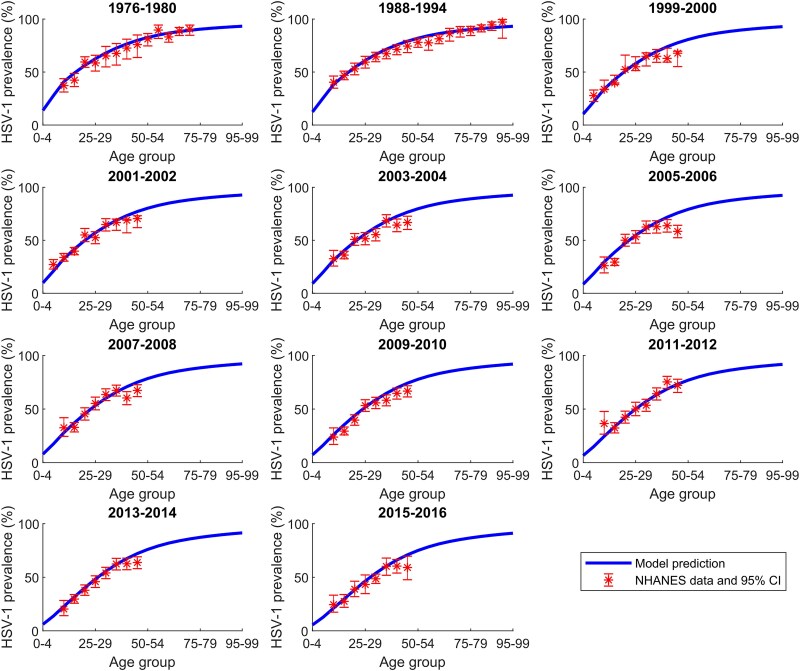
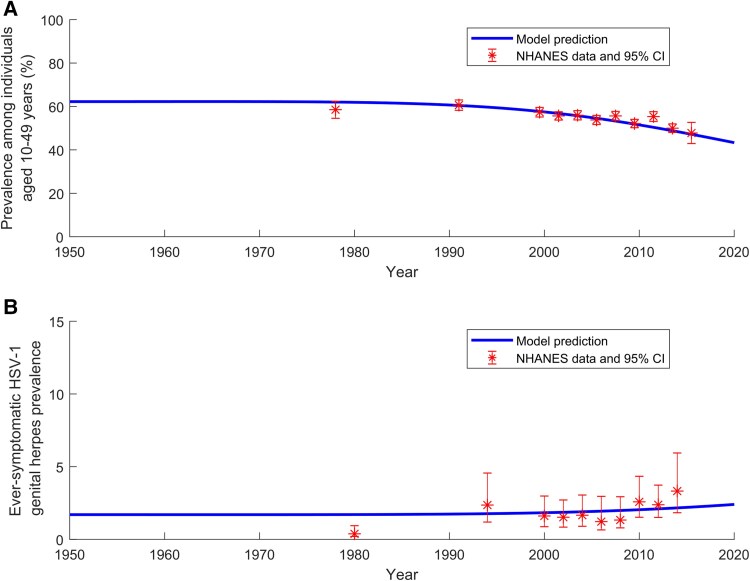
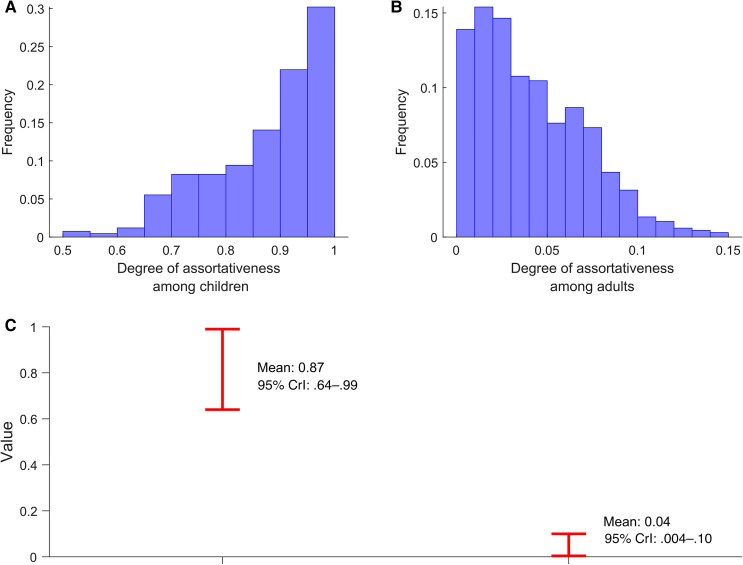
Results: The model demonstrated robust fits to US demographics, age-specific HSV-1 prevalence, and temporal trends in both HSV-1 prevalence and ever-symptomatic HSV-1 genital herpes prevalence. The degree of assortativeness was estimated as 0.87 (95% credible interval [CrI], .64-.99) for children, indicating strong age-based assortativity, and as 0.04 (95% CrI, .004-.10) for adults, indicating weak age-based assortativity.
Conclusions: Most HSV-1 infections among children are acquired from peers within their own age group, whereas adults acquire HSV-1 infections from a broad range of age groups.
期刊介绍:
Published continuously since 1904, The Journal of Infectious Diseases (JID) is the premier global journal for original research on infectious diseases. The editors welcome Major Articles and Brief Reports describing research results on microbiology, immunology, epidemiology, and related disciplines, on the pathogenesis, diagnosis, and treatment of infectious diseases; on the microbes that cause them; and on disorders of host immune responses. JID is an official publication of the Infectious Diseases Society of America.



 京公网安备 11010802042870号
京ICP备2023020795号-1
京公网安备 11010802042870号
京ICP备2023020795号-1

 分享
分享
 求助内容:
求助内容: 应助结果提醒方式:
 扫码关注我们
