Rajesh Melaram, Hongmei Zhang, James Adefisoye, Hasan Arshad
{"title":"The Association of Childhood Allergic Diseases with Prenatal Exposure to Pollen Grains Through At-Birth DNA Methylation.","authors":"Rajesh Melaram, Hongmei Zhang, James Adefisoye, Hasan Arshad","doi":"10.3390/epigenomes9010009","DOIUrl":null,"url":null,"abstract":"<p><strong>Background: </strong>Pollen exposure in early life is shown to be associated with allergy and asthma. DNA methylation (DNAm), an epigenetic marker, potentially reacts to pollen. However, the role of at-birth DNAm between prenatal pollen grain (PPG) exposure and childhood asthma and allergic rhinitis is unknown.</p><p><strong>Methods: </strong>Data in a birth cohort study on the Isle of Wight, UK, were analyzed (<i>n</i> = 236). Newborn DNAm was measured in cord blood or blood spots on Guthrie cards and screened for potential association with PPG exposure using the R package ttScreening. CpGs that passed screening were further assessed for such associations via linear regressions with adjusting covariates included. Finally, DNAm at PPG-associated CpGs were evaluated for their association with asthma and allergic rhinitis using logistic regressions, adjusting for covariates. The impact of cell heterogeneity on the findings was assessed. Statistical significance was set at <i>p</i> < 0.05.</p><p><strong>Results: </strong>In total, 42 CpGs passed screening, with 41 remaining statistically significant after adjusting for covariates and cell types (<i>p</i> < 0.05). High PPG exposure was associated with lower DNAm at cg12318501 (<i>ZNF99</i>, β = -0.029, <i>p</i> = 0.032) and cg00929606 (<i>ADM2</i>, β = -0.023, <i>p</i> = 0.008), which subsequently was associated with decreased odds of asthma (OR = 0.11, 95% CI 0.02-0.53, <i>p</i> = 0.006; OR = 0.14, 95% CI 0.02-1.00, <i>p</i> = 0.049). For rhinitis, cg15790214 (<i>HCG11</i>) was shown to play such a role as a mediator (β = -0.027, <i>p</i> ≤ 0.0001; OR = 0.22, 95% CI 0.07-0.72, <i>p</i> = 0.01).</p><p><strong>Conclusions: </strong>The association of PPG exposure with childhood asthma and allergic rhinitis incidence is potentially mediated by DNAm at birth.</p>","PeriodicalId":55768,"journal":{"name":"Epigenomes","volume":"9 1","pages":""},"PeriodicalIF":3.5000,"publicationDate":"2025-03-11","publicationTypes":"Journal Article","fieldsOfStudy":null,"isOpenAccess":false,"openAccessPdf":"https://www.ncbi.nlm.nih.gov/pmc/articles/PMC11940834/pdf/","citationCount":"0","resultStr":null,"platform":"Semanticscholar","paperid":null,"PeriodicalName":"Epigenomes","FirstCategoryId":"1085","ListUrlMain":"https://doi.org/10.3390/epigenomes9010009","RegionNum":0,"RegionCategory":null,"ArticlePicture":[],"TitleCN":null,"AbstractTextCN":null,"PMCID":null,"EPubDate":"","PubModel":"","JCR":"Q3","JCRName":"GENETICS & HEREDITY","Score":null,"Total":0}
引用次数: 0
Abstract
Background: Pollen exposure in early life is shown to be associated with allergy and asthma. DNA methylation (DNAm), an epigenetic marker, potentially reacts to pollen. However, the role of at-birth DNAm between prenatal pollen grain (PPG) exposure and childhood asthma and allergic rhinitis is unknown.
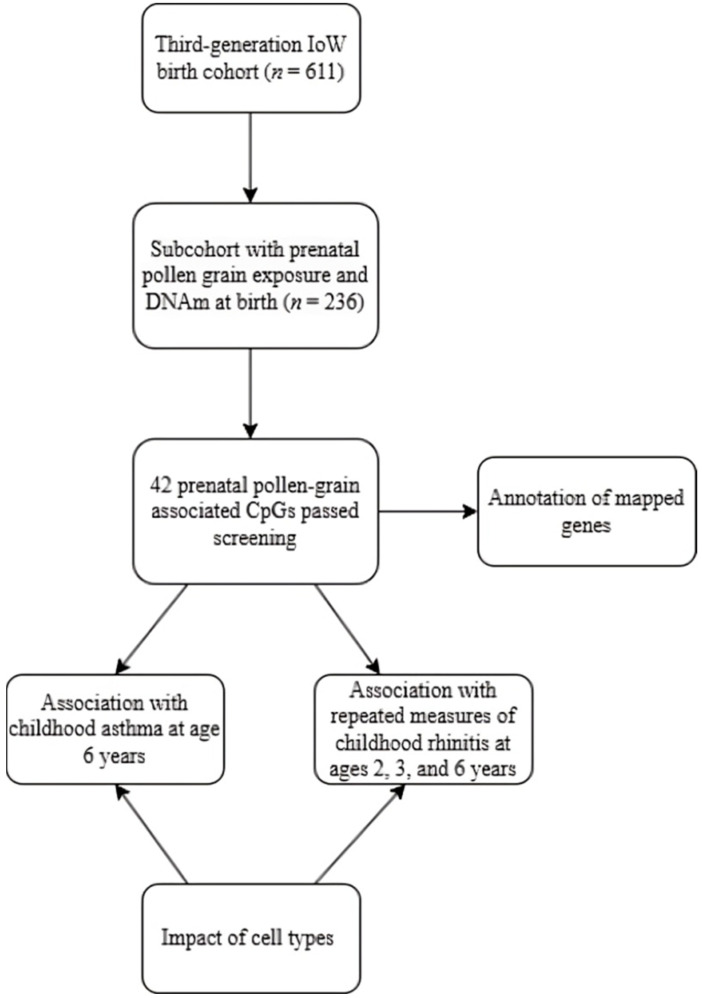
Methods: Data in a birth cohort study on the Isle of Wight, UK, were analyzed (n = 236). Newborn DNAm was measured in cord blood or blood spots on Guthrie cards and screened for potential association with PPG exposure using the R package ttScreening. CpGs that passed screening were further assessed for such associations via linear regressions with adjusting covariates included. Finally, DNAm at PPG-associated CpGs were evaluated for their association with asthma and allergic rhinitis using logistic regressions, adjusting for covariates. The impact of cell heterogeneity on the findings was assessed. Statistical significance was set at p < 0.05.
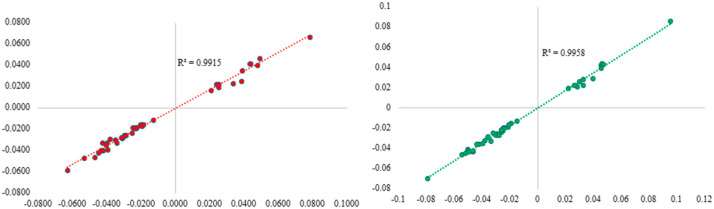
Results: In total, 42 CpGs passed screening, with 41 remaining statistically significant after adjusting for covariates and cell types (p < 0.05). High PPG exposure was associated with lower DNAm at cg12318501 (ZNF99, β = -0.029, p = 0.032) and cg00929606 (ADM2, β = -0.023, p = 0.008), which subsequently was associated with decreased odds of asthma (OR = 0.11, 95% CI 0.02-0.53, p = 0.006; OR = 0.14, 95% CI 0.02-1.00, p = 0.049). For rhinitis, cg15790214 (HCG11) was shown to play such a role as a mediator (β = -0.027, p ≤ 0.0001; OR = 0.22, 95% CI 0.07-0.72, p = 0.01).
Conclusions: The association of PPG exposure with childhood asthma and allergic rhinitis incidence is potentially mediated by DNAm at birth.




 京公网安备 11010802042870号
京ICP备2023020795号-1
京公网安备 11010802042870号
京ICP备2023020795号-1

 分享
分享
 求助内容:
求助内容: 应助结果提醒方式:
 扫码关注我们
