Francis Gaudreault, Traian Sulea, Christopher R Corbeil
{"title":"AI-augmented physics-based docking for antibody-antigen complex prediction.","authors":"Francis Gaudreault, Traian Sulea, Christopher R Corbeil","doi":"10.1093/bioinformatics/btaf129","DOIUrl":null,"url":null,"abstract":"<p><strong>Motivation: </strong>Predicting the structure of antibody-antigen complexes is a challenging task with significant implications for the design of better antibody therapeutics. However, the levels of success have remained dauntingly low, particularly when high standards for model quality are required, a necessity for efficient antibody design. Artificial intelligence (AI) has significantly impacted the landscape of structure prediction for antibodies, both alone and in complex with their antigens.</p><p><strong>Methods: </strong>We utilized AI-guided antibody modeling tools to generate ensembles displaying diversity in the complementarity-determining region (CDR) and integrated those into our previously published AlphaFold2-rescored docking pipeline, a strategy called AI-augmented physics-based docking. In this study, we also compare docking performance with AlphaFold and Boltz-1, the new state-of-the-art. We distinguish between two types of success tailored to specific downstream applications: (i) criteria sufficient for epitope mapping, where gross quality is adequate and can complement experimental techniques, and (ii) criteria for producing higher-quality models suitable for engineering purposes.</p><p><strong>Results: </strong>We highlight that the quality of the ensemble is crucial for docking performance, that including too many models can be detrimental, and that prioritization of models is essential for achieving good performance. In a scenario analogous to docking using a crystallized antigen, our results robustly demonstrate the advantages of AI-augmented docking over AlphaFold2, further accentuated when higher standards in quality are imposed. Docking also shows improvements over Boltz-1, but those are less pronounced. Docking performance is still noticeably lower than AlphaFold3 in both epitope mapping and antibody design use cases. We observe a strong dependence on CDR-H3 loop length for physics-based tools on their ability to successfully predict. This helps define an applicability range where physics-based docking can be competitive to the newer generation of AI tools.</p><p><strong>Availability and implementation: </strong>The AF2 rescoring scripts are available at github.com/gaudreaultfnrc/AF2-Rescoring.</p>","PeriodicalId":93899,"journal":{"name":"Bioinformatics (Oxford, England)","volume":" ","pages":""},"PeriodicalIF":5.4000,"publicationDate":"2025-03-29","publicationTypes":"Journal Article","fieldsOfStudy":null,"isOpenAccess":false,"openAccessPdf":"https://www.ncbi.nlm.nih.gov/pmc/articles/PMC11978387/pdf/","citationCount":"0","resultStr":null,"platform":"Semanticscholar","paperid":null,"PeriodicalName":"Bioinformatics (Oxford, England)","FirstCategoryId":"1085","ListUrlMain":"https://doi.org/10.1093/bioinformatics/btaf129","RegionNum":0,"RegionCategory":null,"ArticlePicture":[],"TitleCN":null,"AbstractTextCN":null,"PMCID":null,"EPubDate":"","PubModel":"","JCR":"","JCRName":"","Score":null,"Total":0}
引用次数: 0
Abstract
Motivation: Predicting the structure of antibody-antigen complexes is a challenging task with significant implications for the design of better antibody therapeutics. However, the levels of success have remained dauntingly low, particularly when high standards for model quality are required, a necessity for efficient antibody design. Artificial intelligence (AI) has significantly impacted the landscape of structure prediction for antibodies, both alone and in complex with their antigens.
Methods: We utilized AI-guided antibody modeling tools to generate ensembles displaying diversity in the complementarity-determining region (CDR) and integrated those into our previously published AlphaFold2-rescored docking pipeline, a strategy called AI-augmented physics-based docking. In this study, we also compare docking performance with AlphaFold and Boltz-1, the new state-of-the-art. We distinguish between two types of success tailored to specific downstream applications: (i) criteria sufficient for epitope mapping, where gross quality is adequate and can complement experimental techniques, and (ii) criteria for producing higher-quality models suitable for engineering purposes.
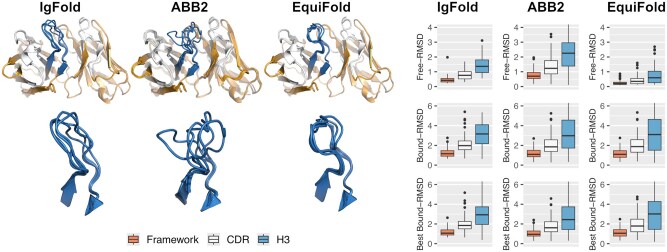
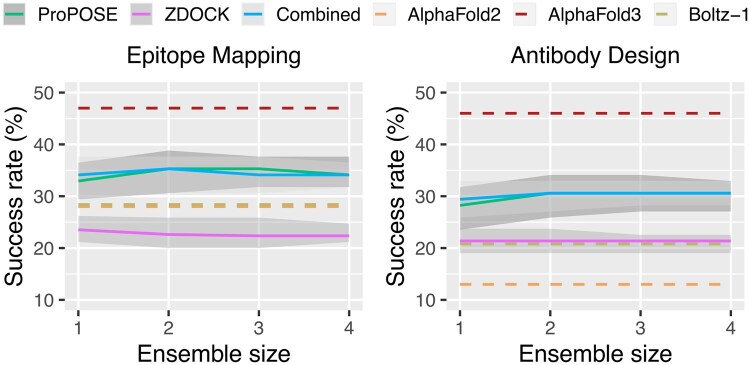
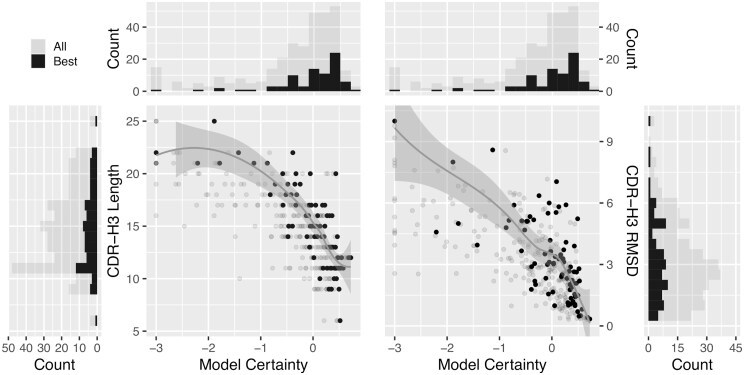
Results: We highlight that the quality of the ensemble is crucial for docking performance, that including too many models can be detrimental, and that prioritization of models is essential for achieving good performance. In a scenario analogous to docking using a crystallized antigen, our results robustly demonstrate the advantages of AI-augmented docking over AlphaFold2, further accentuated when higher standards in quality are imposed. Docking also shows improvements over Boltz-1, but those are less pronounced. Docking performance is still noticeably lower than AlphaFold3 in both epitope mapping and antibody design use cases. We observe a strong dependence on CDR-H3 loop length for physics-based tools on their ability to successfully predict. This helps define an applicability range where physics-based docking can be competitive to the newer generation of AI tools.
Availability and implementation: The AF2 rescoring scripts are available at github.com/gaudreaultfnrc/AF2-Rescoring.



 京公网安备 11010802042870号
京ICP备2023020795号-1
京公网安备 11010802042870号
京ICP备2023020795号-1

 分享
分享

 求助内容:
求助内容: 应助结果提醒方式:
 扫码关注我们
