Pregnancy Rate Is High When the Length of the Luteal Phase During the In Vitro Fertilization Hormone Replacement Cycle Is 144 Hours or More Before Embryo Transfer.
{"title":"Pregnancy Rate Is High When the Length of the Luteal Phase During the In Vitro Fertilization Hormone Replacement Cycle Is 144 Hours or More Before Embryo Transfer.","authors":"Eiji Nishio, Shota Oikawa, Eriko Sakakibara, Miho Ishikawa, Kiriko Kotani, Hikari Yoshizawa, Hironori Miyamura, Takanori Hayashi, Haruki Nishizawa","doi":"10.7759/cureus.81185","DOIUrl":null,"url":null,"abstract":"<p><strong>Background: </strong>When using assisted reproductive technology, there are cases where, despite the transfer of a good embryo, sometimes pregnancy may not be the case. Thus, during hormone replacement cycle implantation, it is important to synchronize the number of days of progesterone administration with the degree of embryo maturity. This study aimed to compare the outcomes of the administration of oral dydrogesterone for the duration of progestin use during the hormone replacement cycle for frozen-thawed blastocyst transfer.</p><p><strong>Material and methods: </strong>The primary outcome of this study was the clinical pregnancy rate. We performed a retrospective cohort study of patients who underwent frozen-thawed blastocyst transfers between January 2017 and December 2024. According to our standard protocol, a vitrified-warmed blastocyst transfer was performed using dydrogesterone, which was administered orally at our center. A total of 554 cases were included in the study. Using the Gardner classification to evaluate the quality of blastocysts, grade AA was classified as the best quality, the AB/BA group as good quality, and the BB group as fair quality. We classified the 554 cases into 317 AA, 163 AB/BA, and 74 BB cases using the Gardner classification. Based on the duration of progestin administration, patients were divided into four groups: 120 hours (120 h), 132 hours (132 h), 144 hours (144 h), and 156 hours (156 h). We used the Shapiro-Wilk method and the Steel-Dwass test to determine whether there were differences in patients' background age and BMI among the four groups (120 h, 132 h, 144 h, and 156 h). We used Fisher's exact test and the Bonferroni method to determine whether there were differences in the final outcome of pregnancy rate between the four groups of 120 h, 132 h, 144 h, and 156 h.</p><p><strong>Results: </strong>In the analysis of all embryos, the pregnancy rate at each timepoint of the primary evaluation was significantly higher in the 144-h group than in the 132-h group. Next, on analyzing the results by embryo grade, there was no difference in the pregnancy rate at each timepoint in the AA group. In the AB/BA group, the pregnancy rate was higher in the 144-h group than in the 132-h group. In the BB group, the pregnancy rate was higher in the 144-h group than in the 132-h group.</p><p><strong>Conclusion: </strong>This study clarified two aspects. First, the pregnancy rate in the 144-h group was significantly higher than that in the 132-h group in the analysis of all embryos. Second, the window of implantation may be more important for poor-quality embryos. This study showed that the oral administration of dydrogesterone requires a window of implantation of at least 144 hours.</p>","PeriodicalId":93960,"journal":{"name":"Cureus","volume":"17 3","pages":"e81185"},"PeriodicalIF":1.3000,"publicationDate":"2025-03-25","publicationTypes":"Journal Article","fieldsOfStudy":null,"isOpenAccess":false,"openAccessPdf":"https://www.ncbi.nlm.nih.gov/pmc/articles/PMC11936491/pdf/","citationCount":"0","resultStr":null,"platform":"Semanticscholar","paperid":null,"PeriodicalName":"Cureus","FirstCategoryId":"1085","ListUrlMain":"https://doi.org/10.7759/cureus.81185","RegionNum":0,"RegionCategory":null,"ArticlePicture":[],"TitleCN":null,"AbstractTextCN":null,"PMCID":null,"EPubDate":"2025/3/1 0:00:00","PubModel":"eCollection","JCR":"Q3","JCRName":"MEDICINE, GENERAL & INTERNAL","Score":null,"Total":0}
引用次数: 0
Abstract
Background: When using assisted reproductive technology, there are cases where, despite the transfer of a good embryo, sometimes pregnancy may not be the case. Thus, during hormone replacement cycle implantation, it is important to synchronize the number of days of progesterone administration with the degree of embryo maturity. This study aimed to compare the outcomes of the administration of oral dydrogesterone for the duration of progestin use during the hormone replacement cycle for frozen-thawed blastocyst transfer.
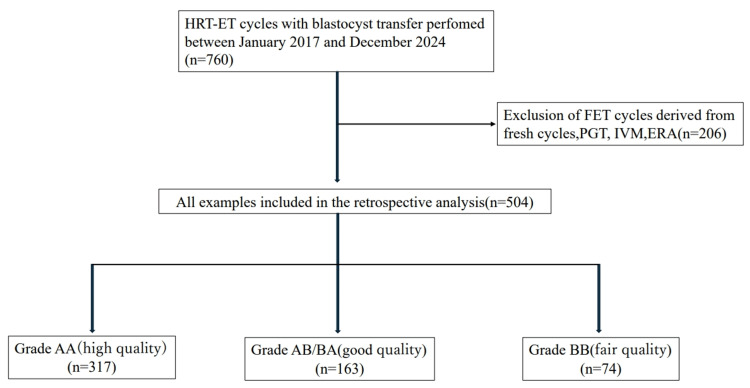
Material and methods: The primary outcome of this study was the clinical pregnancy rate. We performed a retrospective cohort study of patients who underwent frozen-thawed blastocyst transfers between January 2017 and December 2024. According to our standard protocol, a vitrified-warmed blastocyst transfer was performed using dydrogesterone, which was administered orally at our center. A total of 554 cases were included in the study. Using the Gardner classification to evaluate the quality of blastocysts, grade AA was classified as the best quality, the AB/BA group as good quality, and the BB group as fair quality. We classified the 554 cases into 317 AA, 163 AB/BA, and 74 BB cases using the Gardner classification. Based on the duration of progestin administration, patients were divided into four groups: 120 hours (120 h), 132 hours (132 h), 144 hours (144 h), and 156 hours (156 h). We used the Shapiro-Wilk method and the Steel-Dwass test to determine whether there were differences in patients' background age and BMI among the four groups (120 h, 132 h, 144 h, and 156 h). We used Fisher's exact test and the Bonferroni method to determine whether there were differences in the final outcome of pregnancy rate between the four groups of 120 h, 132 h, 144 h, and 156 h.
Results: In the analysis of all embryos, the pregnancy rate at each timepoint of the primary evaluation was significantly higher in the 144-h group than in the 132-h group. Next, on analyzing the results by embryo grade, there was no difference in the pregnancy rate at each timepoint in the AA group. In the AB/BA group, the pregnancy rate was higher in the 144-h group than in the 132-h group. In the BB group, the pregnancy rate was higher in the 144-h group than in the 132-h group.
Conclusion: This study clarified two aspects. First, the pregnancy rate in the 144-h group was significantly higher than that in the 132-h group in the analysis of all embryos. Second, the window of implantation may be more important for poor-quality embryos. This study showed that the oral administration of dydrogesterone requires a window of implantation of at least 144 hours.





 京公网安备 11010802042870号
京ICP备2023020795号-1
京公网安备 11010802042870号
京ICP备2023020795号-1

 分享
分享

 求助内容:
求助内容: 应助结果提醒方式:
 扫码关注我们
