Yumo Li, Qiandong Wang, Siqi Yuan, Tak Kwan Lam, Kun Guo, Yong Q. Zhang, Li Yi
{"title":"Reduced attention to human eyes in autism-associated Shank3 mutant laboratory beagle dogs","authors":"Yumo Li, Qiandong Wang, Siqi Yuan, Tak Kwan Lam, Kun Guo, Yong Q. Zhang, Li Yi","doi":"10.1038/s41380-025-02965-7","DOIUrl":null,"url":null,"abstract":"Autistic individuals often exhibit reduced attention to faces and eyes, which may underlie their social difficulty. This study used eye-tracking techniques to explore visual attention towards faces in Shank3 mutant laboratory beagle dogs, a model for autism, to identify parallels with human autism. We first assessed visual attention differences towards the eyes between Shank3 mutant and wild-type (WT) laboratory beagles by presenting them with human and dog face images. Then, using the gaze cueing paradigm, we directed the dogs’ gaze towards the eyes and mouth and quantified their gaze shifts. Finally, we investigated the impact of oxytocin on eye-gaze behavior by comparing gaze patterns under pre-administration, vehicle, and oxytocin conditions while viewing human faces. We found that mutant dogs showed a reduced proportional viewing time of human eyes than WT dogs (p = 0.032), but no difference in proportional eye viewing time when viewing dog faces (p = 0.691). Mutant dogs shifted their gazes away from the human eyes more quickly than the mouth (p = 0.043), unlike WT dogs (p = 0.345), suggesting an active eye avoidance. Furthermore, exogenous oxytocin increased proportional viewing time on human eyes in mutant dogs than pre-administration and vehicle conditions (p = 0.022), suggesting a potential effect of oxytocin on social attention in autism. To our knowledge, this study is the first to report an eye avoidance phenotype in an animal model of autism. These findings contribute to our understanding of the mechanisms underlying social difficulties in autism and the development of supporting strategies for autism.","PeriodicalId":19008,"journal":{"name":"Molecular Psychiatry","volume":"30 8","pages":"3765-3773"},"PeriodicalIF":10.1000,"publicationDate":"2025-03-27","publicationTypes":"Journal Article","fieldsOfStudy":null,"isOpenAccess":false,"openAccessPdf":"","citationCount":"0","resultStr":null,"platform":"Semanticscholar","paperid":null,"PeriodicalName":"Molecular Psychiatry","FirstCategoryId":"3","ListUrlMain":"https://www.nature.com/articles/s41380-025-02965-7","RegionNum":1,"RegionCategory":"医学","ArticlePicture":[],"TitleCN":null,"AbstractTextCN":null,"PMCID":null,"EPubDate":"","PubModel":"","JCR":"Q1","JCRName":"BIOCHEMISTRY & MOLECULAR BIOLOGY","Score":null,"Total":0}
引用次数: 0
Abstract
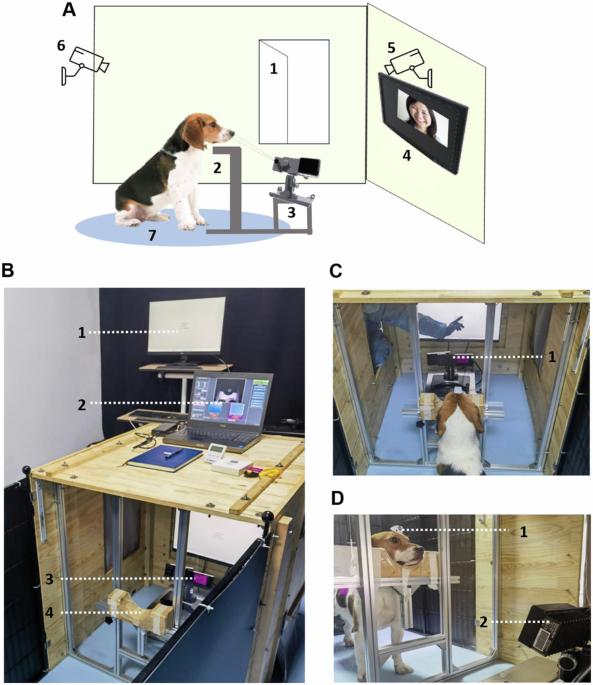
Autistic individuals often exhibit reduced attention to faces and eyes, which may underlie their social difficulty. This study used eye-tracking techniques to explore visual attention towards faces in Shank3 mutant laboratory beagle dogs, a model for autism, to identify parallels with human autism. We first assessed visual attention differences towards the eyes between Shank3 mutant and wild-type (WT) laboratory beagles by presenting them with human and dog face images. Then, using the gaze cueing paradigm, we directed the dogs’ gaze towards the eyes and mouth and quantified their gaze shifts. Finally, we investigated the impact of oxytocin on eye-gaze behavior by comparing gaze patterns under pre-administration, vehicle, and oxytocin conditions while viewing human faces. We found that mutant dogs showed a reduced proportional viewing time of human eyes than WT dogs (p = 0.032), but no difference in proportional eye viewing time when viewing dog faces (p = 0.691). Mutant dogs shifted their gazes away from the human eyes more quickly than the mouth (p = 0.043), unlike WT dogs (p = 0.345), suggesting an active eye avoidance. Furthermore, exogenous oxytocin increased proportional viewing time on human eyes in mutant dogs than pre-administration and vehicle conditions (p = 0.022), suggesting a potential effect of oxytocin on social attention in autism. To our knowledge, this study is the first to report an eye avoidance phenotype in an animal model of autism. These findings contribute to our understanding of the mechanisms underlying social difficulties in autism and the development of supporting strategies for autism.
期刊介绍:
Molecular Psychiatry focuses on publishing research that aims to uncover the biological mechanisms behind psychiatric disorders and their treatment. The journal emphasizes studies that bridge pre-clinical and clinical research, covering cellular, molecular, integrative, clinical, imaging, and psychopharmacology levels.




 京公网安备 11010802042870号
京ICP备2023020795号-1
京公网安备 11010802042870号
京ICP备2023020795号-1

 分享
分享
 求助内容:
求助内容: 应助结果提醒方式:
 扫码关注我们
