{"title":"Unlocking Ultrafast Charging: Reinforcement Learning With Reliability Guarantee for Ultrafast EV Charging Hub Under Behavior Uncertainty","authors":"Shangyang He;Weijie Mai;Jinpeng Tian;Haosen Yang;Zipeng Liang;Chunhua Wang;Zhigang Li;Chi Yung Chung","doi":"10.1109/TTE.2025.3554590","DOIUrl":null,"url":null,"abstract":"The direct current (DC) ultrafast electric vehicle charging hub (UFEVCH) represents a cutting-edge infrastructure designed to meet the growing high-power charging demands of electric vehicles (EVs) and support the goal of carbon neutrality. The way that UFEVCH realizes ultrafast charging is its ability to gather power by allocating power modules (PMs) to charging dispensers. Intelligent and real-time dispatching of PMs can enhance the overall utilization rate of UFEVCH and reduce losses associated with frequent reallocation. However, the PM dispatch has yet to be comprehensively studied. This study introduces a novel UFEVCH model that simulates the operational conditions of PMs and formulates a PM dispatch problem to achieve a higher utilization rate and modular cost-effectiveness. A real-time PM dispatch method, termed reinforcement learning and secondary dispatch (RLSD), is proposed to accommodate the uncertain behavior of EV charging. This method employs reinforcement learning (RL) to optimize PM allocation in real-time. In addition, the secondary dispatch (SD) ensures the reliability of UFEVCH by refining the RL solutions. The proposed UFEVCH model and RLSD method are validated using data from over 100 practical UFEVCH in Shenzhen, China, demonstrating nearly doubled service quality compared with numerous model-free and model-based methods. In addition, a theoretical analysis is provided to illustrate the convergence of the RLSD method.","PeriodicalId":56269,"journal":{"name":"IEEE Transactions on Transportation Electrification","volume":"11 4","pages":"10262-10275"},"PeriodicalIF":8.3000,"publicationDate":"2025-03-26","publicationTypes":"Journal Article","fieldsOfStudy":null,"isOpenAccess":false,"openAccessPdf":"","citationCount":"0","resultStr":null,"platform":"Semanticscholar","paperid":null,"PeriodicalName":"IEEE Transactions on Transportation Electrification","FirstCategoryId":"5","ListUrlMain":"https://ieeexplore.ieee.org/document/10938698/","RegionNum":1,"RegionCategory":"工程技术","ArticlePicture":[],"TitleCN":null,"AbstractTextCN":null,"PMCID":null,"EPubDate":"","PubModel":"","JCR":"Q1","JCRName":"ENGINEERING, ELECTRICAL & ELECTRONIC","Score":null,"Total":0}
引用次数: 0
Abstract
The direct current (DC) ultrafast electric vehicle charging hub (UFEVCH) represents a cutting-edge infrastructure designed to meet the growing high-power charging demands of electric vehicles (EVs) and support the goal of carbon neutrality. The way that UFEVCH realizes ultrafast charging is its ability to gather power by allocating power modules (PMs) to charging dispensers. Intelligent and real-time dispatching of PMs can enhance the overall utilization rate of UFEVCH and reduce losses associated with frequent reallocation. However, the PM dispatch has yet to be comprehensively studied. This study introduces a novel UFEVCH model that simulates the operational conditions of PMs and formulates a PM dispatch problem to achieve a higher utilization rate and modular cost-effectiveness. A real-time PM dispatch method, termed reinforcement learning and secondary dispatch (RLSD), is proposed to accommodate the uncertain behavior of EV charging. This method employs reinforcement learning (RL) to optimize PM allocation in real-time. In addition, the secondary dispatch (SD) ensures the reliability of UFEVCH by refining the RL solutions. The proposed UFEVCH model and RLSD method are validated using data from over 100 practical UFEVCH in Shenzhen, China, demonstrating nearly doubled service quality compared with numerous model-free and model-based methods. In addition, a theoretical analysis is provided to illustrate the convergence of the RLSD method.
期刊介绍:
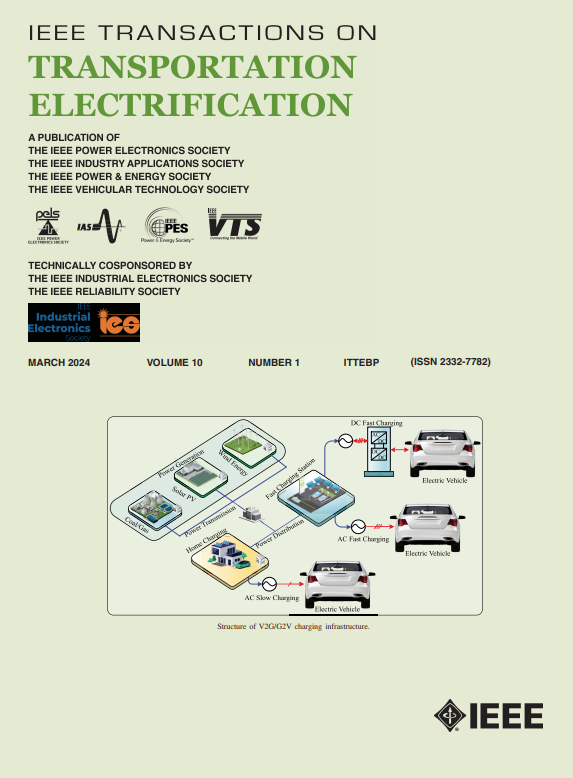
IEEE Transactions on Transportation Electrification is focused on components, sub-systems, systems, standards, and grid interface technologies related to power and energy conversion, propulsion, and actuation for all types of electrified vehicles including on-road, off-road, off-highway, and rail vehicles, airplanes, and ships.



 京公网安备 11010802042870号
京ICP备2023020795号-1
京公网安备 11010802042870号
京ICP备2023020795号-1

 分享
分享
 求助内容:
求助内容: 应助结果提醒方式:
 扫码关注我们
