Li Du, Gaojie Xu, Chenghao Sun, Yu-Han Zhang, Huanrui Zhang, Tiantian Dong, Lang Huang, Jun Ma, Fu Sun, Chuanchuan Li, Xiangchun Zhuang, Shenghang Zhang, Jiedong Li, Bin Xie, Jinzhi Wang, Jingwen Zhao, Jiangwei Ju, Zhiwei Hu, Fan-Hsiu Chang, Chang-Yang Kuo, Chien-Te Chen, André Hilger, Ingo Manke, Shanmu Dong, Guanglei Cui
{"title":"Smart gel polymer electrolytes enlightening high safety and long life sodium ion batteries","authors":"Li Du, Gaojie Xu, Chenghao Sun, Yu-Han Zhang, Huanrui Zhang, Tiantian Dong, Lang Huang, Jun Ma, Fu Sun, Chuanchuan Li, Xiangchun Zhuang, Shenghang Zhang, Jiedong Li, Bin Xie, Jinzhi Wang, Jingwen Zhao, Jiangwei Ju, Zhiwei Hu, Fan-Hsiu Chang, Chang-Yang Kuo, Chien-Te Chen, André Hilger, Ingo Manke, Shanmu Dong, Guanglei Cui","doi":"10.1038/s41467-025-57964-7","DOIUrl":null,"url":null,"abstract":"<p>The overall performance of sodium-ion batteries, particularly regarding safety and cycle life, remains below expectations due to severe degradation of electrode materials and the electrode/electrolyte interphase. Herein, we develop a smart gel polymer electrolyte for hard carbon||NaNi<sub>1/3</sub>Fe<sub>1/3</sub>Mn<sub>1/3</sub>O<sub>2</sub> batteries through the in situ radical polymerization of a cyanoethylurea-containing methacrylate monomer and an isocyanate-based methacrylate monomer in conventional NaPF<sub>6</sub>-carbonate-based electrolytes. We demonstrate that the smart gel polymer electrolyte facilitates the formation of robust electrode/electrolyte interphase layers, thus improving the thermal and chem-electrochemical stability of the electrodes. When the temperature exceeds 120 °C, the in situ formed gel polymer electrolyte undergoes further crosslinking through nucleophilic addition reactions between urea and isocyanate motifs. This additional crosslinking blocks ion transportation and inhibits crosstalk effects, thus boosting the safety of pouch-type hard carbon||NaNi<sub>1/3</sub>Fe<sub>1/3</sub>Mn<sub>1/3</sub>O<sub>2</sub> batteries. Moreover, the smart gel polymer electrolyte enables hard carbon||NaNi<sub>1/3</sub>Fe<sub>1/3</sub>Mn<sub>1/3</sub>O<sub>2</sub> full cells to achieve improved cycle life even at the elevated temperature of 50 °C. The design philosophy behind the development of in situ formed smart gel polymer electrolytes offers valuable guidance for creating high-safety, long-life, and sustainable sodium-ion batteries.</p>","PeriodicalId":19066,"journal":{"name":"Nature Communications","volume":"10 1","pages":""},"PeriodicalIF":15.7000,"publicationDate":"2025-03-26","publicationTypes":"Journal Article","fieldsOfStudy":null,"isOpenAccess":false,"openAccessPdf":"","citationCount":"0","resultStr":null,"platform":"Semanticscholar","paperid":null,"PeriodicalName":"Nature Communications","FirstCategoryId":"103","ListUrlMain":"https://doi.org/10.1038/s41467-025-57964-7","RegionNum":1,"RegionCategory":"综合性期刊","ArticlePicture":[],"TitleCN":null,"AbstractTextCN":null,"PMCID":null,"EPubDate":"","PubModel":"","JCR":"Q1","JCRName":"MULTIDISCIPLINARY SCIENCES","Score":null,"Total":0}
引用次数: 0
Abstract
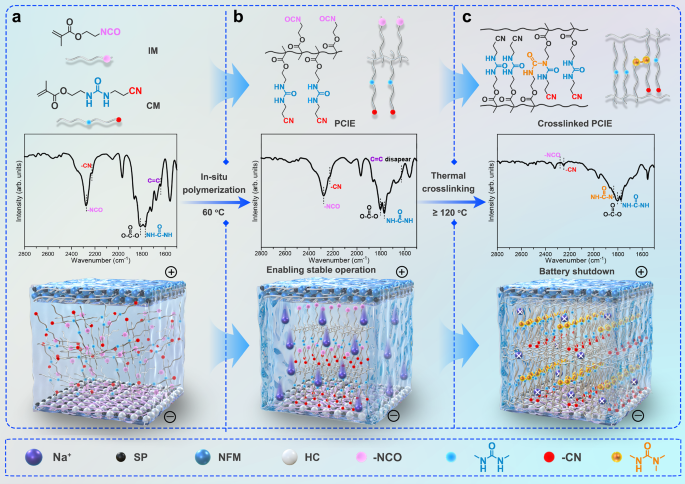
The overall performance of sodium-ion batteries, particularly regarding safety and cycle life, remains below expectations due to severe degradation of electrode materials and the electrode/electrolyte interphase. Herein, we develop a smart gel polymer electrolyte for hard carbon||NaNi1/3Fe1/3Mn1/3O2 batteries through the in situ radical polymerization of a cyanoethylurea-containing methacrylate monomer and an isocyanate-based methacrylate monomer in conventional NaPF6-carbonate-based electrolytes. We demonstrate that the smart gel polymer electrolyte facilitates the formation of robust electrode/electrolyte interphase layers, thus improving the thermal and chem-electrochemical stability of the electrodes. When the temperature exceeds 120 °C, the in situ formed gel polymer electrolyte undergoes further crosslinking through nucleophilic addition reactions between urea and isocyanate motifs. This additional crosslinking blocks ion transportation and inhibits crosstalk effects, thus boosting the safety of pouch-type hard carbon||NaNi1/3Fe1/3Mn1/3O2 batteries. Moreover, the smart gel polymer electrolyte enables hard carbon||NaNi1/3Fe1/3Mn1/3O2 full cells to achieve improved cycle life even at the elevated temperature of 50 °C. The design philosophy behind the development of in situ formed smart gel polymer electrolytes offers valuable guidance for creating high-safety, long-life, and sustainable sodium-ion batteries.
期刊介绍:
Nature Communications, an open-access journal, publishes high-quality research spanning all areas of the natural sciences. Papers featured in the journal showcase significant advances relevant to specialists in each respective field. With a 2-year impact factor of 16.6 (2022) and a median time of 8 days from submission to the first editorial decision, Nature Communications is committed to rapid dissemination of research findings. As a multidisciplinary journal, it welcomes contributions from biological, health, physical, chemical, Earth, social, mathematical, applied, and engineering sciences, aiming to highlight important breakthroughs within each domain.




 京公网安备 11010802042870号
京ICP备2023020795号-1
京公网安备 11010802042870号
京ICP备2023020795号-1

 分享
分享
 求助内容:
求助内容: 应助结果提醒方式:
 扫码关注我们
