{"title":"Discovery of novel 1,2,3-Triazole hybrids derivatives as vasorelaxant agents: Molecular structure, Hirshfeld surface, in-vivo and in-silico investigation by molecular docking simulation","authors":"Yassine Rhazi , Ismail Bouadid , Asmae Nakkabi , Usama Raza , Lohith Tumakuru Nagarajappa , Noemi Deak , Albert Soran , Mohamed El Yazidi , Marwa Alaqarbeh , Abdessamad Tounsi , Mohamed Anouar Harrad , Mohamed Eddouks","doi":"10.1016/j.ejmech.2025.117515","DOIUrl":null,"url":null,"abstract":"<div><div>In this study, we have developed a new category of antihypertensive agents using copper-catalysed \"click chemistry\". This series of six hybrid compounds (HRa-f) consists of quinazoline-(3H)-one-1,2,3-triazole-acetamide derivatives. In order to confirm their structures, they were characterised by a number of techniques including infrared spectroscopy, proton and carbon nuclear magnetic resonance, heteronuclear multiple bond correlation, heteronuclear single quantum coherence and correlation spectroscopy. X-ray diffraction analysis and interactions, including hydrogen bonding which stabilises the crystal lattice, have been studied. Analyses of the Hirshfeld surface mapped t<em>o</em> d<em>i</em>, d<em>e</em>, d<em>norm</em> and shape index were used to detect intermolecular interactions. The histogram of the fingerprints shows that the H⋯H (48.2 %) and O⋯H (12.6 %) contacts are the dominant interactions in the crystal stacking. The vasorelaxant activity of the synthesised compounds was evaluated using aortic rings from precontracted rats exposed to epinephrine (10 μM). Dose-response studies indicated that the vasorelaxant efficacy varied depending on the structural modifications of the drugs. Molecular docking studies were also performed to predict binding affinity and identify the most likely binding interactions between the hybrid molecules and the calcium channel. Cav 1.2, the alpha-subunit containing key binding sites (EEE locus: GLU 363, GLU 706, GLU 1135, GLU 1464), was compared with the drug verapamil. Docking results confirmed that verapamil (−8.22 kcal/mol) was the most potent compound, followed by the HRa-f compounds.</div></div>","PeriodicalId":314,"journal":{"name":"European Journal of Medicinal Chemistry","volume":"291 ","pages":"Article 117515"},"PeriodicalIF":5.9000,"publicationDate":"2025-07-05","publicationTypes":"Journal Article","fieldsOfStudy":null,"isOpenAccess":false,"openAccessPdf":"","citationCount":"0","resultStr":null,"platform":"Semanticscholar","paperid":null,"PeriodicalName":"European Journal of Medicinal Chemistry","FirstCategoryId":"3","ListUrlMain":"https://www.sciencedirect.com/science/article/pii/S0223523425002806","RegionNum":2,"RegionCategory":"医学","ArticlePicture":[],"TitleCN":null,"AbstractTextCN":null,"PMCID":null,"EPubDate":"2025/3/27 0:00:00","PubModel":"Epub","JCR":"Q1","JCRName":"CHEMISTRY, MEDICINAL","Score":null,"Total":0}
引用次数: 0
Abstract
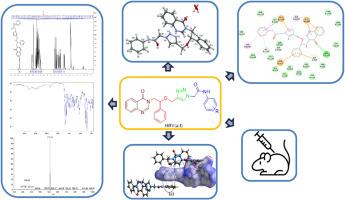
In this study, we have developed a new category of antihypertensive agents using copper-catalysed "click chemistry". This series of six hybrid compounds (HRa-f) consists of quinazoline-(3H)-one-1,2,3-triazole-acetamide derivatives. In order to confirm their structures, they were characterised by a number of techniques including infrared spectroscopy, proton and carbon nuclear magnetic resonance, heteronuclear multiple bond correlation, heteronuclear single quantum coherence and correlation spectroscopy. X-ray diffraction analysis and interactions, including hydrogen bonding which stabilises the crystal lattice, have been studied. Analyses of the Hirshfeld surface mapped to di, de, dnorm and shape index were used to detect intermolecular interactions. The histogram of the fingerprints shows that the H⋯H (48.2 %) and O⋯H (12.6 %) contacts are the dominant interactions in the crystal stacking. The vasorelaxant activity of the synthesised compounds was evaluated using aortic rings from precontracted rats exposed to epinephrine (10 μM). Dose-response studies indicated that the vasorelaxant efficacy varied depending on the structural modifications of the drugs. Molecular docking studies were also performed to predict binding affinity and identify the most likely binding interactions between the hybrid molecules and the calcium channel. Cav 1.2, the alpha-subunit containing key binding sites (EEE locus: GLU 363, GLU 706, GLU 1135, GLU 1464), was compared with the drug verapamil. Docking results confirmed that verapamil (−8.22 kcal/mol) was the most potent compound, followed by the HRa-f compounds.
期刊介绍:
The European Journal of Medicinal Chemistry is a global journal that publishes studies on all aspects of medicinal chemistry. It provides a medium for publication of original papers and also welcomes critical review papers.
A typical paper would report on the organic synthesis, characterization and pharmacological evaluation of compounds. Other topics of interest are drug design, QSAR, molecular modeling, drug-receptor interactions, molecular aspects of drug metabolism, prodrug synthesis and drug targeting. The journal expects manuscripts to present the rational for a study, provide insight into the design of compounds or understanding of mechanism, or clarify the targets.




 京公网安备 11010802042870号
京ICP备2023020795号-1
京公网安备 11010802042870号
京ICP备2023020795号-1

 分享
分享
 求助内容:
求助内容: 应助结果提醒方式:
 扫码关注我们
