{"title":"Exploring the origin of electron spin polarization in metal-containing chromophore–radical systems via multireference calculations†","authors":"Ryosuke Sowa and Yuki Kurashige","doi":"10.1039/D4CP04695A","DOIUrl":null,"url":null,"abstract":"<p >The electron spin polarization (ESP) phenomenon in photoexcited chromophore–radical connected systems was analyzed by multireference electronic structure calculations. We focused on bpy-M-CAT-<em>m</em>Ph-NN (bpy = 4,4′-di-<em>tert</em>-butyl-2,2′-bipyridine, M = Pt or Pd, CAT = 3-<em>tert</em>-butylcatecholate, <em>m</em>Ph = <em>meta</em>-phenylene, and NN = nitronyl nitroxide) reported by Kirk <em>et al.</em>, which is a connected system consisting of a donor–acceptor complex and a radical, and elucidated the mechanism behind the reversal of the sign of photoinduced ESP depending on the metal species. The low-lying electronic states of these molecules were revealed through the multireference theory, suggesting that the ligand-to-ligand charge-transfer states play a significant role. Additionally, several structural factors that influence the energies of the excited states were identified. To enhance our understanding of the ESP, we incorporated spin–orbit coupling as a direct transition term between excited states and explicitly considered its effects on the ESP. The results of evaluating transition rates through a transition simulation indicate that when the influence of spin–orbit coupling is significant, the sign of the ESP in the ground state can reverse. This novel ESP mechanism mediated by spin–orbit coupling may offer fundamental insights for designing molecules to precisely control electron distribution across multiple spin states.</p>","PeriodicalId":99,"journal":{"name":"Physical Chemistry Chemical Physics","volume":" 17","pages":" 9005-9015"},"PeriodicalIF":2.9000,"publicationDate":"2025-03-27","publicationTypes":"Journal Article","fieldsOfStudy":null,"isOpenAccess":false,"openAccessPdf":"https://pubs.rsc.org/en/content/articlepdf/2025/cp/d4cp04695a?page=search","citationCount":"0","resultStr":null,"platform":"Semanticscholar","paperid":null,"PeriodicalName":"Physical Chemistry Chemical Physics","FirstCategoryId":"92","ListUrlMain":"https://pubs.rsc.org/en/content/articlelanding/2025/cp/d4cp04695a","RegionNum":3,"RegionCategory":"化学","ArticlePicture":[],"TitleCN":null,"AbstractTextCN":null,"PMCID":null,"EPubDate":"","PubModel":"","JCR":"Q3","JCRName":"CHEMISTRY, PHYSICAL","Score":null,"Total":0}
引用次数: 0
Abstract
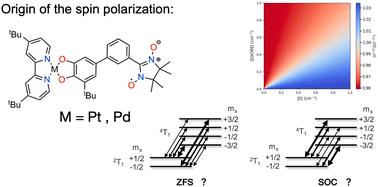
The electron spin polarization (ESP) phenomenon in photoexcited chromophore–radical connected systems was analyzed by multireference electronic structure calculations. We focused on bpy-M-CAT-mPh-NN (bpy = 4,4′-di-tert-butyl-2,2′-bipyridine, M = Pt or Pd, CAT = 3-tert-butylcatecholate, mPh = meta-phenylene, and NN = nitronyl nitroxide) reported by Kirk et al., which is a connected system consisting of a donor–acceptor complex and a radical, and elucidated the mechanism behind the reversal of the sign of photoinduced ESP depending on the metal species. The low-lying electronic states of these molecules were revealed through the multireference theory, suggesting that the ligand-to-ligand charge-transfer states play a significant role. Additionally, several structural factors that influence the energies of the excited states were identified. To enhance our understanding of the ESP, we incorporated spin–orbit coupling as a direct transition term between excited states and explicitly considered its effects on the ESP. The results of evaluating transition rates through a transition simulation indicate that when the influence of spin–orbit coupling is significant, the sign of the ESP in the ground state can reverse. This novel ESP mechanism mediated by spin–orbit coupling may offer fundamental insights for designing molecules to precisely control electron distribution across multiple spin states.
期刊介绍:
Physical Chemistry Chemical Physics (PCCP) is an international journal co-owned by 19 physical chemistry and physics societies from around the world. This journal publishes original, cutting-edge research in physical chemistry, chemical physics and biophysical chemistry. To be suitable for publication in PCCP, articles must include significant innovation and/or insight into physical chemistry; this is the most important criterion that reviewers and Editors will judge against when evaluating submissions.
The journal has a broad scope and welcomes contributions spanning experiment, theory, computation and data science. Topical coverage includes spectroscopy, dynamics, kinetics, statistical mechanics, thermodynamics, electrochemistry, catalysis, surface science, quantum mechanics, quantum computing and machine learning. Interdisciplinary research areas such as polymers and soft matter, materials, nanoscience, energy, surfaces/interfaces, and biophysical chemistry are welcomed if they demonstrate significant innovation and/or insight into physical chemistry. Joined experimental/theoretical studies are particularly appreciated when complementary and based on up-to-date approaches.




 京公网安备 11010802042870号
京ICP备2023020795号-1
京公网安备 11010802042870号
京ICP备2023020795号-1

 分享
分享
 求助内容:
求助内容: 应助结果提醒方式:
 扫码关注我们
