Hui Chen, Hanyu Yang, Yi Zheng, Yingying Li, Jie Hu, Xiupei Yang, Ya Wang
{"title":"Detection of doxycycline via a smartphone-assisted ratiometric fluorescence platform with cerium‑nickel bimetallic nanoclusters","authors":"Hui Chen, Hanyu Yang, Yi Zheng, Yingying Li, Jie Hu, Xiupei Yang, Ya Wang","doi":"10.1016/j.foodchem.2025.144074","DOIUrl":null,"url":null,"abstract":"<div><div>The accumulation of tetracycline antibiotics, such as doxycycline (DOX), in animal-derived foods poses considerable health risks to humans when found in excessive concentration levels. This research introduces a ratiometric fluorescence sensor for the detection of DOX utilizing ovalbumin-stabilized cerium‑nickel bimetallic nanoclusters (OVA-Ce/Ni NCs). The sensor exploits the sensitizing effect of ovalbumin on DOX, resulting in a fluorescence peak at 510 nm, while its inherent blue fluorescence at 420 nm gradually quenches. Under optimal conditions, the OVA-Ce/Ni NCs sensor exhibited a linear response range of 0.2–80 μM for DOX, with an exceptionally low detection limit of 51 nM. The sensor exhibited excellent selectivity for DOX and was successfully applied for the detection of DOX in milk and fish samples. Furthermore, smartphone-assisted detection facilitated visual identification of DOX. This study demonstrates a highly sensitive and selective approach for detecting DOX in animal-derived foods, with potential implications in pollutant identification and control.</div></div>","PeriodicalId":318,"journal":{"name":"Food Chemistry","volume":"482 ","pages":"Article 144074"},"PeriodicalIF":9.8000,"publicationDate":"2025-03-27","publicationTypes":"Journal Article","fieldsOfStudy":null,"isOpenAccess":false,"openAccessPdf":"","citationCount":"0","resultStr":null,"platform":"Semanticscholar","paperid":null,"PeriodicalName":"Food Chemistry","FirstCategoryId":"97","ListUrlMain":"https://www.sciencedirect.com/science/article/pii/S0308814625013251","RegionNum":1,"RegionCategory":"农林科学","ArticlePicture":[],"TitleCN":null,"AbstractTextCN":null,"PMCID":null,"EPubDate":"","PubModel":"","JCR":"Q1","JCRName":"CHEMISTRY, APPLIED","Score":null,"Total":0}
引用次数: 0
Abstract
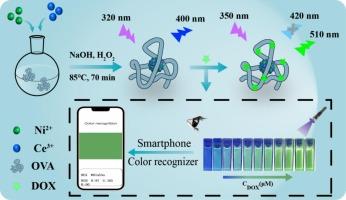
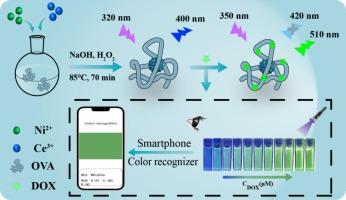
The accumulation of tetracycline antibiotics, such as doxycycline (DOX), in animal-derived foods poses considerable health risks to humans when found in excessive concentration levels. This research introduces a ratiometric fluorescence sensor for the detection of DOX utilizing ovalbumin-stabilized cerium‑nickel bimetallic nanoclusters (OVA-Ce/Ni NCs). The sensor exploits the sensitizing effect of ovalbumin on DOX, resulting in a fluorescence peak at 510 nm, while its inherent blue fluorescence at 420 nm gradually quenches. Under optimal conditions, the OVA-Ce/Ni NCs sensor exhibited a linear response range of 0.2–80 μM for DOX, with an exceptionally low detection limit of 51 nM. The sensor exhibited excellent selectivity for DOX and was successfully applied for the detection of DOX in milk and fish samples. Furthermore, smartphone-assisted detection facilitated visual identification of DOX. This study demonstrates a highly sensitive and selective approach for detecting DOX in animal-derived foods, with potential implications in pollutant identification and control.
期刊介绍:
Food Chemistry publishes original research papers dealing with the advancement of the chemistry and biochemistry of foods or the analytical methods/ approach used. All papers should focus on the novelty of the research carried out.



 京公网安备 11010802042870号
京ICP备2023020795号-1
京公网安备 11010802042870号
京ICP备2023020795号-1

 分享
分享
 求助内容:
求助内容: 应助结果提醒方式:
 扫码关注我们
