Qingzhen Tian , Jinjin Liu , Yuxuan Long , Hao Liang , Kechen Wu , Xi Chen , Qinqin Bai , Xiangheng Niu
{"title":"Catalytic preference-enabled exclusive bimodal detection of methyl-paraoxon in complex food matrices using double site-synergized organophosphorus hydrolase-mimetic fluorescent nanozymes","authors":"Qingzhen Tian , Jinjin Liu , Yuxuan Long , Hao Liang , Kechen Wu , Xi Chen , Qinqin Bai , Xiangheng Niu","doi":"10.1016/j.foodchem.2025.144023","DOIUrl":null,"url":null,"abstract":"<div><div>Pesticide sensing crucially safeguards food safety and public health against environmental and health hazards. While oxidoreductase-type nanozymes (peroxidase and oxidase) have been widely used in optical pesticide detection, their susceptibility to redox interference as well as poor target specificity limits practical applications. To overcome the deficiencies, here we developed Ca<sup>2+</sup>-chelated 2-aminoterephthalic acid on nanosized ceria (Ca-ATPA@CeO<sub>2</sub>) as an organophosphorus hydrolase mimic. This design integrates stable fluorescence and dual-site catalytic activity to specifically detect methyl-paraoxon (MP) in complex food matrices. The synergy between Ca<sup>2+</sup> (hard Lewis acid) and CeO<sub>2</sub> creates dual active sites to catalyze MP hydrolysis into yellow <em>p</em>-nitrophenol (pNP), and the latter quenches nanozyme fluorescence via inner filter effect. The system enables cross-validated quantification of MP in complex samples, eliminating redox interference through target-specific catalysis. The bimodal “on” colorimetric (pNP color signal) and “off” fluorescence (nanozyme fluorescence intensity) detection achieved linear ranges within 1–200 μM, providing detection limits of 1.43 μM and 0.087 μM, respectively. Our work proposes a reliable strategy for selective MP detection that can avoid redox interference, also providing a simple yet efficient design of high-activity fluorescent hydrolase mimics with broadened applications in food safety analysis and beyond.</div></div>","PeriodicalId":318,"journal":{"name":"Food Chemistry","volume":"481 ","pages":"Article 144023"},"PeriodicalIF":9.8000,"publicationDate":"2025-07-30","publicationTypes":"Journal Article","fieldsOfStudy":null,"isOpenAccess":false,"openAccessPdf":"","citationCount":"0","resultStr":null,"platform":"Semanticscholar","paperid":null,"PeriodicalName":"Food Chemistry","FirstCategoryId":"97","ListUrlMain":"https://www.sciencedirect.com/science/article/pii/S0308814625012749","RegionNum":1,"RegionCategory":"农林科学","ArticlePicture":[],"TitleCN":null,"AbstractTextCN":null,"PMCID":null,"EPubDate":"2025/3/27 0:00:00","PubModel":"Epub","JCR":"Q1","JCRName":"CHEMISTRY, APPLIED","Score":null,"Total":0}
引用次数: 0
Abstract
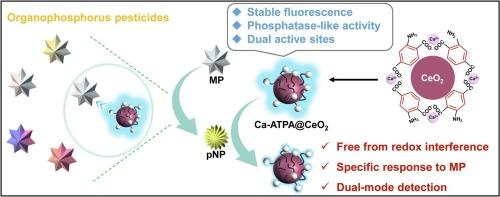
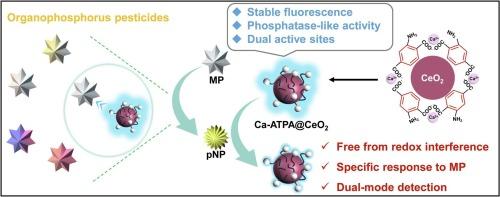
Pesticide sensing crucially safeguards food safety and public health against environmental and health hazards. While oxidoreductase-type nanozymes (peroxidase and oxidase) have been widely used in optical pesticide detection, their susceptibility to redox interference as well as poor target specificity limits practical applications. To overcome the deficiencies, here we developed Ca2+-chelated 2-aminoterephthalic acid on nanosized ceria (Ca-ATPA@CeO2) as an organophosphorus hydrolase mimic. This design integrates stable fluorescence and dual-site catalytic activity to specifically detect methyl-paraoxon (MP) in complex food matrices. The synergy between Ca2+ (hard Lewis acid) and CeO2 creates dual active sites to catalyze MP hydrolysis into yellow p-nitrophenol (pNP), and the latter quenches nanozyme fluorescence via inner filter effect. The system enables cross-validated quantification of MP in complex samples, eliminating redox interference through target-specific catalysis. The bimodal “on” colorimetric (pNP color signal) and “off” fluorescence (nanozyme fluorescence intensity) detection achieved linear ranges within 1–200 μM, providing detection limits of 1.43 μM and 0.087 μM, respectively. Our work proposes a reliable strategy for selective MP detection that can avoid redox interference, also providing a simple yet efficient design of high-activity fluorescent hydrolase mimics with broadened applications in food safety analysis and beyond.
期刊介绍:
Food Chemistry publishes original research papers dealing with the advancement of the chemistry and biochemistry of foods or the analytical methods/ approach used. All papers should focus on the novelty of the research carried out.




 京公网安备 11010802042870号
京ICP备2023020795号-1
京公网安备 11010802042870号
京ICP备2023020795号-1

 分享
分享
 求助内容:
求助内容: 应助结果提醒方式:
 扫码关注我们
