{"title":"Electric Field-Induced Fast Li-Ion Channels in Ionic Plastic Crystal Electrolytes for All-Solid-State Batteries","authors":"Xinyu Ma, Jiangtao Yu, Xiuyang Zou, Xiaoliang Wang, Huihui Wang, Yin Hu, Minzhi Duan, Songlin Tao, Shipeng Sun, Yanbin Shen, Feng Yan","doi":"10.1002/anie.202505035","DOIUrl":null,"url":null,"abstract":"<p>The practical use of all-solid-state batteries (ASSBs) is hindered by the intractable electrolyte/electrode interfacial resistance and discontinuous ion transport networks within electrodes. Ionic plastic crystals offer a potential solution to these challenges due to their melt-permeable properties to the electrodes. However, their limited ionic conductivity restricts their application. Here, we propose a design principle for solid-state electrolytes based on an electric field-induced strategy by using ionic plastic crystals with low self-migrating and high conductivity toward target ions. Through the external potential difference, an ordered internal electric field is generated within the ionic plastic crystal-based solid-state electrolytes (IPCEs), which mitigates the coordination limitations of anions on target ions to facilitate rapid ion conduction. The prepared IPCE demonstrates high ionic conductivity (1.08 × 10<sup>−3</sup> S cm<sup>−1</sup> at 25 °C) and a Li<sup>+</sup> transfer number (0.77), enabling the application of ASSBs over a wide temperature range (from 0 to 60 °C). Furthermore, the assembled Li||LiNi<sub>0.8</sub>Co<sub>0.1</sub>Mn<sub>0.1</sub>O<sub>2</sub> ASSBs exhibit stable cycling, maintaining 97.5% capacity retention after 500 cycles at 25 °C. This work provides a fresh perspective on the practical application of ASSBs, highlighting the potential of IPCEs in enhancing battery performance.</p>","PeriodicalId":125,"journal":{"name":"Angewandte Chemie International Edition","volume":"64 23","pages":""},"PeriodicalIF":16.9000,"publicationDate":"2025-03-26","publicationTypes":"Journal Article","fieldsOfStudy":null,"isOpenAccess":false,"openAccessPdf":"","citationCount":"0","resultStr":null,"platform":"Semanticscholar","paperid":null,"PeriodicalName":"Angewandte Chemie International Edition","FirstCategoryId":"92","ListUrlMain":"https://onlinelibrary.wiley.com/doi/10.1002/anie.202505035","RegionNum":1,"RegionCategory":"化学","ArticlePicture":[],"TitleCN":null,"AbstractTextCN":null,"PMCID":null,"EPubDate":"","PubModel":"","JCR":"Q1","JCRName":"CHEMISTRY, MULTIDISCIPLINARY","Score":null,"Total":0}
引用次数: 0
Abstract
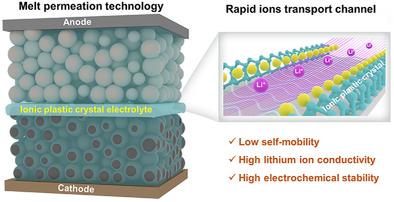
The practical use of all-solid-state batteries (ASSBs) is hindered by the intractable electrolyte/electrode interfacial resistance and discontinuous ion transport networks within electrodes. Ionic plastic crystals offer a potential solution to these challenges due to their melt-permeable properties to the electrodes. However, their limited ionic conductivity restricts their application. Here, we propose a design principle for solid-state electrolytes based on an electric field-induced strategy by using ionic plastic crystals with low self-migrating and high conductivity toward target ions. Through the external potential difference, an ordered internal electric field is generated within the ionic plastic crystal-based solid-state electrolytes (IPCEs), which mitigates the coordination limitations of anions on target ions to facilitate rapid ion conduction. The prepared IPCE demonstrates high ionic conductivity (1.08 × 10⁻³ S cm−1 at 25 °C) and a Li+ transfer number (0.77), enabling the application of ASSBs over a wide temperature range (from 0 to 60 °C). Furthermore, the assembled Li||LiNi0.8Co0.1Mn0.1O2 ASSBs exhibit stable cycling, maintaining 97.5% capacity retention after 500 cycles at 25 °C. This work provides a fresh perspective on the practical application of ASSBs, highlighting the potential of IPCEs in enhancing battery performance.
全固态电池(assb)的实际应用受到难以处理的电解质/电极界面电阻和电极内不连续离子传输网络的阻碍。离子塑料晶体由于其对电极的熔融渗透特性,为这些挑战提供了一个潜在的解决方案。然而,它们有限的离子电导率限制了它们的应用。在这里,我们提出了一种基于电场诱导策略的固态电解质的设计原则,即使用具有低自迁移和对目标离子高导电性的离子塑料晶体。通过外部电位差,离子塑料晶体固态电解质(IPCEs)内部产生了有序的内部电场,从而减轻了阴离子与目标离子的配位限制,促进了离子的快速传导。制备的IPCE具有高离子电导率(在25°C时为1.08×10‐3 S cm‐1)和Li+转移数(0.77),使assb能够在较宽的温度范围(0°C至60°C)内应用。此外,组装的Li||LiNi0.8Co0.1Mn0.1O2 assb表现出稳定的循环,在25℃下循环500次后仍保持97.5%的容量。这项工作为assb的实际应用提供了一个新的视角,突出了ipce在提高电池性能方面的潜力。
期刊介绍:
Angewandte Chemie, a journal of the German Chemical Society (GDCh), maintains a leading position among scholarly journals in general chemistry with an impressive Impact Factor of 16.6 (2022 Journal Citation Reports, Clarivate, 2023). Published weekly in a reader-friendly format, it features new articles almost every day. Established in 1887, Angewandte Chemie is a prominent chemistry journal, offering a dynamic blend of Review-type articles, Highlights, Communications, and Research Articles on a weekly basis, making it unique in the field.



 京公网安备 11010802042870号
京ICP备2023020795号-1
京公网安备 11010802042870号
京ICP备2023020795号-1

 分享
分享
 求助内容:
求助内容: 应助结果提醒方式:
 扫码关注我们
