Hang Zhang, Zhen Liu, Xiao-Fei Zhu, Jun-Long Zhang and Liangbing Gan
{"title":"Hydroxyl-modified fullerene C70(OH)8 induces pyroptosis for cancer therapy†","authors":"Hang Zhang, Zhen Liu, Xiao-Fei Zhu, Jun-Long Zhang and Liangbing Gan","doi":"10.1039/D5QI00548E","DOIUrl":null,"url":null,"abstract":"<p >Fullerene (C<small><sub>70</sub></small>), a promising new photosensitizer, faces challenges in its biological applications due to its extreme hydrophobicity. In order to enhance the solubility of fullerene (C<small><sub>70</sub></small>) and facilitate its biological applications, we synthesized a novel hydroxyl-modified fullerene compound (C<small><sub>70</sub></small>(OH)<small><sub>8</sub></small>) with excellent photosensitizing properties. The introduction of hydroxyl groups allows it to self-assemble with DSPE-PEG(2000); therefore, we prepared it as a nanomedicine (C<small><sub>70</sub></small>(OH)<small><sub>8</sub></small>@NP). Under white light irradiation, C<small><sub>70</sub></small>(OH)<small><sub>8</sub></small>@NP stimulates the production of reactive oxygen species (ROS). Furthermore, results have demonstrated that a substantial amount of ROS can also be generated within cells, resulting in cell death. We found that C<small><sub>70</sub></small>(OH)<small><sub>8</sub></small>@NP can induce both apoptosis and pyroptosis in HeLa cells and identified its mechanism of cell death through the activation of caspase 3/gasdermin E pathways. Importantly, C<small><sub>70</sub></small>(OH)<small><sub>8</sub></small>@NP demonstrates significant anti-tumor activity in a nude mouse tumor-bearing model. These results highlight the potential of novel fullerene compounds as photodynamic therapy agents.</p>","PeriodicalId":79,"journal":{"name":"Inorganic Chemistry Frontiers","volume":" 14","pages":" 4383-4391"},"PeriodicalIF":6.2000,"publicationDate":"2025-03-27","publicationTypes":"Journal Article","fieldsOfStudy":null,"isOpenAccess":false,"openAccessPdf":"","citationCount":"0","resultStr":null,"platform":"Semanticscholar","paperid":null,"PeriodicalName":"Inorganic Chemistry Frontiers","FirstCategoryId":"92","ListUrlMain":"https://pubs.rsc.org/en/content/articlelanding/2025/qi/d5qi00548e","RegionNum":1,"RegionCategory":"化学","ArticlePicture":[],"TitleCN":null,"AbstractTextCN":null,"PMCID":null,"EPubDate":"","PubModel":"","JCR":"Q1","JCRName":"CHEMISTRY, INORGANIC & NUCLEAR","Score":null,"Total":0}
引用次数: 0
Abstract
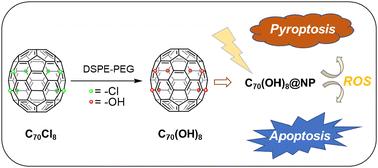
Fullerene (C70), a promising new photosensitizer, faces challenges in its biological applications due to its extreme hydrophobicity. In order to enhance the solubility of fullerene (C70) and facilitate its biological applications, we synthesized a novel hydroxyl-modified fullerene compound (C70(OH)8) with excellent photosensitizing properties. The introduction of hydroxyl groups allows it to self-assemble with DSPE-PEG(2000); therefore, we prepared it as a nanomedicine (C70(OH)8@NP). Under white light irradiation, C70(OH)8@NP stimulates the production of reactive oxygen species (ROS). Furthermore, results have demonstrated that a substantial amount of ROS can also be generated within cells, resulting in cell death. We found that C70(OH)8@NP can induce both apoptosis and pyroptosis in HeLa cells and identified its mechanism of cell death through the activation of caspase 3/gasdermin E pathways. Importantly, C70(OH)8@NP demonstrates significant anti-tumor activity in a nude mouse tumor-bearing model. These results highlight the potential of novel fullerene compounds as photodynamic therapy agents.





 京公网安备 11010802042870号
京ICP备2023020795号-1
京公网安备 11010802042870号
京ICP备2023020795号-1

 分享
分享
 求助内容:
求助内容: 应助结果提醒方式:
 扫码关注我们
