Raymond F. Berkeley, Alexander P. Plonski, Tien M. Phan, Kristof Grohe, Lukas Becker, Sebastian Wegner, Mark A. Herzik, Jr., Jeetain Mittal, Galia T. Debelouchina
{"title":"Capturing the Conformational Heterogeneity of HSPB1 Chaperone Oligomers at Atomic Resolution","authors":"Raymond F. Berkeley, Alexander P. Plonski, Tien M. Phan, Kristof Grohe, Lukas Becker, Sebastian Wegner, Mark A. Herzik, Jr., Jeetain Mittal, Galia T. Debelouchina","doi":"10.1021/jacs.4c18668","DOIUrl":null,"url":null,"abstract":"Small heat shock proteins (sHSPs), including HSPB1, are essential regulators of cellular proteostasis that interact with unfolded and partially folded proteins to prevent aberrant misfolding and aggregation. These proteins fulfill a similar role in biological condensates, where they interact with intrinsically disordered proteins to modulate their liquid–liquid and liquid-to-solid phase transitions. Characterizing the sHSP structure, dynamics, and client interactions is challenging due to their partially disordered nature, their tendency to form polydisperse oligomers, and their diverse range of clients. In this work, we leverage various biophysical methods, including fast <sup>1</sup>H-based magic angle spinning (MAS) NMR spectroscopy, molecular dynamics (MD) simulations, and modeling, to shed new light on the structure and dynamics of HSPB1 oligomers. Using split-intein-mediated segmental labeling, we provide unambiguous evidence that in the oligomer context, the N-terminal domain (NTD) of HSPB1 is rigid and adopts an ensemble of heterogeneous conformations, the α-Crystallin domain (ACD) forms dimers and experiences multiple distinct local environments, while the C-terminal domain (CTD) remains highly dynamic. Our computational models suggest that the NTDs participate in extensive NTD–NTD and NTD–ACD interactions and are sequestered within the oligomer interior. We further demonstrate that HSPB1 higher order oligomers disassemble into smaller oligomeric species in the presence of a client protein and that an accessible NTD is essential for HSPB1 partitioning into condensates and interactions with client proteins. Our integrated approach provides a high-resolution view of the complex oligomeric landscape of HSPB1 and sheds light on the elusive network of interactions that underlies the function of HSPB1 in biological condensates.","PeriodicalId":49,"journal":{"name":"Journal of the American Chemical Society","volume":"29 1","pages":""},"PeriodicalIF":15.6000,"publicationDate":"2025-03-27","publicationTypes":"Journal Article","fieldsOfStudy":null,"isOpenAccess":false,"openAccessPdf":"","citationCount":"0","resultStr":null,"platform":"Semanticscholar","paperid":null,"PeriodicalName":"Journal of the American Chemical Society","FirstCategoryId":"92","ListUrlMain":"https://doi.org/10.1021/jacs.4c18668","RegionNum":1,"RegionCategory":"化学","ArticlePicture":[],"TitleCN":null,"AbstractTextCN":null,"PMCID":null,"EPubDate":"","PubModel":"","JCR":"Q1","JCRName":"CHEMISTRY, MULTIDISCIPLINARY","Score":null,"Total":0}
引用次数: 0
Abstract
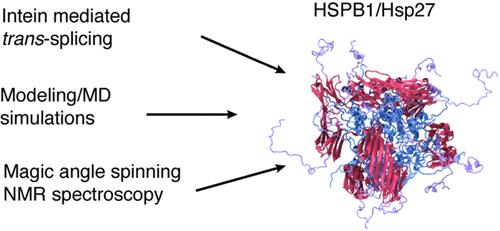
Small heat shock proteins (sHSPs), including HSPB1, are essential regulators of cellular proteostasis that interact with unfolded and partially folded proteins to prevent aberrant misfolding and aggregation. These proteins fulfill a similar role in biological condensates, where they interact with intrinsically disordered proteins to modulate their liquid–liquid and liquid-to-solid phase transitions. Characterizing the sHSP structure, dynamics, and client interactions is challenging due to their partially disordered nature, their tendency to form polydisperse oligomers, and their diverse range of clients. In this work, we leverage various biophysical methods, including fast 1H-based magic angle spinning (MAS) NMR spectroscopy, molecular dynamics (MD) simulations, and modeling, to shed new light on the structure and dynamics of HSPB1 oligomers. Using split-intein-mediated segmental labeling, we provide unambiguous evidence that in the oligomer context, the N-terminal domain (NTD) of HSPB1 is rigid and adopts an ensemble of heterogeneous conformations, the α-Crystallin domain (ACD) forms dimers and experiences multiple distinct local environments, while the C-terminal domain (CTD) remains highly dynamic. Our computational models suggest that the NTDs participate in extensive NTD–NTD and NTD–ACD interactions and are sequestered within the oligomer interior. We further demonstrate that HSPB1 higher order oligomers disassemble into smaller oligomeric species in the presence of a client protein and that an accessible NTD is essential for HSPB1 partitioning into condensates and interactions with client proteins. Our integrated approach provides a high-resolution view of the complex oligomeric landscape of HSPB1 and sheds light on the elusive network of interactions that underlies the function of HSPB1 in biological condensates.
期刊介绍:
The flagship journal of the American Chemical Society, known as the Journal of the American Chemical Society (JACS), has been a prestigious publication since its establishment in 1879. It holds a preeminent position in the field of chemistry and related interdisciplinary sciences. JACS is committed to disseminating cutting-edge research papers, covering a wide range of topics, and encompasses approximately 19,000 pages of Articles, Communications, and Perspectives annually. With a weekly publication frequency, JACS plays a vital role in advancing the field of chemistry by providing essential research.



 京公网安备 11010802042870号
京ICP备2023020795号-1
京公网安备 11010802042870号
京ICP备2023020795号-1

 分享
分享
 求助内容:
求助内容: 应助结果提醒方式:
 扫码关注我们
